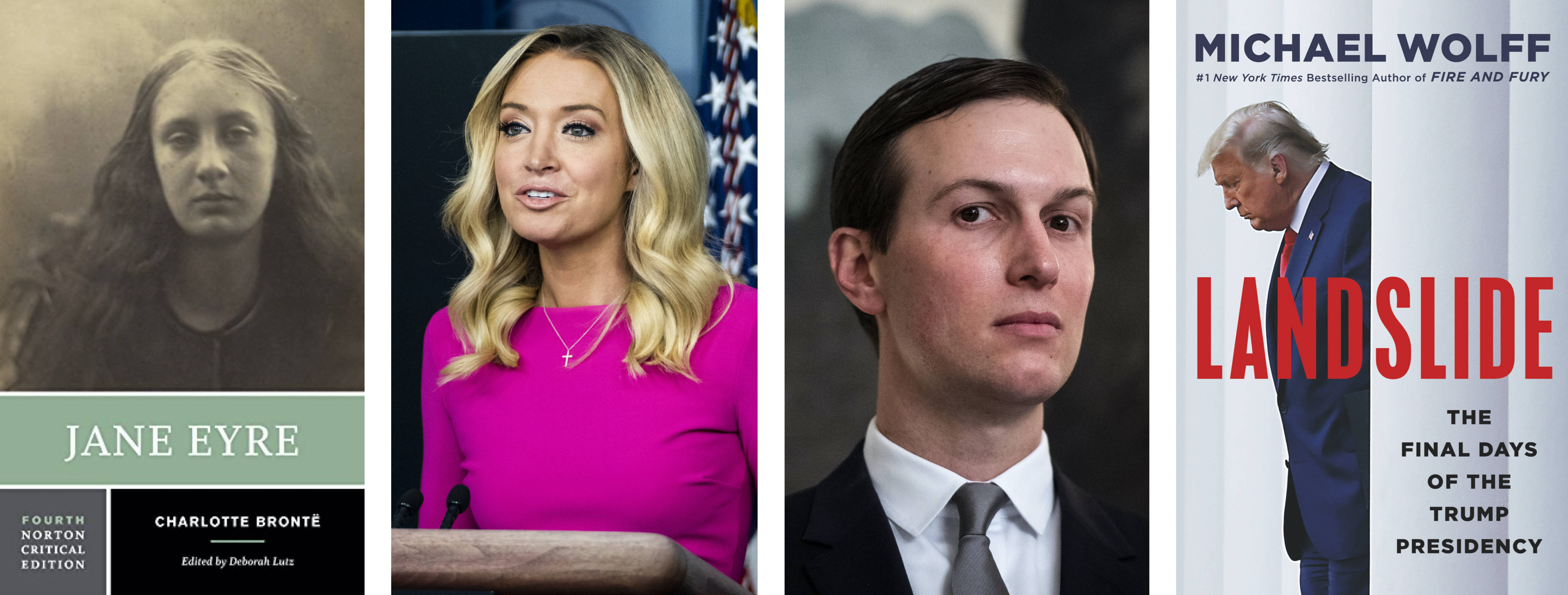
 "Jane Eyre," by Charlotte Brontë (Norton Critical Editions); White House Press Secretary Kayleigh McEnany at the White House in 2020 (Jabin Botsford/The Washington Post); Senior Adviser Jared Kushner at the White House in 2019 (Jabin Botsford/The Washington Post); Michael Wolff's forthcoming "Landslide: The Final Days of the Trump Presidency" (Henry Holt) | As is so often the case, this political moment is perfectly captured by Charlotte Brontë's "Jane Eyre." Like Mr. Rochester, America has moved on with plans for a happy new life. But the nation's previous president is still raging away in the attic. Ignoring those strange sounds during the night may not forestall his fiery revenge. Last Friday, Donald Trump said, "I'm writing like crazy," which sounds about right. He went on to claim, "I turned down two book deals, from the most unlikely of publishers." (The most unlikely? Archie Comics? Harlequin?) To solve that mystery, Politico contacted all five of the big publishing houses, but each of them denied knowing anything about an offer for what the Very Stable Genius calls "the book of all books." In a follow-up comment to Politico, Trump predicted that a prestigious publisher would eventually cave and make a deal with him because "some of the biggest sleazebags on earth run these companies." Meanwhile, other members of the Trump gang have secured actual book deals. On Tuesday, former White House Fabulist Kayleigh McEnany tweeted that she has finished the manuscript of her memoir, "For Such a Time As This: My Faith Journey Through the White House and Beyond," a title which manages to evoke both the Book of Esther and Buzz Lightyear. McEnany's book will be released on Dec. 7 by Post Hill Press, the same firm that's committed to publishing a memoir by Sgt. Jonathan Mattingly, one of the Louisville police officers who killed Breonna Taylor. And we got news that Jared Kushner, the former president's son-in-law and "most consequential adviser," will publish his memoir in early 2022. Broadside Books, a conservative imprint of HarperCollins, said in a statement that Kushner will provide "the definitive, thorough recounting of the administration, and the truth about what happened behind closed doors." But before either of those experimental novels is published, we'll be reading the third and final volume about Trump's antics from journalist Michael Wolff. "Landslide: The Final Days of the Trump Presidency" will be released on July 27. His previous two books — "Fire and Fury: Inside the Trump White House" (review) and "Siege: Trump Under Fire" (review) — were instant bestsellers propelled, predictably, by Trump's threats to sue the publisher and author (story). 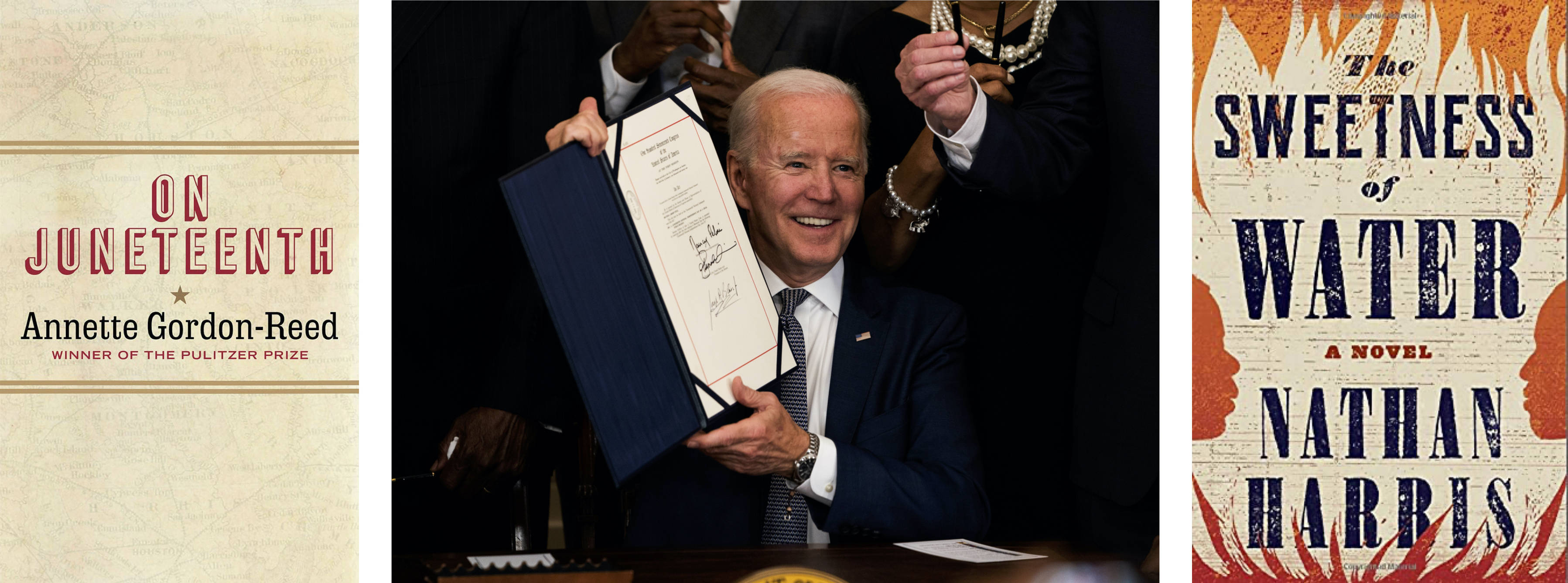 Liveright; President Joe Biden holding up the signed Juneteenth National Independence Day Act in the White House on June 17, 2021. (Photo by Demetrius Freeman/The Washington Post); Little, Brown | This week in Washington, Congress worked with unusual speed and bipartisanship to establish Juneteenth as a national holiday. President Biden signed the bill yesterday just in time to give federal workers today off. (Merriam-Webster reports that online searches for "Juneteenth" rose by 8,200 percent.) Like all our holidays, Juneteenth harbors rich complications that it threatens to obscure and preserve. It's a day of celebration, of course, but it's also a reminder of our country's erratic progress toward racial equality (wonderful multimedia feature). President Lincoln issued the Emancipation Proclamation on Jan. 1, 1863, but that only applied to slaves in rebel territory, which initially made the executive order a mostly symbolic (and hypocritical) decree. More than two years later, Maj. Gen. Gordon Granger finally ended slavery in Texas on June 19, 1865 — a day that has since been known as Juneteenth. But how did this moment in one state come to represent the freedom of enslaved people in all states? Pulitzer Prize-winning historian Annette Gordon-Reed starts with that question in her recently published collection of essays called "On Juneteenth." It's a hybrid of memoir and history that delves into her own upbringing in Texas and reclaims events from the distortions of myth and racism (review). And at just 135 pages, it offers a quick introduction to one of America's finest historians. In related news, Oprah just chose "The Sweetness of Water," by Nathan Harris, as the next title for her book club. This remarkable debut novel is set in Georgia during the twilight of the Civil War. The story focuses on an unlikely friendship between a White man who has just lost his son in battle and two recently freed slaves. It's a terrific book about a small group of traumatized people struggling to divine what humanity really is (review). 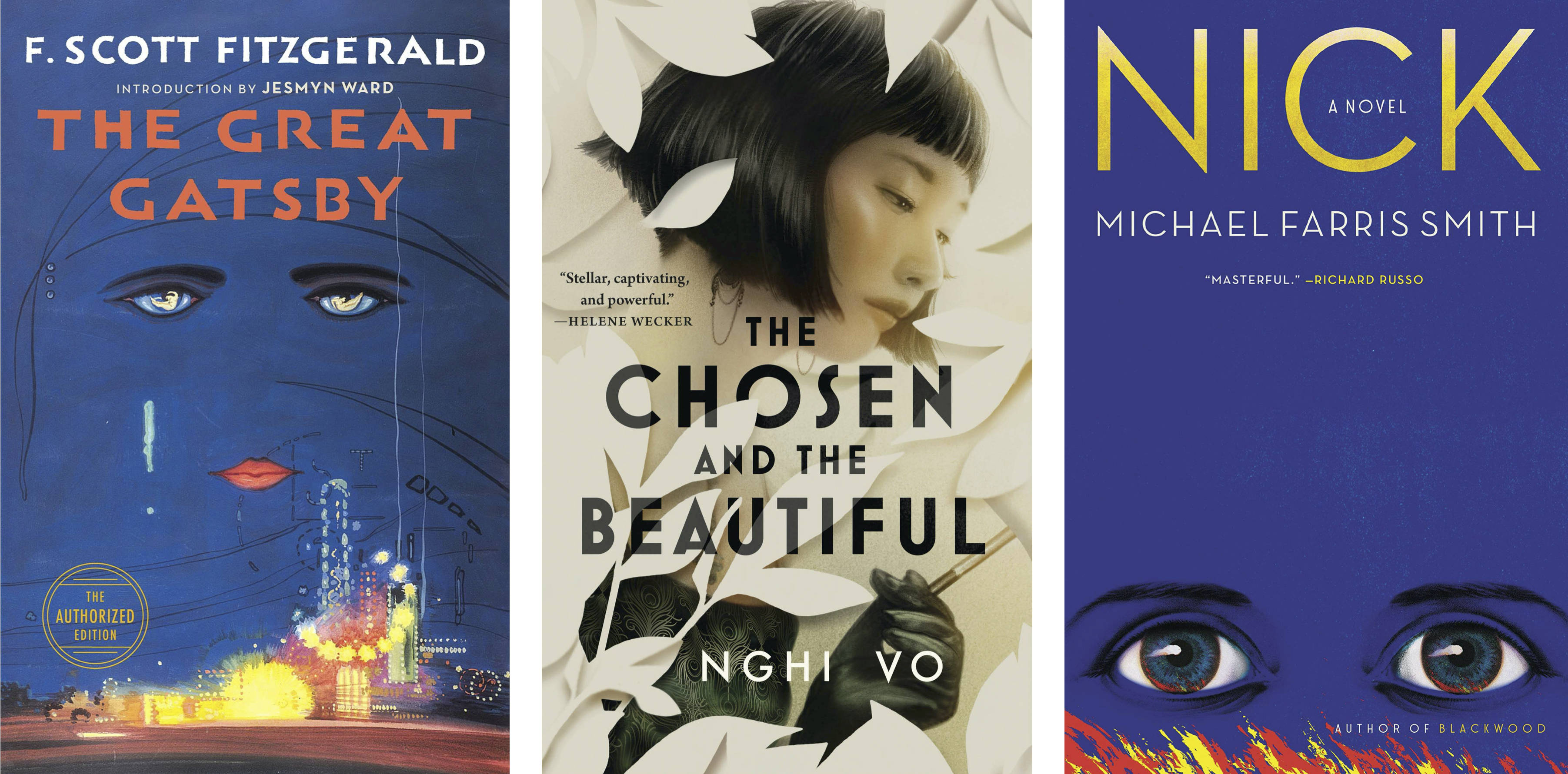 Scribner; Tordotcom; Little, Brown | In the middle of "The Great Gatsby," while Nick is riding into town in Gatsby's splendid car, he thinks, "Anything can happen now . . . anything at all." Legally, he's right. Nowadays, anybody can use and transform "The Great Gatsby" any way they'd like. The copyright on Fitzgerald's classic expired on Jan. 1, 2021. Michael Farris Smith struck four days later with a prequel called "Nick," which imagines Nick's ordeal in World War I and then follows him to New Orleans (review and video). But we're just getting started. When I say anything can happen now, I mean it. This week, I reviewed a fantastic and fantastically bizarre reimagining of "The Great Gatsby" called "The Chosen and the Beautiful," by Nghi Vo. She rotates the story so that it's told by Jordan Baker, a queer Vietnamese orphan, and she recasts the familiar plot as a gothic fantasy. The partygoers drink demon blood, sorcery twists the beams of reality, and Jay Gatsby is a bisexual vampire. Finally, the story makes sense! (review) And 19 students at the University of Iowa have reportedly sold their adaptation of "The Great Gatsby" to Independent Pictures and Fugitive Films. "Gilded in Ash" — the product of a creative English course last fall — reimagines Gatsby as an African American woman who works as an art forger. No word yet on whether the studio will actually make the movie, but as Nick says, "Reserving judgments is a matter of infinite hope." 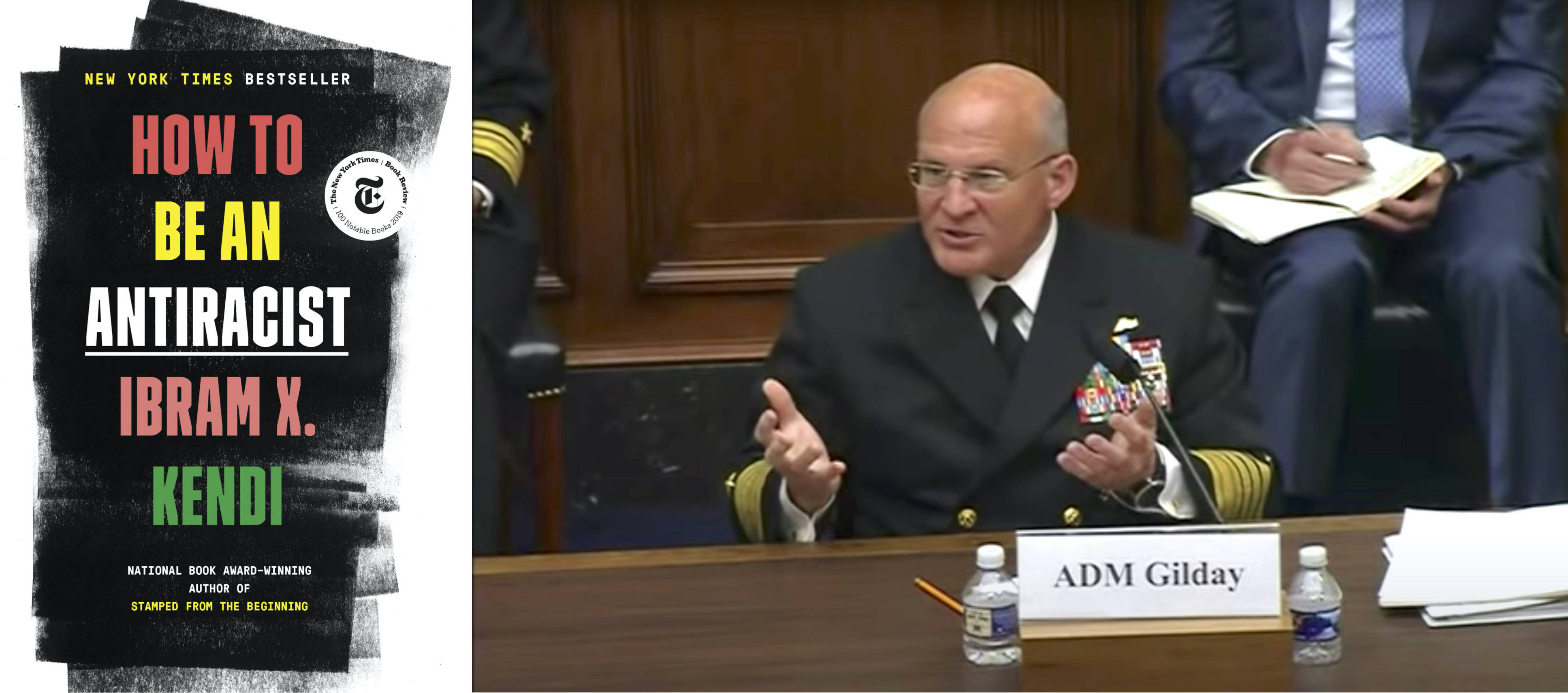 One World; Adm. Michael Gilday, Chief of Naval Operations, testifying at a House Armed Services Committee hearing on June 15, 2021 in Washington, D.C. (Screen shot). | The United States faces a barrage of threats from China, Russia, transnational terrorist groups and a book called "How to Be an Antiracist," by Ibram X. Kendi. That's my take-away from a House Armed Services Committee hearing on Tuesday. Much of the three-hour-long discussion concerned military budget priorities, but Rep. Doug Lamborn (R-Colo.) and Rep. Jim Banks (R-Ind.) seemed convinced that America's navy could be imperiled by Kendi's book about combating racism (review). Lamborn told Adm. Michael Gilday, chief of Naval Operations, that he and "a lot of people in the civilian world" are "concerned" about seeing "How to Be an Antiracist" on a voluntary reading list that the admiral compiled (story). "There's racism in the Navy," Gilday replied, "just like there's racism in our country, and the way we're going to get after it is to be honest about it." He went on to explain that he recommended Kendi's book because "sailors in our Navy have to be able to think critically." Yikes! "To be able to think critically" is practically an admission of treason for some of these people. Rep. Banks rose up in a tower of white fragility to proclaim himself "astonished" that Gilday would put a best-selling book about fighting racism on a reading list about fighting racism. Banks went on to insist that the admiral agree or disagree with a series of provocative statements that he said Kendi had made — including one from when Kendi was in college. It was an inane act of posturing, full of straw-man arguments and feigned outrage — the classic response, calibrated long ago, to snuff out any corrective examination of systemic inequality. But like a parent dealing with a petulant teen, Gilday wouldn't fall into that trap. "I am not going to sit here and defend cherry-picked quotes from somebody's book," the admiral said. "I trust sailors will come to an understanding, hopefully separating fact from fiction, agreeing or disagreeing with Kendi in this case, and come to useful conclusions about how we ought to treat each other in the United States." I want to be in that guy's book club. 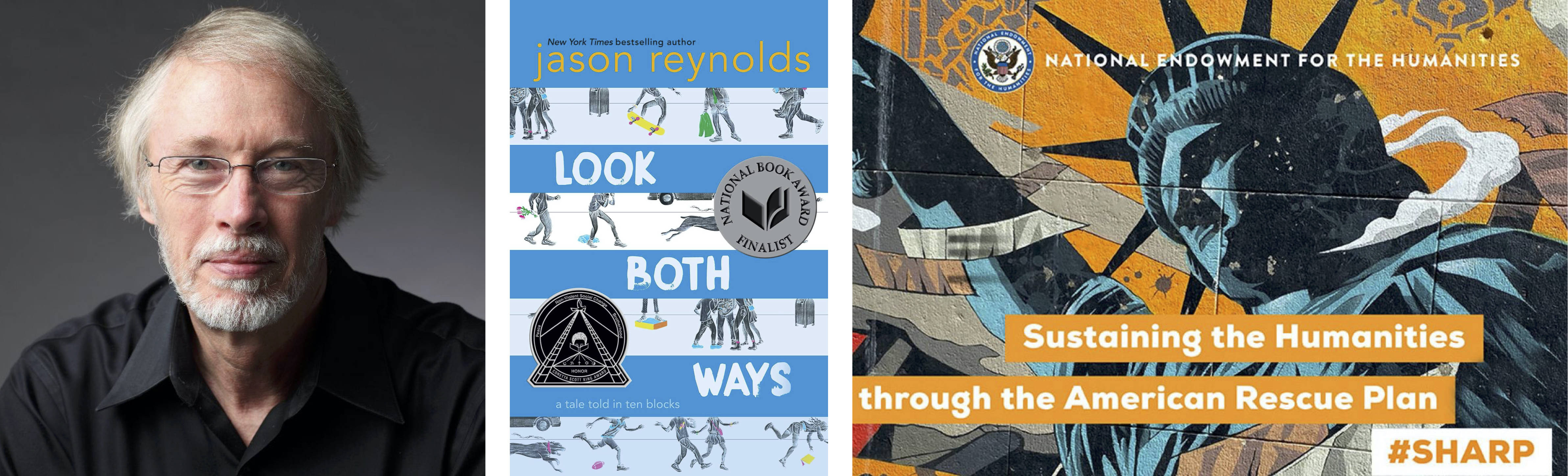 Charles Baxter (Photo by Keri Pickett/Courtesy of PEN/Faulkner); Atheneum/Caitlyn Dlouhy Books; Courtesy of NEH | Literary awards and honors this week: Charles Baxter has been named winner of this year's PEN/Malamud Award for Excellence in the Short Story. Baxter's work has appeared in Best American Short Stories seven times, and he is the author of six collections, including, most recently, "There's Something I Want You to Do" (review). National Ambassador for Young People's Literature Jason Reynolds won the CILIP Carnegie Medal for his YA story collection "Look Both Ways" (review). This British award, which is judged by a panel of U.K. librarians, recognizes "outstanding reading experiences" for children and YA readers. The National Endowment for the Humanities has distributed more than $51 million to humanities councils across the country. The money — part of the $1.9 trillion American Rescue Plan — will support libraries, historical societies, museums, heritage sites, preservation groups, festivals and other cultural nonprofits. (To see how much your state received, click here.) 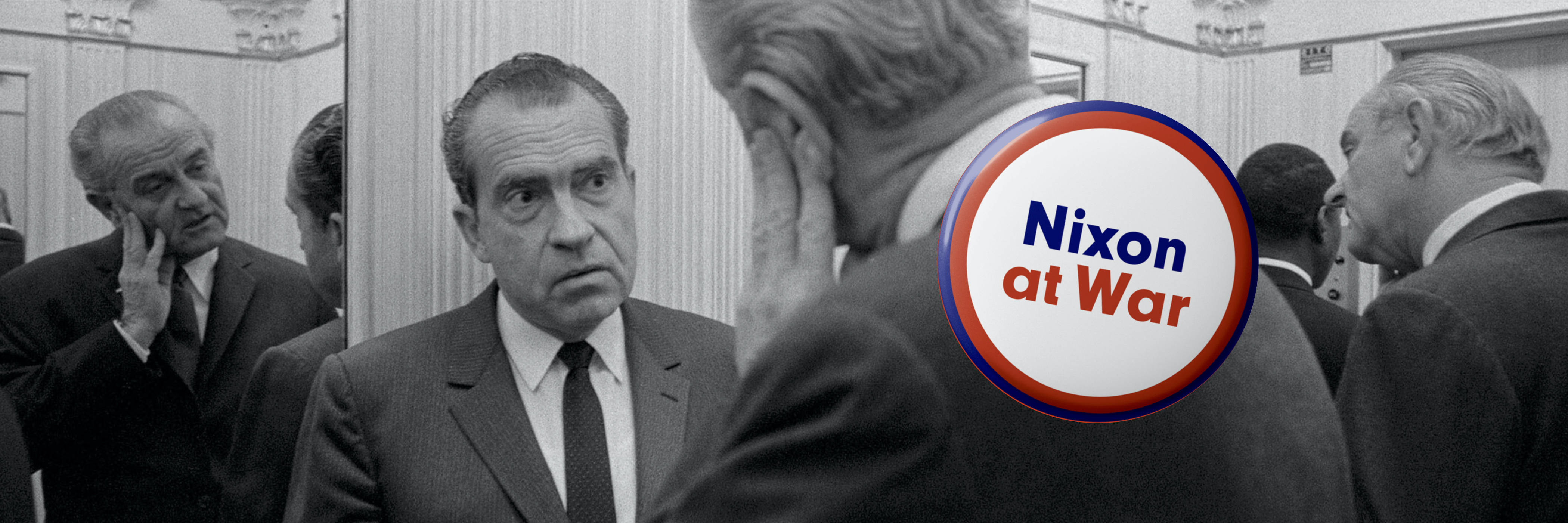 President Lyndon Johnson and President-elect Richard Nixon taking the elevator to the family quarters of the White House, 1968. (Courtesy of Nixon at War) | Novelist and historian Kurt Andersen launched a podcast series this week called "Nixon at War." It's a dramatic blend of narrated history and rare archival recordings that explores Richard Nixon's tricky manipulation of the Vietnam War. Andersen tells me he was drawn to the antiwar period while doing research for his 2012 historical novel, "True Believers" (review). "I'd never really studied Nixon or the war or gone deep into the tapes," he says. When his public radio show "Studio 360" ended in 2020, he was ready for a new audio project that could create "you-are-there, fly-on-the-wall intimacy and drama." A fervid Trump antagonist since he co-founded Spy Magazine in the 1980s, Andersen notes that "Nixon started the paradigm shift — the conspiracist thinking, the political gangsterism, the resentful Us vs. Them politics, etc. — that finally gave us Trumpism and our present fix." "Nixon at War" is a seven-episode series funded by the National Endowment for the Humanities. You can learn more and listen here. 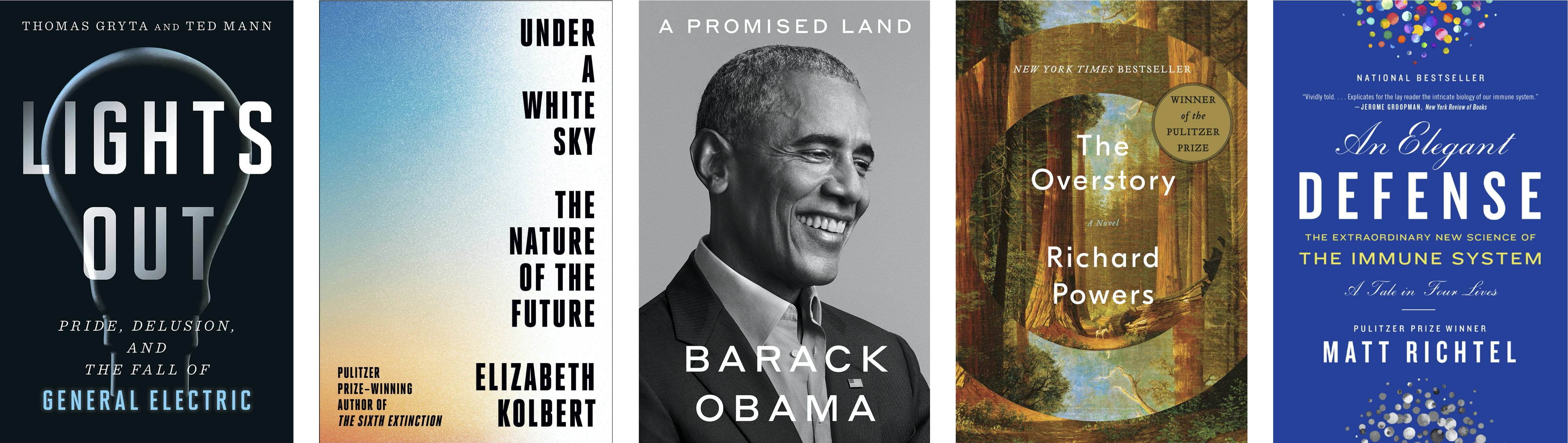 Houghton Mifflin Harcourt; Crown; Crown; W. W. Norton; William Morrow | Bill Gates's summer reading list was supposed to be released last month, but it got delayed by news of his pending divorce. With that unpleasantness out of the way, this week the billionaire philanthropist offered up his recommendations. They are, as usual, wonky but popular. "The books on my summer reading list this year touch on what happens when people come into conflict with the world around them," Gates wrote on his blog: - "Lights Out: Pride, Delusion, and the Fall of General Electric," by Wall Street Journal reporters Thomas Gryta and Ted Mann, investigates one of the greatest corporate declines in U.S. history.
- "Under a White Sky: The Nature of the Future," by Elizabeth Kolbert, examines all the strange steps we're taking to repair the damage we're wreaking on the environment (review).
- "A Promised Land," by Barack Obama (review), is the first volume of the former president's post-White House memoir.
- "The Overstory," by Pulitzer Prize-winner Richard Powers, is the most exciting novel about trees you'll ever read (review).
- "An Elegant Defense: The Extraordinary New Science of the Immune System: A Tale in Four Lives," by Matt Richtel, is an explanation of the human immune system (review).
 William Morrow | My dad's an electrical engineer, so he knows how to fix a dangling wire. My own poor kids have a dad who knows how to fix a dangling participle. My practical incompetence still astounds me. Years ago, when my first car ran out of gas, I stopped using it for so long that two of the tires went flat. Then bees built a nest in the driver's side door. If you're stuck with a clueless father like me, you're probably already one of the 3.4 million people who subscribe to dadvice-sensation Rob Kenney on YouTube. In short, cheery videos, Kenney demonstrates how to Unclog a Drain, Change a Tire, Start a Campfire. Who knows: How to Get Bees Out of the Driver's Side Door could be coming up soon. Kenney recently published his first book, "Dad, How Do I?," which is a curious evolution of his YouTube channel. The second half contains a smattering of the short lessons his fans crave — everything from "How to Fry an Egg" to "How to Use an Iron." But the first and longer part of "Dad, How Do I?" is an earnest set of life lessons drawn from his own difficult adolescence. Kenney's mom descended into alcoholism, and his dad walked out on the family of eight children when Kenney was 13. "I vowed," he writes, "when I grew up and got married and had kids, I would never cause such pain in my children's lives." This book is largely a compendium of the moral and social advice he wishes he'd received. He can sound trite at times, and his Christian evangelicalism won't be for every reader's taste, but there's no knocking a guy determined "to help anybody who needs a dad." 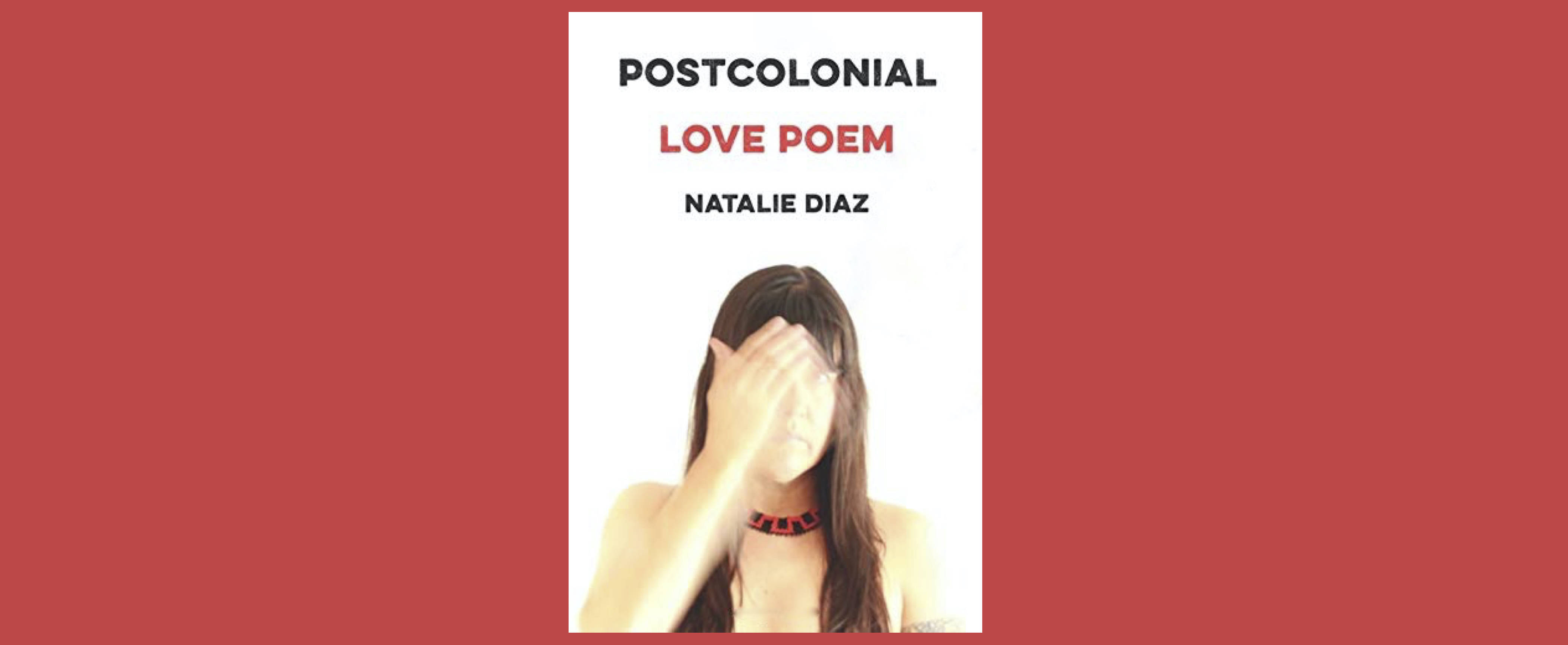 Graywolf Press | Natalie Diaz, an enrolled member of the Gila River Indian Tribe, won the Pulitzer Prize in poetry last week for "Postcolonial Love Poem." In a statement announcing the award, the judges — Marilyn Chin, Lee Ann Roripaugh and Natasha Trethewey — praised the collection for its "tender, heart-wrenching and defiant poems that explore what it means to love and be loved in an America beset by conflict." Last month, "Postcolonial Love Poem" also won the Publishing Triangle's Audre Lorde Award for lesbian poetry. American Arithmetic Native Americans make up less than
1 percent of the population of America.
0.8 percent of 100 percent. O, mine efficient country. I do not remember the days before America—
I do not remember the days when we were all here. Police kill Native Americans more
than any other race. Race is a funny word.
Race implies someone will win,
implies, I have as good a chance of winning as— Who wins the race that isn't a race? Native Americans make up 1.9 percent of all
police killings, higher per capita than any race— sometimes race means run. I'm not good at math—can you blame me?
I've had an American education. We are Americans, and we are less than 1 percent
of Americans. We do a better job of dying
by police than we do existing. When we are dying, who should we call?
The police? Or our senator?
Please, someone, call my mother. At the National Museum of the American Indian,
68 percent of the collection is from the United States.
I am doing my best to not become a museum
of myself. I am doing my best to breathe in and out. I am begging: Let me be lonely but not invisible. But in an American room of one hundred people,
I am Native American—less than one, less than
whole—I am less than myself. Only a fraction
of a body, let's say, I am only a hand— and when I slip it beneath the shirt of my lover
I disappear completely. "American Arithmetic" from "Postcolonial Love Poem." Copyright © 2020 by Natalie Diaz. Reprinted with the permission of Graywolf Press, Minneapolis, Minn. 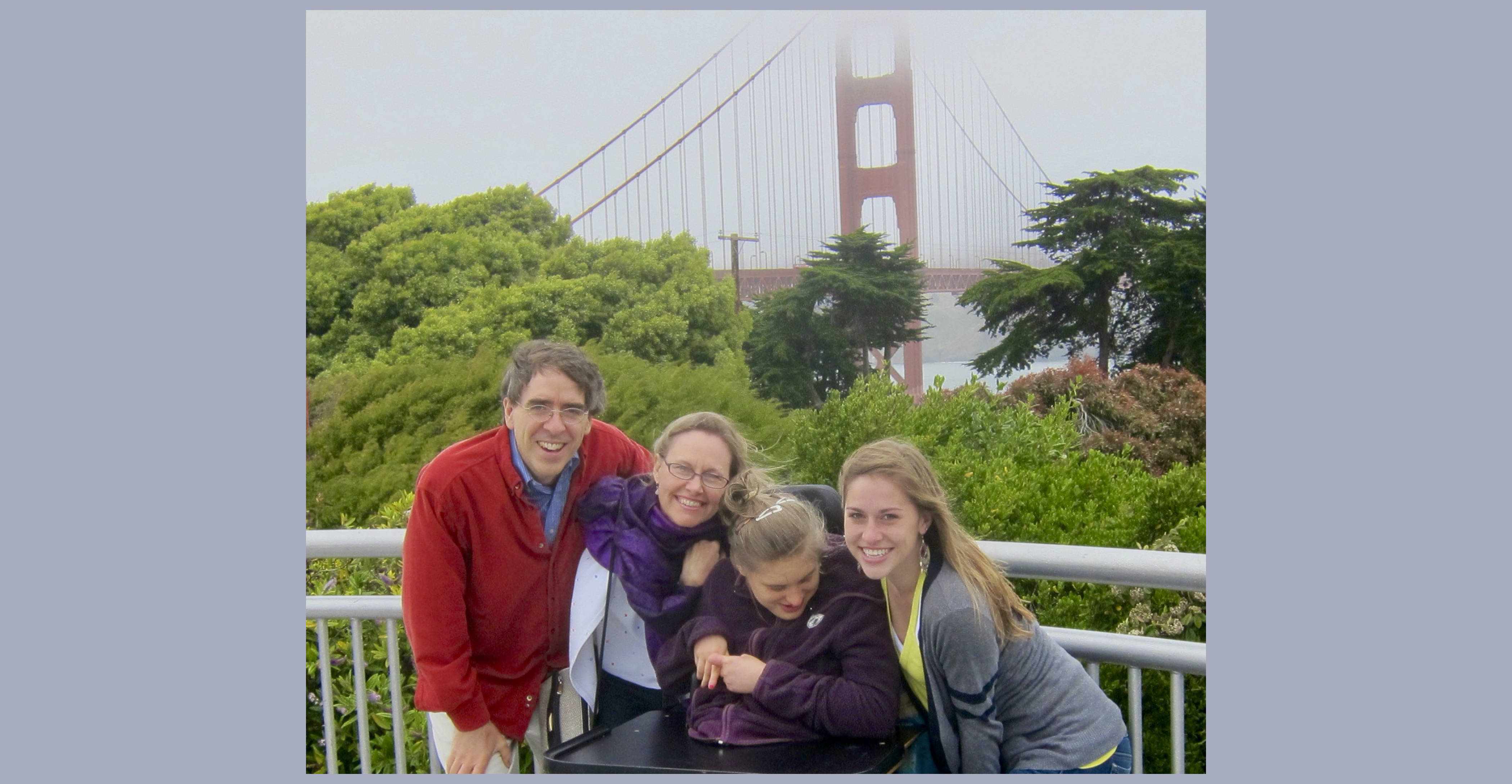 Ron, Dawn, Elissa and Madeline Charles in front of the Golden Gate Bridge in San Francisco in 2011 (Ron Charles/The Washington Post) | Dawn and I are finally getting on a plane again. We're going out to the Bay Area to see our elder daughter for the first time since Christmas 2019. I don't mind that I have to wear a mask for six hours. I don't even mind that I'm sitting so far back in the plane that my seat has a hole in it. Our younger daughter will be flying out there from New York, so we'll all be together for the week. Best Father's Day present ever. Stay-tuned: On Friday, July 2, at 3 p.m. ET, the Book World staff will be online to talk about summer books with you. I'll put a link to our discussion in the newsletter that morning so you can join us. Meanwhile, if you have any questions or comments about our book coverage, contact me at ron.charles@washpost.com. And if you know someone who would enjoy this newsletter, please help me out and forward it to them. To subscribe, click here.
Interested in advertising in our bookish newsletter? Contact Michael King at michael.king@washpost.com. | 




 Email
Email