| House Democrats look set to start their own investigation of the Jan. 6 riot at the Capitol, almost a month after Republicans blocked the formation of an independent, nonpartisan commission. While four Senate Republicans joined Democrats in voting for the proposed nonpartisan commission in May, the Senate still fell short of the 60 votes needed, in a 54-to-35 vote (yes, the Senate is the chamber of Congress in which 54 senators can be outvoted by 35). 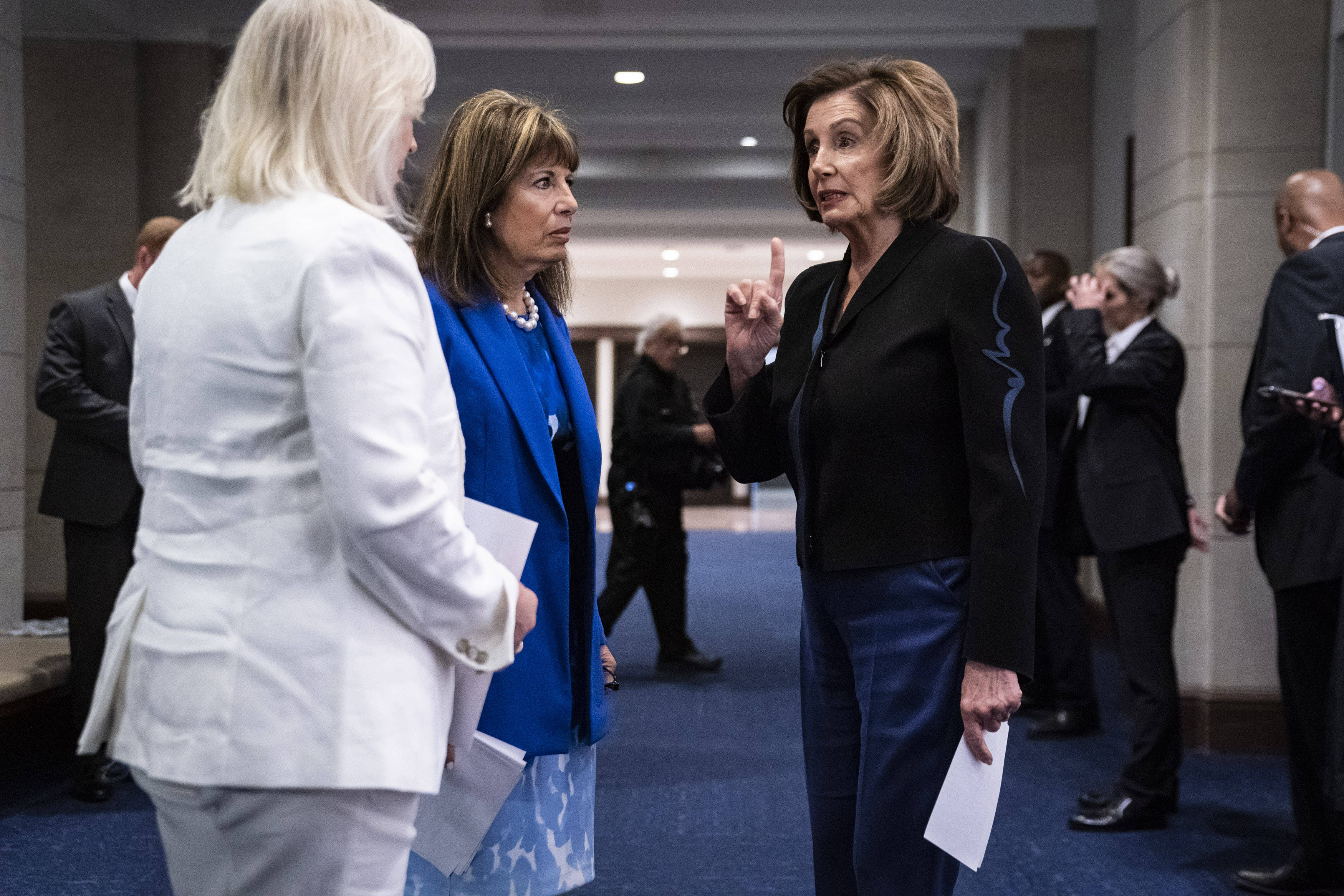 House Speaker Nancy Pelosi (D-Calif.) with Democratic colleagues at the Capitol on Wednesday. | But with a majority in the House, Democrats can launch their own investigation — and the Associated Press reported Tuesday that Pelosi told her caucus that she would form a select committee to investigate the attack. Pelosi denied she had fully committed to such a committee — but several news outlets stood by reporting that she'd told Democratic colleagues it's coming soon. Her spokesman said a formal announcement on whether she will create one will come later this week — though her preference is still to form the kind of independent commission Senate Republicans already blocked. While Republicans largely seem to want to move on from the Jan. 6 attack, Democrats don't. Republicans specifically objected to the way commission staff would have been hired — but ultimately just didn't want months of additional public focus on an event that is less than flattering to the Republican Party. "The heart of this recommendation by the Democrats is that they would like to continue to debate things that occurred in the past," Senate Minority Leader Mitch McConnell (R-Ky.) told reporters last month, signaling his eagerness to move on. McConnell is right that Democrats aren't ready to move on; and Democrats say there's no reason they should be. Information about Jan. 6 has slowly been trickling out, including reports about the Defense Department's wariness about deploying the National Guard despite multiple requests from the U.S. Capitol Police. Another report showed the Capitol Police had information weeks before the riot indicating an armed assault was coming. At least seven congressional committees across both houses have launched probes into Jan. 6 and what happened leading up to the attack, but a broader investigation could lead to the kind of in-depth report Democrats say is necessary to comprehend the full scope of the planning and execution it took for hundreds of people to illegally enter the Capitol as lawmakers attempted to complete the election certification process. The elephant in Democrats' way: The filibuster There weren't 60 votes in the Senate supporting a nonpartisan Capitol commission — just like there haven't been 60 votes for several Democratic legislative priorities. And some Democrats say that means it's time to change the Senate's filibuster rules. The Washington Post's JM Rieger and Adrian Blanco are tracking where Democratic senators stand on changing — or entirely eliminating — the filibuster. By their count, 19 of 50 Democrats want to eliminate the filibuster. An additional 14 say they want some kind of change to be made to the filibuster rules, while 15 more are open to changes but haven't committed fully. Two Democrats openly oppose changing the filibuster: Sens. Joe Manchin III (W.Va.) and Kyrsten Sinema (Ariz.). Rieger and Blanco write: Many of the senators calling for changing or eliminating the filibuster previously supported the filibuster when Republicans controlled the Senate. Some of these senators have stayed conspicuously quiet about filibuster changes, even as momentum has built in the Democratic base. But Democrats also know the clock is ticking on their ability to pass big-ticket legislation. They have a slim Senate majority, in addition to controlling the House and the White House. But they could lose control of one or both chambers of Congress in the 2022 midterms, and the pressure will keep going up as the midterms approach. | 




 Email
Email 


