| Welcome to The Daily 202 newsletter! Tell your friends to sign up here. On this day in 1788, the Constitution went into effect after New Hampshire became the ninth state to ratify it. A pair of newspaper stories over the weekend looked at what may be one of the most important questions for policymakers as the country emerges from the pandemic: Is the U.S. economy healing, stalling, or is it transforming? The answer appears to be yes, it's doing all of the above, depending on the sector, the geographic region, and even down to the individual worker. But the degree to which America is bouncing back (businesses reopening, routines returning) vs. springing forward (embracing pandemic-era solutions like increased reliance on remote work and the online economy) is an open question. How decision-makers answer it could shape how quickly the economy recovers and set the stage for what may be sweeping changes to the way Americans live and work, with consequences for elections in 2022, 2024 and beyond. 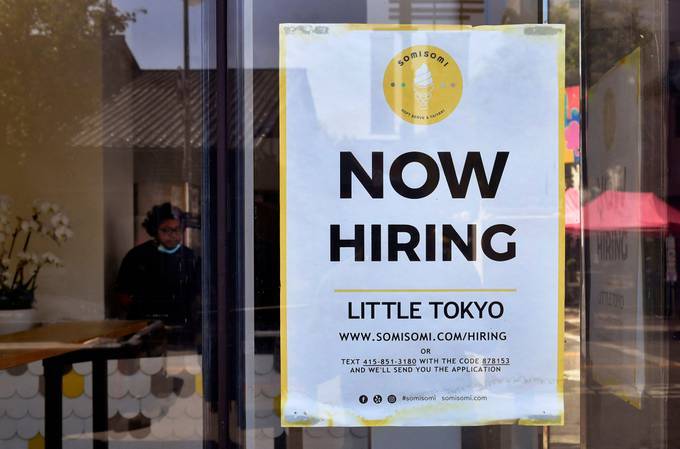 A 'Now Hiring' sign is posted in front of an ice cream shop in Los Angeles on May 28. (Frederic J. Brown/AFP/Getty Images) | We looked back in April at the way the pandemic accelerated a years-long trend (with caveats) of Americans increasingly wanting government to play a larger role in helping its citizens, and the potential ramifications for U.S. politics. Yesterday, my colleague Heather Long took a big-picture look at an American economy she found transformed by the pandemic: "The U.S. economy is emerging from the coronavirus pandemic with considerable speed but markedly transformed, as businesses and consumers struggle to adapt to a new landscape with higher prices, fewer workers, new innovations and a range of inconveniences. … What Americans are encountering … is almost unrecognizable from just 16 months ago. Prices are up. Housing is scarce. It takes months longer than normal to get furniture, appliances and numerous parts delivered. And there is a great dislocation between millions of unemployed workers and millions of vacant jobs." Heather looked at disruptive forces like soaring home prices in parts of the country, as well as inflation (or "shrinkflation" in which the cereal box itself doesn't cost more but there's less in it) for household expenses. And then there's the jobs market. "All of this is coming at a time when workers are increasingly demanding more pay and better working conditions. They want more flexibility, more opportunities for workers of color and more understanding from employers of mental health and child-care needs. Businesses are paying attention, largely because they are desperate for workers. There are an estimated 9.7 million job openings right now, according to job site Indeed. That's a record, and several million more than the nation has seen before." The Bureau of Labor Statistics reported, as of April, there are 1.1 unemployed people per job opening — meaning jobs are nearly as plentiful as right before the pandemic, when the figure was 0.8 unemployed per opening in February 2020. Republicans say Americans aren't going back to work because government is paying them not to — and GOP governors are ending a weekly $300 federal boost to state unemployment before the benefit's scheduled Labor Day expiration. (That's $7.50 an hour if you work 40 hours. Federal minimum wage is $7.25 an hour.) Democrats from President Biden on down dispute this, pointing to child-care scarcity and lasting coronavirus concerns. Some note all jobs aren't created equal: Workers might hope to return to a job where they had the benefits of seniority rather than take a new entry-level position. (My colleague Ovetta Wiggins chronicled some of the complexities earlier this month. My colleague Eli Rosenberg reported on employers embracing the market-oriented solution of raising wages, and its impacts. Anecdotally, some seasonal jobs — lifeguards, camp counselors — have traditionally been filled by foreigners who are still barred from traveling to the United States.) "Americans want to work," Biden said in May. "The people who claim Americans won't work even if they find a good and fair opportunity underestimate the American people." Over at the New York Times, Nelson D. Schwartz, Patrick McGeehan and Nicole Hong took a look at the possibility the "patterns of work and travel" that fueled the Big Apple's prosperity may have been "irreversibly altered." They write: "New York has suffered deeper job losses as a share of its work force than any other big American city. And while the country has regained two-thirds of the positions it lost after the coronavirus arrived, New York has recouped fewer than half, leaving a deficit of more than 500,000 jobs." Their reporting highlights the importance of determining which pandemic-forced changes will fade and which will last. "All eyes are on September, when many companies aim to bring their workers back to the office and Broadway fully reopens, attracting more visitors and their dollars. But even then, the rebound will be only partial. The shift toward remote work endangers thousands of businesses that serve commuters who are likely to come into the office less frequently than before the pandemic, if at all. By the end of September, the Partnership for New York City, a business advocacy group, predicts that only 62 percent of office workers will return, mostly three days a week." What does that mean? "Even if just 10 percent of Manhattan office workers begin working remotely most of the time, that translates into more than 100,000 people a day not picking up a coffee and bagel on their way to work or a drink afterward, said James Parrott, an economist with the Center for New York City Affairs at the New School." It may not be clear for months which profound changes — good and bad — are permanent, and which turned out to be transitory. But the pandemic's impacts on the economy and politics overall seem likely to be with us for years. | | | What's happening now The Supreme Court rejected the NCAA's tight limits on athlete benefits and compensation. The decision, made this morning, could have broad ramifications for the future of college sports, report the Wall Street Journal's Brent Kendall and Louise Radnofsky: "The court, in a unanimous opinion by Justice Neil Gorsuch, upheld lower court rulings that said the NCAA unlawfully limited schools from competing for player talent by offering better benefits, to the detriment of college athletes. The decision doesn't open up a world of unlimited pay for college athletes, an issue that wasn't before the court. Instead, the justices said the NCAA must allow colleges to recruit athletes by offering them additional compensation and benefits, as long as they are tied to education." Japan will allow up to 10,000 domestic spectators at Olympic venues despite pandemic concerns. "Olympic organizers will allow spectators at this summer's Tokyo Games but cap attendance at 10,000 people or 50 percent of a venue's capacity, whichever is smaller, they announced" this morning, Simone Denyer reports. "But organizers also warned they could still ban spectators entirely if the situation with coronavirus infections deteriorates dramatically before the Games begin on July 23. ... A group of medical experts said last week the 'least risky' and most desirable option would be to ban spectators entirely." To start your day with a full political briefing, sign up for our Power Up newsletter. | | | Lunchtime reads from The Post - "New book offers fresh details about chaos, conflicts inside Trump's pandemic response," by Dan Diamond: "In the early days of the coronavirus pandemic, as White House officials debated whether to bring infected Americans home for care, Trump suggested his own plan for where to send them, eager to suppress the numbers on U.S. soil. 'Don't we have an island that we own?' the president reportedly asked those assembled in the Situation Room in February 2020, before the U.S. outbreak would explode. 'What about Guantánamo?' 'We import goods,' Trump specified, lecturing his staff. 'We are not going to import a virus.' Aides were stunned, and when Trump brought it up a second time, they quickly scuttled the idea." Such insider conversations are among the revelations in "Nightmare Scenario: Inside the Trump Administration's Response to the Pandemic That Changed History," a new book by our colleagues Yasmeen Abutaleb and Damian Paletta that draws on interviews with more than 180 people, including White House senior staff members.
| | | … and beyond - "The man who controls the Senate," by the New Yorker's Evan Osnos: "When Manchin looks at today's Republican Party, he sees, almost literally, his neighbors and friends. Since 2000, the congressional delegation of West Virginia has gone from all Democrats to all Republicans — except for him. ... Whether or not his peers like it, his unease with some key elements of the progressive agenda reflects the views of millions of Americans, not only people like him — what we might call Tommy Bahama Democrats, the prosperous boomers who look askance at Trump-supporting friends but have no plans to stop inviting them for dinner — but also rural voters who feel estranged from the Democratic Party. ... In that sense, Manchin's innate conservatism also sets boundaries around the Party's instincts, forestalling transformative changes that could drive away moderate voters in 2022 and 2024."
- "Who are the billionaires' pick for New York mayor? Follow the money," by the New York Times's Dana Rubinstein, Jonah E. Bromwich and Katie Glueck: "Together, billionaires have spent more than $16 million this year on super PACs that are primarily focused on the mayoral primary campaign that ends on Tuesday. ... Dedicated super PACs exist for all but one of the eight major Democratic candidates, but half of the billionaires' spending has benefited just three of the field's more moderate contenders: Eric Adams, the Brooklyn borough president who is considered the front-runner; Andrew Yang, the 2020 presidential candidate and a top rival; and Raymond J. McGuire, a former Citigroup executive who trails in the polls."
| | | The Biden agenda Biden encouraged Americans to take advantage of the child tax credit. - The president made a strong push for the credit this morning in a video released by the White House. He also urged Americans to press their lawmakers to make the tax benefit permanent. The tax credit is only in place for 2021, Eugene Scott reports.
- "With the power of the American Rescue Plan and you, our country can ensure that all working families can raise their kids with the support and dignity they deserve," Biden said.
- The expansion has the potential to benefit nearly 83 million children and decrease the number of impoverished children by more than 40 percent — for the year.
Sen. Robert Menendez (D-N.J.) renewed his push for the creation of a bipartisan, independent commission to investigate the pandemic. - "Menendez, along with Sen. Susan Collins (R-Maine), introduced legislation in the fall, but it went nowhere as the nation was still in the throes of the deadly pandemic. Now that life is getting back to normal and more people are getting vaccinated, Menendez said it was a good time to revive it," Colby Itkowitz reports.
- "Even though such a commission has bipartisan support, it could face similar challenges as the one to investigate the Jan. 6 attack on the U.S. Capitol if Republicans say the commission will highlight failings of the Trump administration."
Bipartisan infrastructure talks are colliding with Democrats' goal to tax the rich. - The infrastructure deal, for some Democrats, is seen as a "rare opportunity to harness the political popularity of infrastructure spending to achieve their long-held policy goal of raising taxes on the rich," the Times's Jonathan Weisman reports.
- "For liberal Democrats in particular — including newcomers like Representative Alexandria Ocasio-Cortez of New York and more senior members like Senator Ron Wyden of Oregon — the tax side of the ledger is not a mere accounting exercise to pay for spending, but a critical policymaking tool unto itself."
- "The emerging $1.2 trillion proposal — which still faces substantial obstacles — omits tax increases and focuses entirely on physical infrastructure. ... Even as the White House has pushed hard for a bipartisan agreement, officials have also made it clear they support a reconciliation package to push through the rest of Mr. Biden's economic agenda, including tax increases. ... Many liberals are concerned they might never reach that level of support if the bipartisan plan succeeds. They are convinced that once conservative Democrats [Manchin] and [Sen.] Kyrsten Sinema of Arizona get their roads and bridges, they will not support a reconciliation bill."
- But Manchin is finding few allies in his quest for bipartisanship, both on the voting rights bill and the infrastructure deal, write our colleagues Annie Linskey and Mike DeBonis in a profile of the senator.
| | | Trump, post-presidency Trump and his CFO Allen Weisselberg are staying close as prosecutors advance their case. - "If Donald Trump was looking for some good news on his 75th birthday last Monday, it arrived at 8:15 a.m. by way of a blue Mercedes slipping into Trump Tower's private garage entrance on West 56th Street. Behind the wheel was Allen Weisselberg, Trump's longtime confidant and Trump Organization chief financial officer, whom the Manhattan District Attorney's Office has pressed to turn on the former president as they investigate Trump's business dealings," Josh Dawsey reports.
- "Every day that Weisselberg arrives for work at Trump Tower ... could be seen as a public signal that he is sticking with Trump and deflecting investigators' advances. As the most senior non-Trump executive at the former president's private, closely held company, Weisselberg is probably a key figure in prosecutors' efforts to indict Trump, legal experts say."
- "More than two years after opening an inquiry of the Trump Organization, Manhattan District Attorney Cyrus R. Vance Jr. has convened the grand jury that is expected to decide whether to indict the former president, according to two people familiar with the development, and is pressing Weisselberg to provide evidence implicating Trump. Yet officials involved in the Weisselberg investigation have grown frustrated about what they view as a lack of cooperation from Weisselberg and believe he continues to regularly speak with Trump."
- "Authorities have not accused Trump or either Weisselberg of wrongdoing, and it remains possible that the investigation will end without anyone being criminally charged. ... Weisselberg will turn 74 in August. If authorities move against him, as some legal experts predict, he may have to decide whether to face charges, possibly alongside his son, or to accept a deal that would require testifying against Trump. ... Without Weisselberg's cooperation, legal experts say, it's unclear whether prosecutors would be able to establish any required intent on Trump's part were they to allege that the Trump Organization or any of its officers committed crimes."
| | | Quote of the day "I think [Weisselberg's] playing Russian roulette with the district attorney's office if he thinks that even if he is indicted he is going to get a pass," said Robert C. Gottlieb, a New York defense lawyer and former prosecutor for the district attorney. "We're not talking about fraud involving a few thousand dollars. We're talking about allegations of a massive fraud involving millions of dollars over an extended period of time in which he was CFO." | | | The new world order Iranian President-elect Ebrahim Raisi said he doesn't want to meet with Biden and that he opposes talks on limiting Tehran's ballistic missile program. - Raisi won Friday's presidential election in Iran. "When asked by a reporter if he was willing to meet the U.S. president, Raisi simply said, 'No.' He added that Iran's ballistic missiles and regional presence are 'not negotiable,'" Erin Cunningham reports.
- "He made the comments a day after Iranian authorities said they had temporarily shut down the country's only nuclear power plant due to unspecified technical difficulties. A statement from Iran's Atomic Energy Organization late Sunday said the Bushehr plant on the Persian Gulf was shut down following a 'technical defect' and that it would be disconnected from the national power grid for several days."
- "Raisi, an ultraconservative Shiite cleric, is a hard-liner who enjoyed the backing of Iran's supreme leader, Ayatollah Ali Khamenei, and allied security services in last week's presidential election. His victory marks a shift from the more reform-minded presidency of Hassan Rouhani, a moderate pragmatist who favored engagement with the West. Still, he faces political, economic and diplomatic challenges as Iran continues to grapple with the effects of U.S. sanctions."
The United States is preparing more sanctions against Russia, per Biden's national security adviser. - National security adviser Jake Sullivan said more sanctions on Russia will be established "in response to the poisoning of Aleksei A. Navalny, the country's most prominent opposition leader," the Times's Annie Karni reports. "Mr. Sullivan was vague when pressed on the timing of the sanctions or what they would include, saying only that additional action would come 'as soon as we develop the packages to ensure that we're getting the right targets.' 'When we do that,' he said, 'we will impose further sanctions with respect to chemical weapons.'"
The Taliban entered key cities in northern Afghanistan after a swift offensive. - "The Taliban entered two provincial capitals in northern Afghanistan Sunday, local officials said, the culmination of an insurgent offensive that has overrun dozens of rural districts and forced the surrender and capture of hundreds of government forces and their military equipment in recent weeks," the Times's Thomas Gibbons-Neff and Najim Rahim report.
- "The setbacks come at a harrowing moment for Afghanistan. American and international troops, now mostly based in Kabul, the capital, and at Bagram airfield, are set to leave the country in weeks."
Pro-democracy Hong Kong newspaper Apple Daily might shut down if its parent company can't access its bank accounts. - "In an internal memo at the flagship newspaper of media tycoon Jimmy Lai, a senior editor said online news would stop at 11:59 p.m. on Friday night and the final print edition would be distributed on Saturday if the funds remain frozen," Bloomberg News's John Cheng, Felix Tam and Iain Marlow report. "Hong Kong national security officials are blocking the newspaper's bank accounts, and it may need to close its print and digital operations unless authorities allow access to the funds, Mark Simon, a top adviser to Lai, said earlier on Monday."
| | | Hot on the left Sen. Ron Johnson (R-Wis.) was booed at Milwaukee's Juneteenth celebration this weekend, with some members of the crowd yelling: "We don't want you here." "The incident came days after Congress voted to make Juneteenth a federal holiday. Johnson had originally objected to the move on the grounds that taxpayers should not be forced to pay for an additional holiday for federal workers. He relented last week, paving the way for the Senate's unanimous passage of the bill," Felicia Sonmez reports. | | | Hot on the right The city of Portland published a full-page advertisement in the New York Times promoting its tourism, a move that drew some criticism from the right as it came days after dozens of the city's police officers resigned. About 50 officers assigned to the police department's crowd control team quit "one day after one of the team's officers was indicted for allegedly using his department-issued baton to assault a protester last summer," CNN reports. The Portland ad, which ran Sunday, reads: "Some of what you've heard about Portland is true. Some is not. What matters most is that we're true to ourselves." "You've heard a lot about us lately. It's been a while since you heard from us," it continues. "We have some of the loudest voices on the West Coast. And yes, passion pushes the volume all the way up. We've always been like this. We wouldn't have it any other way." | | | Amtrak expansion, visualized The nation's passenger rail service is eyeing the 250-mile swath across Ohio for one of 39 proposed new routes. Using its success in the populous Northeast Corridor as a model, Amtrak is pushing a $75 billion expansion to bring trains to dozens of cities and towns across the nation. | | | Today in Washington Biden will meet with leading financial regulators for an update on the nation's financial system today at 1:45 p.m. The meeting will include Federal Reserve Chair Jerome H. Powell, Treasury Secretary Janet L. Yellen and SEC Chairman Gary Gensler. Harris is visiting Pittsburgh today to recognize Child Tax Credit Awareness Day. She will deliver remarks at 12:35 p.m. along with Labor Secretary Marty Walsh. At 2:20 p.m., Harris and Walsh will hold a roundtable as part of a task force on worker organizing. | | | In closing | John Oliver warned against the dangers of PACE, a government program meant to pay for environmentally friendly houses that has put Americans at risk of losing their homes:  | | | | | | |


 Email
Email 





