Becoming the main character of someone else’s viral video

 Summer Mckeen missed the mark in her latest YouTube vlog on eating disorders 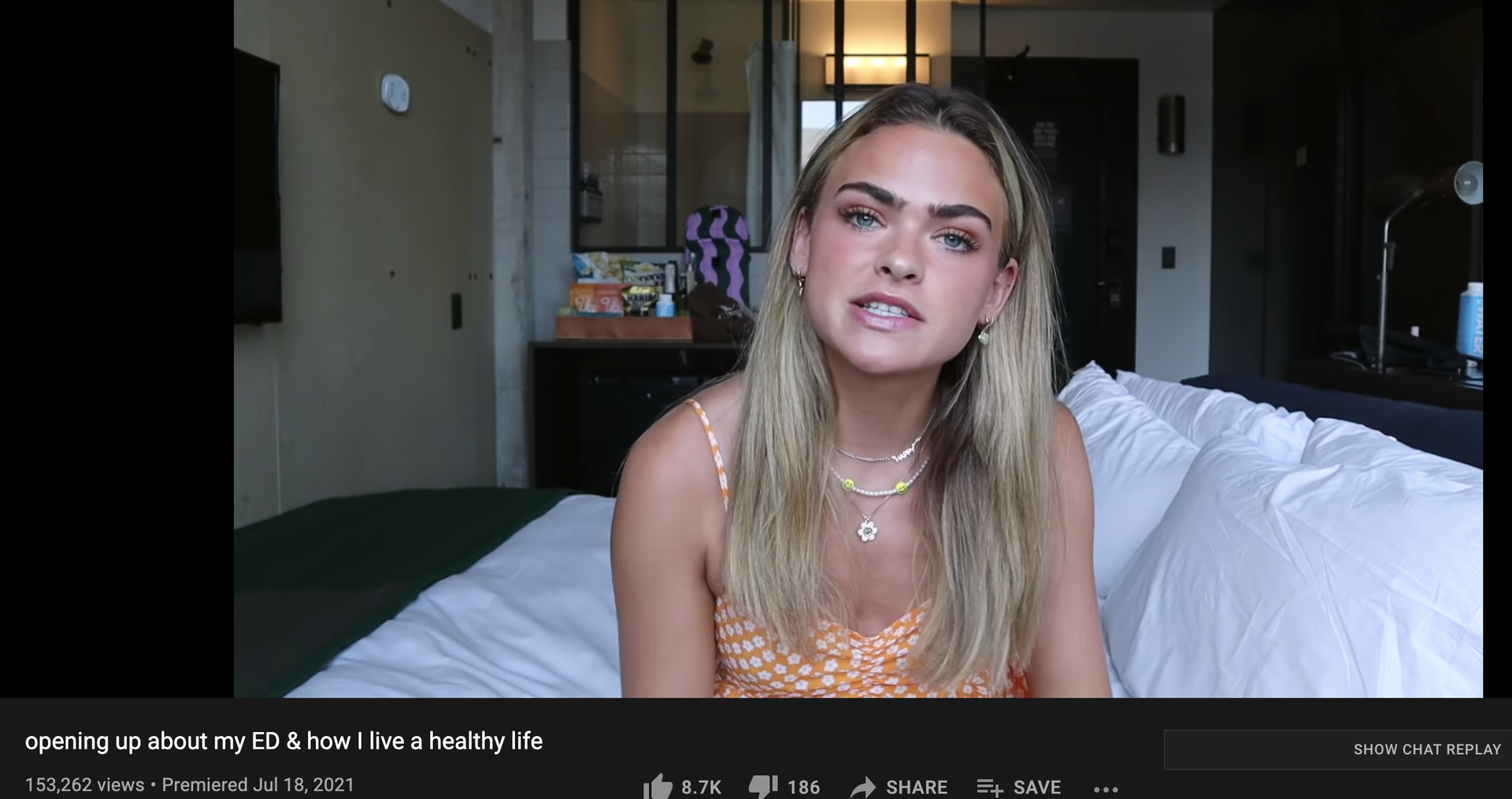 YouTube / Summer Mckeen On Sunday, YouTuber Summer Mckeen uploaded a video titled "opening up about my ED & how I live a healthy life." In it, she says she overcame binge-eating disorder and explains how. At the time of this writing, the video only has 171 dislikes, which is shocking, considering what she says in it.
Mckeen contradicts herself throughout the video. She says it's bad to restrict your eating, then later says that she only "treats" herself once a week. While she says she got over an addiction to eating, she also says she found Orange Theory fitness classes and quickly got addicted to them. At the beginning of the video, she warns her viewers that her approach might not be for everyone and reminds them that all bodies are beautiful. But toward the end of the video, she applauds herself for getting rid of her cellulite.
All of that would be harmful on its own, but Mckeen also never discloses if she sought help from a professional. Instead, she said Google diagnosed her disorder. (Mckeen didn't return a request for comment on this video or the criticism.)
Alexis Conason, psychologist, certified eating-disorder specialist-supervisor, and author of The Diet-Free Revolution, told me she considers Mckeen's advice to be dieting tips. While consumers know to expect this kind of language from Weight Watchers or other weight-loss companies, it can be surprising and harmful to hear it from a social media influencer who also says she's promoting body positivity.
"A lot of the advice she's recommending would tend to worsen an eating disorder or trigger an eating disorder," Conason said.
Mckeen, 20, started her YouTube as a teen and primarily uploads lifestyle videos that focus on beauty and fashion. In 2018, she starred in Endless Summer, Snapchat's first-ever reality show, which ran for three seasons and followed her life, as well as her relationship with Dylan Jordan, who was Mckeen's boyfriend at the time. In the video posted on Sunday, she says that she gained nearly 20 pounds following the high-profile breakup and ate junk food in bed as a way to cope with her emotions.
Conason said she doesn't want to come off too harsh because she suspects Mckeen is in the early stages of recovery from her eating disorder, and it's a "hard path." However, she wants people watching Mckeen's video to understand that it's not offering good advice.
"This is not healthy advice for most people," Conason said, "especially people who are recovering from an eating disorder, because we know that recovery from an eating disorder is very much about getting rid of food rules, learning to trust your body and listen to your body, try[ing] to accept your body as it is in this moment, shifting the focus away from weight loss and the numbers on the scale."
Social media influencers become popular for sharing their personal lives, so it's no surprise that when they lose weight or achieve fitness goals, fans want to know their secrets. But more times than not, influencers aren't certified to give advice about weight loss or fitness. They're just regular people who have found things that work for them, and sharing that with the their followers can be harmful.
"There's also a lot of general misinformation out there," Conason said. "The kinds of things that the average person thinks that they should do to be healthy or lose weight is not necessarily what we would recommend from a psychological perspective in terms of healing your relationship with food and improving body image."
—Paige Skinner The tension between making viral content and the reality of private people just trying to get on with their days 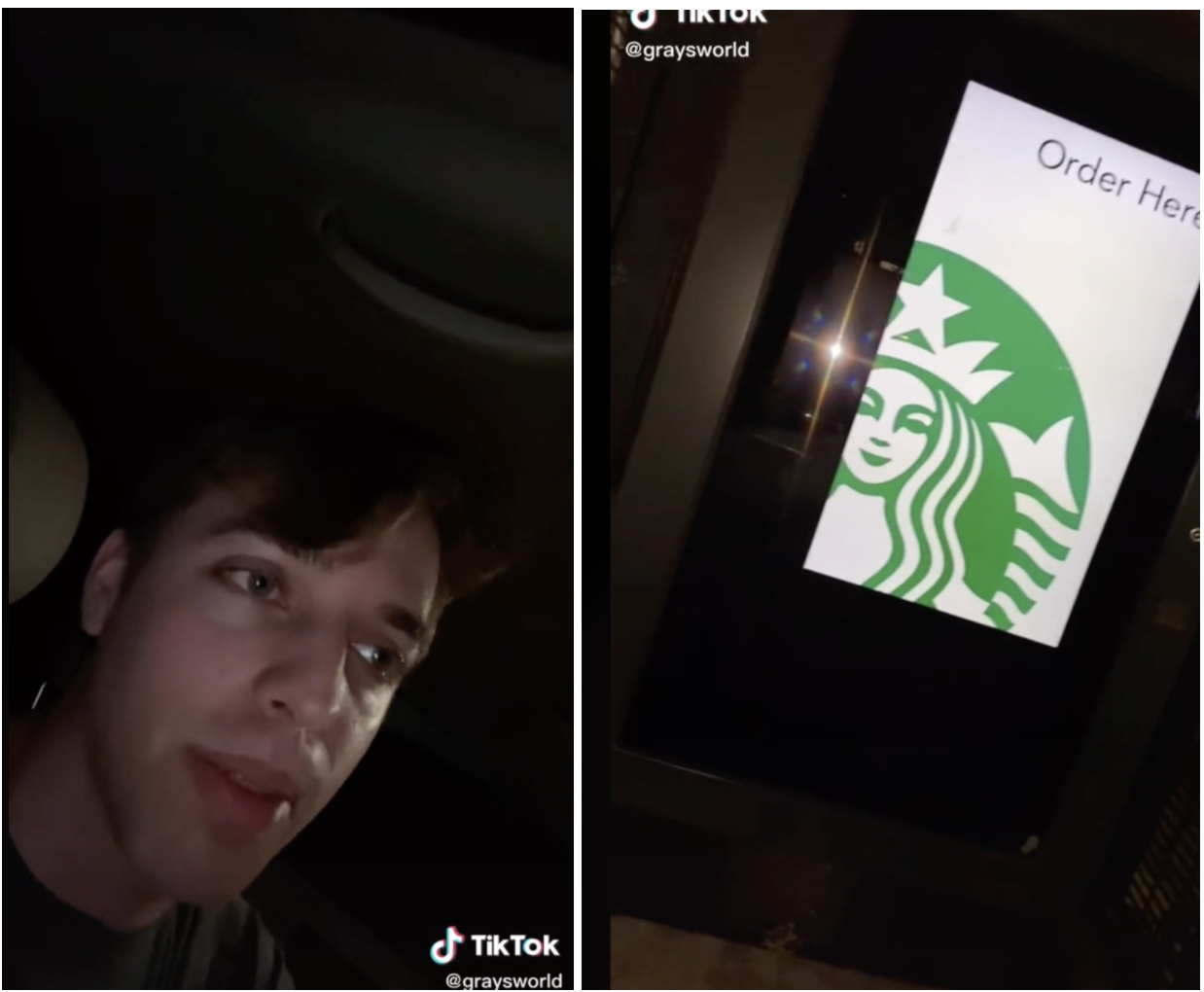 TikTok / @graysworld I love watching feel-good videos online. I believe most of the action in them happens organically, even though I know some of them are also staged. I'm also impressed when the strangers who get caught in the background of some of these videos become likable main characters themselves. (For example, in this viral video, a man belts out K-Ci & JoJo's "All My Life" at a gas station as a bunch of onlookers stare in awe and hype him up.)
It probably wouldn't be me, though.
I'd like to think of myself as a decent citizen who is moderately happy and pleasant as I move through IRL spaces on most days. I'd probably be cheering on the guy singing in that TikTok, like a wonderful lady is seen doing. But sometimes I'm in a crummy mood, and we now live in a society where that could also be captured in a stunt that goes viral and is implanted on the internet forever.
This week I saw a TikTok from a comedian and influencer who goes by Graysworld. In the video, he asks a Starbucks drive-thru employee: "Hey, yeah, um, I was actually wondering if you could maybe make something for someone who might have just gotten their heart broken?"
The Starbucks employee is then heard sighing deeply, and responds, "Can you just get something off the menu?" Gray captioned the TikTok, which has since gone viral, "ill be going to dunkin from now on 💔."
The TikTok had been viewed more than 12.5 million times as of this writing, and the comments are mixed. Some people were disappointed and thought the employee "did not pass the vibe check," reprimanding him for how he spoke to Gray. Others sympathized with the employee, and said he was most likely having a bad day.
The employee hasn't been identified, so we don't know, but I don't think it really matters if he was having a bad day. Anyone who has worked in the service industry can viscerally feel the depletion in his sigh and his response to Gray. Food service jobs are often demoralizing, and service workers are seldom paid wages commensurate with the various difficult people and requests they encounter. I've worked in retail, in restaurants, and at public pools. Almost every day has the potential to be a bad day. I'm sorry — it would have been nice to see a Starbucks employee rise to the occasion and gleefully make Gray a drink concoction, even free of charge because of his heartache! — but I'm on Team Starbucks Employee.
This is especially true because drive-thrus have become popular places for people to film funny stunts featuring employees, which then become the subject of memes. This became a trend as service workers became frontline workers during the pandemic.
Gray's TikTok, while pretty hilarious, made me so conscious of our current reality: We all could unknowingly be the focus or the background of a tweet, a TikTok, or an Instagram story. That makes social media fun, but it's also what makes social media anxiety-inducing. It's like the Improv Everywhere link era of the internet… everywhere. Of course, chances are relatively low that being caught in a scene for social media could happen to you or me on an average day, but it is very much a possibility. We all live with a shadow of pressure to be on our best behavior.
For creators, this new reality is great. They can mine for content the second they step out the door. For the rest of us, it's...precarious. The best place to be in viral theater is in the audience. But if you're either a creator or a person suddenly facing a creator's camera phone, there's a new kind of relationship to consider, and it's one, like many, that hinges on consent.
Stuff like this immediately unlocks a vault of existential questions for me: Outside of recording and privacy laws that vary from state to state in the US and around the world, are we submitting to a social agreement to be recorded when we're private citizens now? Should influencers always ask for consent when they're turning their lives and stunts into posts — especially if they have a massive audience? On what basis can people like the Starbucks employee ask to have posts removed if they do not want to have a moment in their regular degular life forever immortalized on the internet?
I reached out to Gray and his team to ask these very questions, but have not yet heard back. I'll update this post on our website and/or next week in our newsletter if I do get a response. I think these are important questions to start thinking about as IRL and online communities continue to become enmeshed.
Until next time, Tanya Want more? Here are other stories we were following this week. His video got 75 million views, but he didn't make a cent. Lauren spoke to a man named Kevin Parry about how going viral doesn't always mean getting paid.
Mat George, a Twitter personality and cohost of the podcast She Rates Dogs, died at age 26. George was struck by a car early on Saturday; the driver fled the scene.
P.S. If you like this newsletter, help keep our reporting free for all. Support BuzzFeed News by becoming a member here. (Monthly memberships are available worldwide.) 📝 This letter was edited and brought to you by Tanya Chen, Stephanie McNeal, and BuzzFeed News. You can always reach us here. BuzzFeed, Inc. |


