IG is finally paying creators. Alexa, play JoJo’s “Too Little Too Late”

 Is Instagram's new commitment to supporting influencers too little, too late? 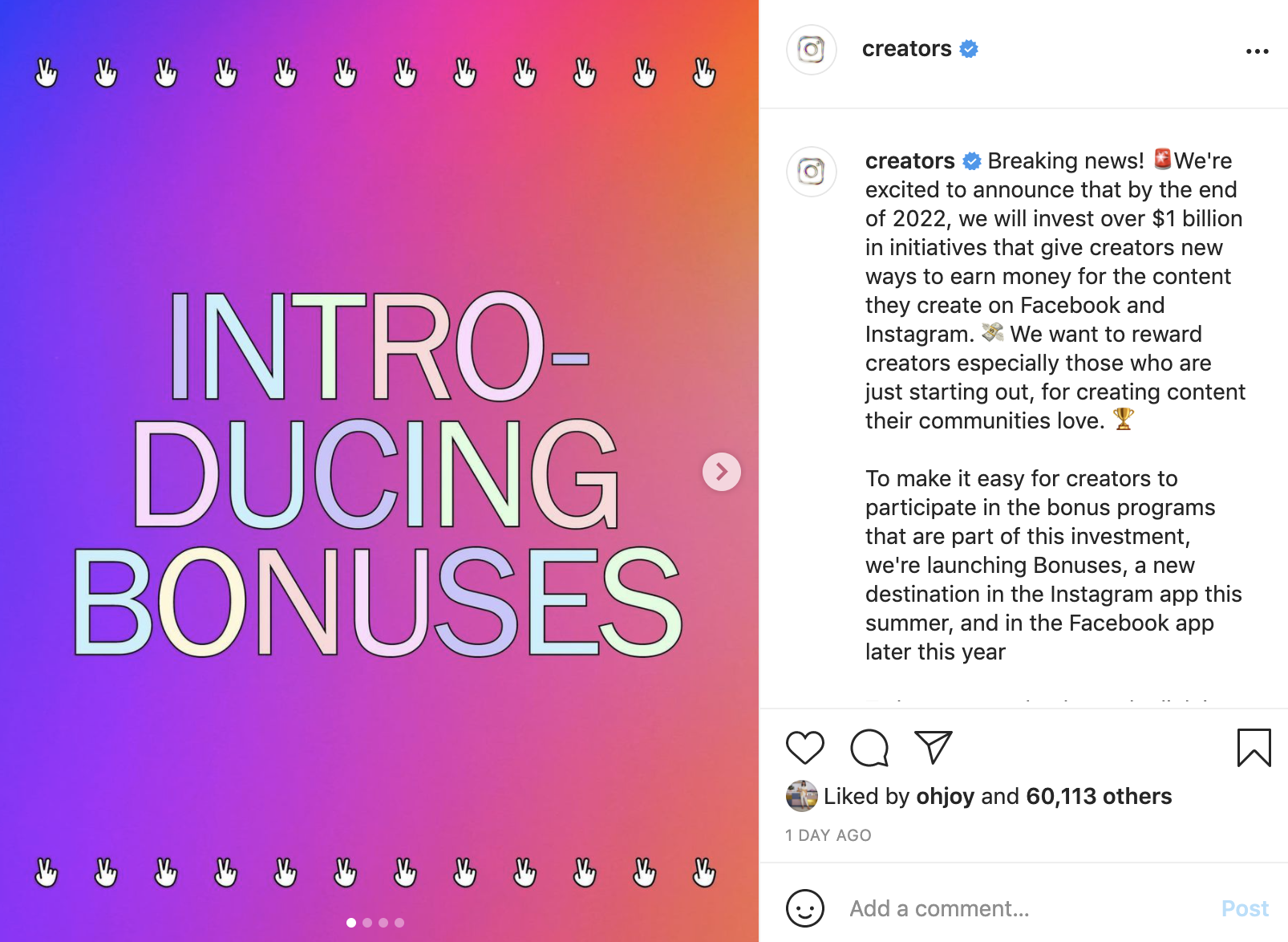 On Wednesday, Facebook took a huge step forward in its commitment to supporting the thousands of influencers who have turned its photo- and video-sharing platform, Instagram, into one of the most popular on the internet for content creation.
In a blog post, the company announced that it plans to invest $1 billion by the end of 2022 in programs specifically designed to support the creator ecosystem on its platforms. It's a move to compensate creators directly.
Facebook has been pretty direct about its intentions with these programs. The company hopes these initiatives will "support the creator community and enable them to earn a sustainable income on our apps."
"Our goal is to help as many creators as possible find sustainable, long-term success on our apps," the blog post reads.
This development shouldn't come as a surprise to anyone who has been paying attention to the creator economy on Instagram. Over the past six months or so, it has become clear that Facebook has made a huge shift. After years of a laissez-faire approach to the influencers who power its apps, the company is now desperately trying to show influencers it cares about their success.
The change has been pretty stark. As I noted last month, Instagram has spent most of its life not investing in its homegrown talent.
This is notable compared to other platforms like YouTube, which has actively cultivated its talent for many years, highlighting creators on billboards and running programs with perks and a dedicated support team. YouTube famously also awards prizes to creators who reach certain milestones, like 1 million subscribers — a simple gesture that has earned the company a lot of goodwill (as evident by how excited YouTubers get about the prizes).
No Instagram influencer ever has been rewarded with a similar honor. Over time, influencers have begun to resent how little support they have gotten from Facebook, and others have filled in. For example, monetization platforms like RewardStyle were started by influencers who noticed a gap in the market, and an entire economy has emerged from their efforts.
Recently, as I reported in June, a sort of mini revolt has sprung up among Instagram influencers, many of whom have expressed frustration with the difficulty of running their businesses on the app and the lack of support from Instagram. Influencers have diversified their businesses, starting Patreons or Substacks or reinvesting in their blogs. Thus, I don't think that Facebook's sudden, frenetic commitment to ensuring influencers invest their time primarily on Instagram is a coincidence.
The question now is: Will Instagram's overtures actually work?
A few parts of Facebook's announcement give me pause. One sentiment I have seen floating around Instagram since the announcement by longtime influencers is "too little, too late." Many influencers seem skeptical that Instagram's announcement is genuine. Instead, it seems like Facebook is trying to stave off competition from TikTok, which has launched its own, exciting pool of fresh-faced creators. Notably, TikTok has a creator fund, which the platform launched to "show [its] appreciation to [its] brilliant creator community by rewarding them for their incredible TikTok videos and creativity."
I can totally understand why Instagram influencers are skeptical of the platform's new programs. Where was this commitment when influencers first launched their brands? Why did it take a hot new platform and a new crop of Gen Z talent for Instagram to realize what it had?
I could also see two other elements of the announcement rankling them. For one, all the first bonus programs revolve around video, for using IGTV, live video, or Reels. The Reels program, in particular, caught my attention. The program "will pay creators for creating great Reels content on Instagram," and influencers will earn money "based on how their reels perform."
Coupled with Instagram CEO Adam Mosseri's comments a few weeks ago that Instagram is no longer a photo-sharing app, it seems clear that Instagram's focus on Reels, its TikTok competitor, isn't ending anytime soon. But I struggle to understand this strategy, because...no one seems to actually like Reels! I have seen complaints constantly on the platform that both influencers and followers dislike the platform's focus on Reels because it is just forcing people who are good at one thing to do something else, and usually not very well. Influencers aren't video content creators most of the time, and that's OK! We don't follow them for that, and creating viral TikToks and good Instagram content are very different skills. Influencers have been complaining for months that Instagram's Reels obsession has made their actual, genuine content perform worse, and this has been a major factor for some to seek different platforms.
The final aspect of the announcement that I could see influencers being annoyed by is a seeming focus on attracting new talent rather than recognizing and honoring the talent they already have. In the blog, Instagram says that one of its main objectives is to "reward creators, especially those who are just starting out, for creating content that their communities love."
As one influencer with more than 200,000 followers commented on Instagram's post on @creators announcing the program, "How about also creators who have been doing this for you for years and have yet to make it big!"
But others seemed excited. "Thank goodness finally some support as a creator!" one person wrote.
The focus on both new talent and video content makes it seem to me that Instagram is specifically targeting short-form, up-and-coming video creators with these programs, not Instagram influencers.
Instagram has promised to launch other features that could help more traditional influencers, such as tools that would allow influencers to sell products directly through their personal profiles and set up new shops via the app. But as of now, I'm not sure how much these programs will help quell the discontent of influencers on the platform.
At the end of the day, influencers deserve to have support from Instagram for growing their businesses on the platform and making it what it is. It's time for Instagram to rise to the challenge rather than focus on the new, shiny creators in front of them.
— Stephanie McNeal The wildly viral "Alors on Danse" dance is an elite TikTok because it's effortless and can't be replicated 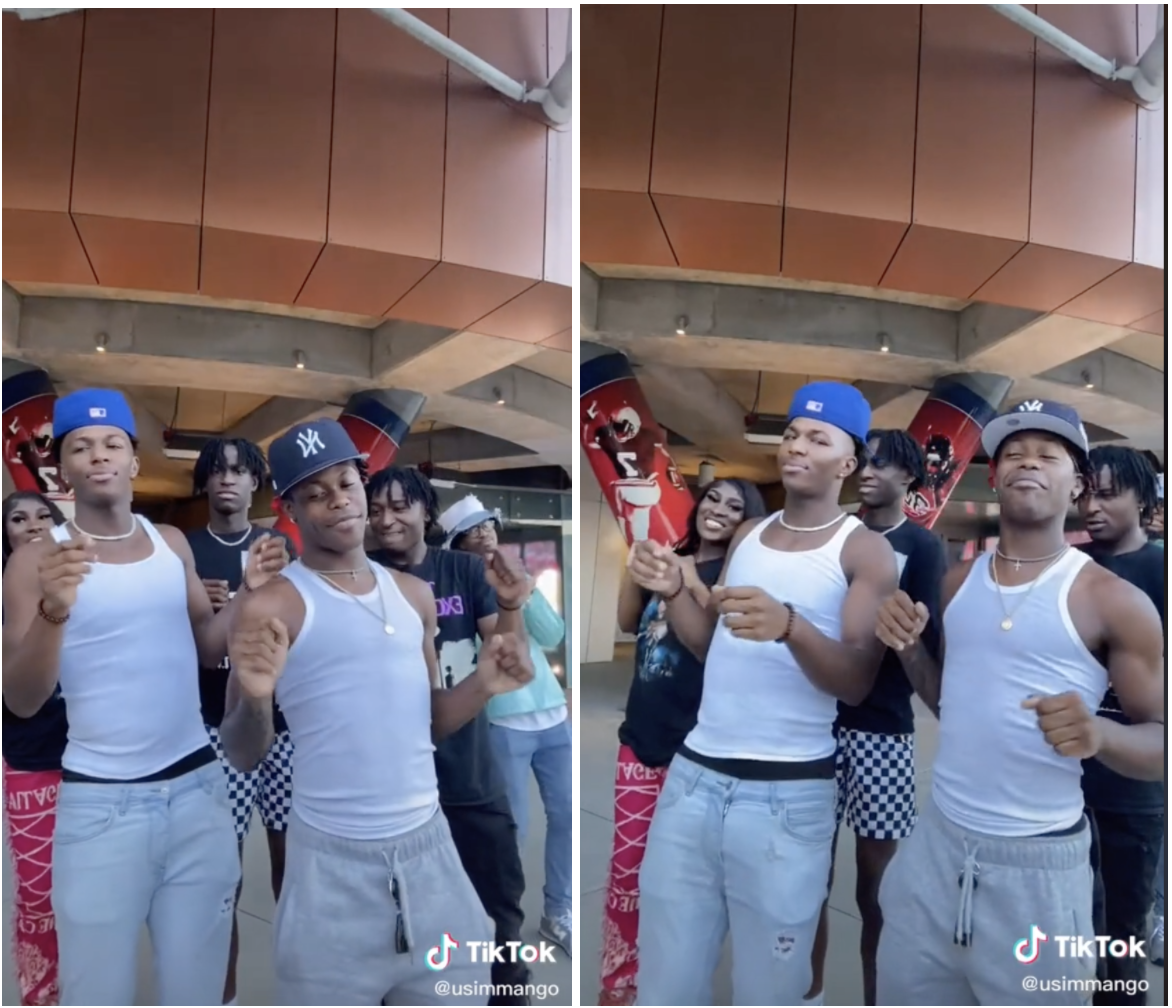 TikTok / @usimmango Every few months, a TikTok breaks through the viral ceiling for good but mysterious reasons. This time around, it's a video of a group of friends dancing simply but with synchronicity to a remix of "Alors on Danse" by Belgian singer and rapper Stromae. (I love this song, BTW.)
The TikTok from @usimmango, a 19-year-old whose real name is Usim E. Mang, now has over 118 million views. It is incroyable, as they say en français. To try to describe it would both minimize the dance's coolness as well as my own, but I will make an attempt. Usim and five of his friends are goofing around when they begin to rock to the very slowed-down horns of the song. Their subtle swaying is in almost perfect harmony and so soothing to watch.
The simple motion has become so captivating that a group of guys tried to recreate it. (Key word: tried. They were not as successful in capturing the silkiness of the original, sorry.) Singer Jesse McCartney even danced to it as a meme to announce "major news" he was dropping. The TikTok was also so colossally popular that it compelled actor Lindsey Shaw to make a TikTok of her own, mocking the dance's simplicity. Other TikTokers then called Shaw's reaction racist because she seemed to be diminishing the success of a group of Black creators "for no reason," as one user, @auntkaren0, pointed out.
The dance is notably very simple — to the point of befuddlement regarding how viral it's become. Of course the app's algorithm quickly signal boosts videos that are already popular to people's FYPs to throw some gasoline on that fire. But there is something naturally captivating about TikToks like Usim's.
There are only a few other videos that fall into this mysterious and magical league of Very Uncomplicated But Very Addictive TikToks. There were the moms (at a bar, amid the pandemic) badly lipsyncing to Aly & AJ. That one reached 88 million views and was parodied everywhere. And of course there's the Ocean Spray skateboarding video from @420doggface208 that then inspired me to try to tediously tease out what a "vibe" is. That one reached 81.4 million views.
Usim's video is overtaking the others that I'm putting in the same category in terms of views. It could be that the app's popularity continues to grow, so the scale of exceptionally viral content has also shifted upward dramatically. It also could be that his video has accentuated the point that perhaps the simplest, most genuine moments captured on film and shared to the internet can be the most fruitful. Influencers every day are coming up with new ways to stand out, so it's always poetic to me when TikToks like these rise to the top largely because of their effortlessness. Usim and his friends have a flair that cannot be easily replicated.
(My colleague Ikran spoke to Usim and will be writing a bit more about him, so please look out for that article!)
Until next time, Tanya Want more? Here are other stories we were following this week. Addison Rae joked that she was hired and then fired from a UFC correspondent job after her "obnoxious" and "tone-deaf" tweet sparked a huge backlash. Someone called the stunt "an obnoxious and tone-deaf slap in the face to people who actually studied for and are trying to make it in that profession."
POTUS Joe Biden confirmed pop star Olivia Rodrigo is going to the White House in an Instagram comment. Good 4 u, Olivia! But what a world we currently live in.
A TikToker called out the VP of a "woman-led" boutique for accidentally sending her an email where he called her "not that cute." Gracie Lorincz is not interested in inciting the backlash mob any further, but she hopes her TikTok is empowering in a way that the email she received wasn't. P.S. If you like this newsletter, help keep our reporting free for all. Support BuzzFeed News by becoming a member here. (Monthly memberships are available worldwide.) 📝 This letter was edited and brought to you by Tanya Chen, Stephanie McNeal, and BuzzFeed News. You can always reach us here. BuzzFeed, Inc. |


