If you think getting the IRS on the phone is tough, try setting up an individual online account. 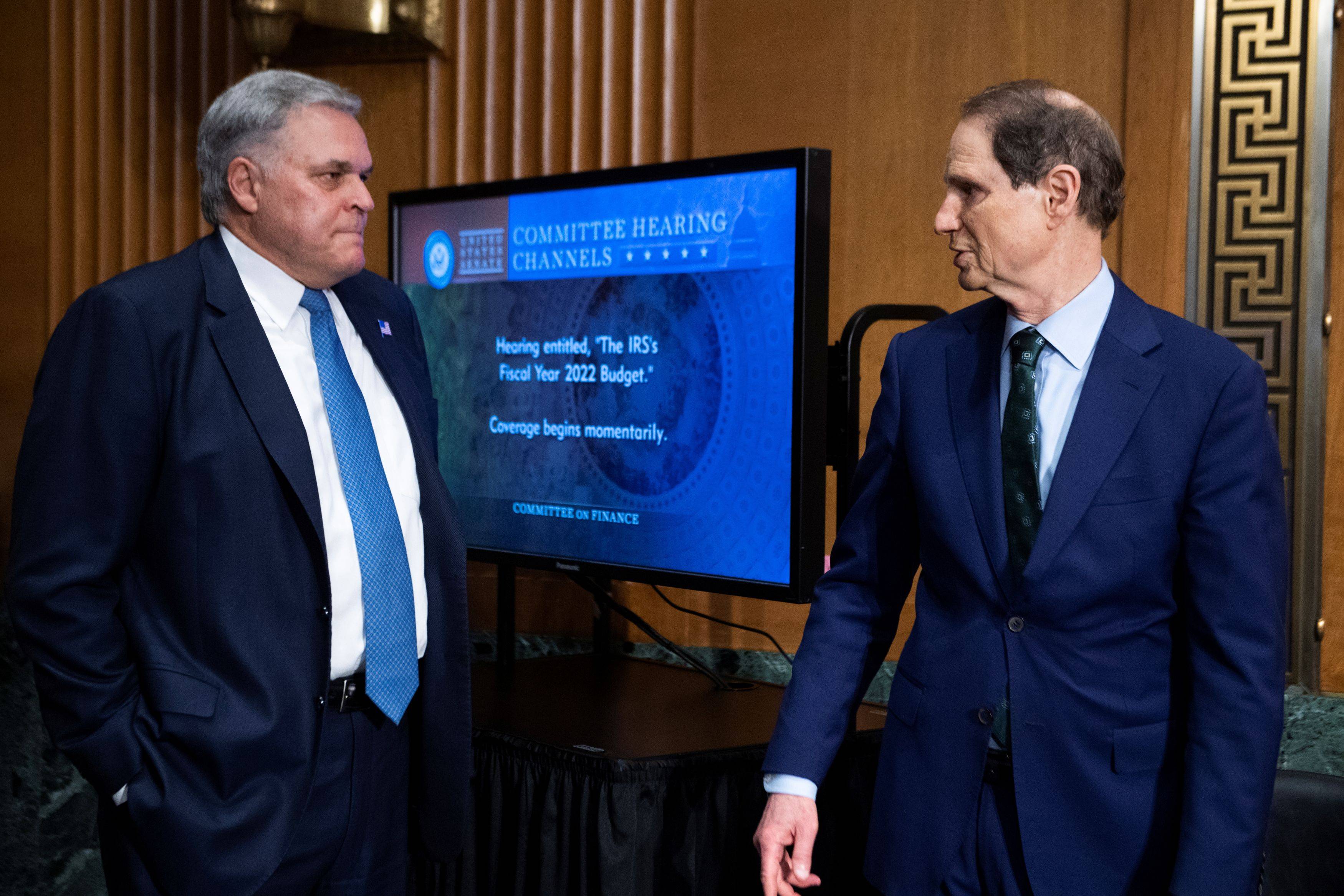 Charles P. Rettig, commissioner of the Internal Revenue Service, greets Sen. Ron Wyden (D-Ore.), before testifying during a Senate Finance Committee hearing in June. (Tom Williams/Pool/Reuters) | If you want to set up an online account with the IRS, good luck. Prepare to swear. And even if you manage to authenticate your information and set up an account, the platform is so glitchy that you might end up getting locked out. Then the taxing agency will have to send you an activation code through the U.S. Postal Service — making you wait up to 10 days to get your account unlocked — although the IRS already has your email address and cellphone number and could simply email or text message you to verify your identity, much like a bank or brokerage. I'm calling this column "Hot Mess Part 2," because many taxpayers just can't take it anymore. I recently wrote about the abysmal record of the IRS at picking up the telephone when taxpayers call. So now let's talk about the agency's antiquated online account system for taxpayers. The IRS is a hot mess: Millions of tax returns haven't been processed, and calls are going unanswered, including mine My husband and I have been trying to fix some errors the IRS made while reviewing our 2018 joint return. As part of our response to the agency, we wanted to double-check some information by accessing our online accounts. I could get into mine. My husband could not. The portal said it couldn't verify his identity. This has happened before. "The information you entered does not match our records," a red-colored notice on the site said. "Please verify your information and try again." Ugh! So, we had to request an activation code be mailed — again. Turns out it didn't matter because neither his account nor mine had the information we needed. What's so maddening about the failures of the individual online account portal is that the IRS can't handle the volume of phone calls from the pandemic-related surge in taxpayer issues. But if the agency had a better online platform, many people might be able to resolve tax problems on their own, if they could just get to the information the IRS has on them, says Erin Collins, the national taxpayer advocate. IRS faces 35 million unprocessed tax returns as backlog swells, watchdog says Because of outdated technology systems, the IRS operates a largely paper-based system, requiring taxpayers to keep copies of paper correspondence or use a patchwork of electronic applications to gather necessary information, Collins complained in her 2020 report to Congress. "Due to years of limited funds, the IRS has only been able to add some online services in a piecemeal fashion," Collins said. "Taxpayers deserve better service from the IRS." Here's a statistic from Collins's midyear report to Congress, released last week, that won't come as a surprise to many people who have tried and failed to set up an individual online account. Most taxpayers who try to establish accounts fail because they cannot pass the e-authentication requirements. The authentication rate for IRS online applications was 42 percent in fiscal2020, according to Collins's report. In other words, fewer than half of the taxpayers who tried to set up online IRS accounts were able to convince the agency of their identities. And clearly more people want to help themselves. The IRS had 9.5 million unique users access its individual online account platform in fiscal 2021 through May, more than double the previous period. IRS launches child tax credit tool for low-income families. Community groups say it's too hard to use. "Taxpayers' inability to establish and use online accounts renders the accounts meaningless," Collins said. Then there is the functionality of the accounts, which is exasperatingly limited. You may find you can't view notices the IRS has sent. There is no place where taxpayers can view all their consolidated information. Bipartisan infrastructure deal could make it harder for tax cheats to elude IRS You can't see an actual copy of the tax return you filed. The only way for the taxpayer to view a copy of what they filed is to mail a request to the IRS, pay a $43 fee, and wait up to 75 days, Collins points out. And given the backlog of processed returns, that time frame is optimistic. "Effective self-service tools with specific account details will help save scarce IRS resources," Collins wrote. "However, to be effective, the IRS needs to offer online services that taxpayers find to be beneficial and easy to use." Understandably, the agency should be protecting taxpayer information. A robust authentication system is necessary. But when more than half of the people trying to set up an account are rejected, that's a horrendous record. "For individuals and businesses that have been banking online for two decades or more, the contrast between their online bank accounts and an online IRS account is stark," Collins said. At the very least, a better online portal would free up IRS employees to answer their phones, which presumably means they would hear less profanity on the other end of the line. Reader Question of the Week If you have a personal finance or retirement question, send it to colorofmoney@washpost.com. In the subject line put "Question of the Week." Please note that questions may be edited for clarity. Q: My mom has severe dementia and is being cared for at home by my brother and his wife. Recently she broke her hip, was treated, and came home. What's strange is they are now being approached by several "hospice" services that claim supplies (like adult diapers) will be reimbursed by Medicare. It feels like this is a scam. Is it? A: Medicare Part B covers medically necessary "durable medical equipment" if your doctor prescribes it for use in your home. Medicare doesn't cover adult diapers, says Medicare.gov. But there's a possibility, if your mother has a Medicare Advantage Plan (Part C), that adult diapers may be covered. It's also possible that the hospice service will provide certain supplies, such as adult diapers, without a cost to you because of some other funding. However, since Medicare fraud is real, check with your mother's medical plan provider to find out what is and isn't a covered expense. In Retirement News Part of planning for retirement and then living on the money you've saved or invested for retirement is keeping up with the issues that you need to know. In this section, I feature blogs, news stories, new research, surveys, and government policy changes that could affect your retirement. If you see a news story or issue you think would help folks, let me know and I'll check it out and share it with newsletter subscribers. There has been a lot of news about how uber-rich folks take advantage of tax-friendly vehicles such as the Roth IRA. A ProPublica investigation found billionaire Peter Thiel, a founder of PayPal, has amassed $5 billion in a Roth IRA using company stock. "It's not a coincidence that Thiel opted for a Roth IRA to hold his PayPal shares: Investments in a Roth IRA grow tax-free," wrote Chris Davis, a writer for personal finance website NerdWallet. Davis' point is that you don't have to be rich to invest in a Roth IRA. "By opening and investing through a Roth IRA, you're growing your wealth over time," David recently wrote. "Your account balance may not have as many zeros as Thiel's, but the mechanism for accumulating your own level of wealth is the same. Then, come retirement, you can draw on that accumulated wealth, meaning at least part of your income would go untaxed — just like some of the world's richest people." You may already be sold on the benefits of a Roth, but pass along the information to others in your circle of influence. Send along the link for Davis's article: You too can reap the tax advantages of a Roth IRA Here's some additional reading on Roth IRAs: Roth IRA vs. 401(k): Why one may be better for you than the other Millennials are racking up retirement savings in Roth IRAs Should you be saving for college using a 529 plan or a Roth IRA? Retirement Rants and Raves What are your thoughts about saving for retirement? If you're retired, how is it going? What advice would you have for others about retirement? This is your space to rant or rave about anything related to retirement. Send your comments to colorofmoney@washpost.com. Please include your name, city, and state. In the subject line, put "Retirement Rants and Raves." Responses may be edited for clarity. Bill Meader, who spends winters in Thailand and summers in Seattle, offered a lot of advice on investing for retirement. He's 63 now and retired at 61. "I have been investing my whole life and retired with close to $1 million saved," Meader wrote. "This took lots of planning and lots of great returns. I did not make a killing, but I did well, averaging 10 percent to 12 percent for most of my earning years. This was done by lots of reading and not jumping from stock to stock." After retiring, Meader hired a financial adviser. He said he worked with his adviser on how much he wanted to spend each month. "My girlfriend owns the house we live in, so I am 100 percent debt-free," he said. "I am not saving anymore. I only spend. My children are grown and do not require financial support. My parents are gone, so I have no other financial obligations, which make things very easy. I am healthy and play golf four times a week. I am an avid reader and have an active social life. In his words, here's how Meader was able to retire well. It's not a foolproof plan, of course, but is still possible for a lot of folks. - Plan what you want to do in retirement, including how much you think you will need. Then add 20 percent, as that is what you will most likely spend.
- Keep invested in equities and, as you grow old, go more into bonds depending on your risk. This will keep your nest egg solvent.
- Retire to something. Don't stop working 60-hour weeks without a plan on what you want to do with your life. You might have 30 more years.
- Take care of yourself health-wise from an early age. - If you can, find affordable health care before Medicare kicks in. I am fortunate to have military health care.
- Downsize and move to something that is easy to maintain. And if it's going to be your last home, make sure it's single-story, as going up and down flights of stairs will get very old.
- Keep active mentally and physically.
- Now that you have all the time in the world, use it, and explore places outside your state or even your country. You might find someplace you want to live part or full time that you never thought of.
- Get and stay out of debt at all costs. This can kill any plans for what you might want to do. | 



 Email
Email 

