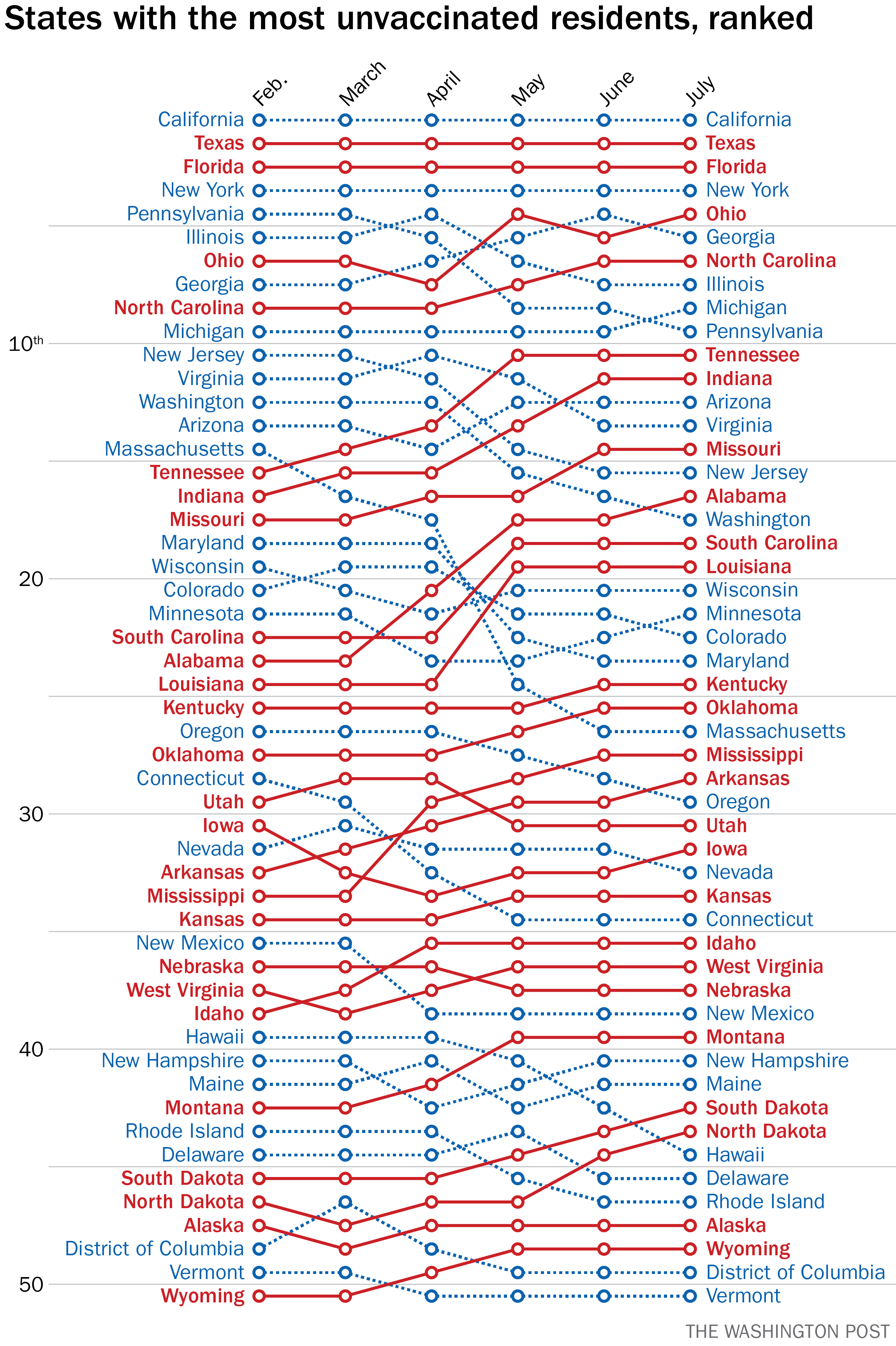
| Hello, gentle reader! I am Philip Bump, your guest host of this newsletter for the next week or so since Amber Phillips is on leave, Aaron Blake is on vacation at Busch Gardens or something, and Jeff Bezos is still decompressing from his flight. I wrote for The Fix until early 2017 at which point I began doing my own thing, but about 80 percent of people think I'm still part of the team so we figured why not lean into it? Over the course of the next eight days, I have three goals. First, to keep you broadly up-to-date on what's happening in politics, just enough to keep you wanting more. Second, to spend a little more time looking at data visualizations, something I happen to find interesting. To that end, I'm adding a section called "How to Read This Graph," which I hope you'll find enlightening. My third goal, of course, is to be so effective and entertaining that the eventual return of Aaron or Amber will be met with audible sighs of disappointment, so loud that my dog up here in New York pricks up his ears and starts to howl. Just this cascade of resigned exhalations that disrupts the sleep patterns of wild animals, marking the end of the greatest era in the history of this newsletter. With expectations set appropriately, let's go. The House investigation into Jan. 6 reaches its inevitable, single-party endpoint I suspect that we tend to underestimate the extent to which history will marvel at the aftermath of the riot at the U.S. Capitol on Jan. 6. It was a blur of a month, with the day's violence overlapping with a peak in new coronavirus cases and a rapid transition from insurrection to impeachment to inauguration. At 10 a.m. on Jan. 6, things seemed unstable but within the range of expectations; by 10 p.m. we'd probably have shrugged at extraterrestrials absconding with Oklahoma. Both because of how much the bar for incredulity was lifted that day and because it mostly happened in the middle of the night, we tend not to dwell on the fact that more than half of the House Republican caucus voted to block the counting of electoral votes from two states — the exact outcome sought by President Donald Trump and the rioters. There has however been a lot of rationalization of that vote since, mostly centered on the retconned idea that the lawmakers were simply objecting to how votes were cast. The reality, quite obviously, is that it was determined to be more politically viable to accede to Trump's false claims of rampant electoral fraud than it was to contest them. In the months that have followed, that has become something of a self-fulfilling prophecy: because everyone agreed then to go along with Trump, those who now don't want to are asked to please shut up about it. (I'm talking about you, Rep. Liz Cheney (R-Wyo.), in case you happen to be reading this.) When House Democrats began pushing for a more robust bipartisan investigation into the riot, Republicans declined to sign up. Everyone — including the Democrats, of course — understands that investigation will not reflect positively on Trump and therefore on the Republican Party. There's reason for concern that other elected Republicans will also be implicated by a probe. So the party decided that the smart play was to cast the entire thing as political. And to be fair, playing the hand that you're dealt, it may be the best option the party has. That meant that when Democrats moved forward with their own investigation, creating space for Republican participation, it was fairly obvious what would happen: Republicans would seek to cast the investigation as a partisan effort to score points. On Tuesday, House Minority Leader Kevin McCarthy (R-Calif.) offered up a slate of five Republicans to serve on the body. Three of them, including Rep. Jim Banks (R-Ind.), intended as the ranking member of the team, supported the effort to reject the electoral vote count. Banks even released a statement after his nomination, disparaging the effort in its entirety. House Speaker Nancy Pelosi (D-Calif.) rejected two of the nominees, Banks and Trump loyalist Rep. Jim Jordan (R-Ohio). And that, of course, prompted McCarthy to deem the whole thing hopelessly tainted and pull his entire recommendation list. "Denying the voices of members who have served in the military and law enforcement," he said, "as well as leaders of standing committees, has made it undeniable this panel has lost all legitimacy and credibility and shows the Speaker is more interested in playing politics than seeking the truth." The member who served in law enforcement is apparently a reference to Rep. Troy E. Nehls (R-N.D.), who voted to block the electoral votes Jan. 6 — but who Pelosi didn't reject. But who are we to quibble. Cheney, for her part, called the statement "disingenuous." What's left, it seems, is a committee with only members selected by Democrats, though including Cheney. McCarthy and his colleagues get to frame this as a witch hunt unfairly targeting Trump. So the Democrats get their investigation and the Republicans get to complain about the Democrats having an investigation. Everyone wins, using "win" only in the very narrow sense that it can be applied to Congress. How to read this graph I thought it might be interesting to invert the way we usually look at the uptake of coronavirus vaccines in the United States by considering the number of unvaccinated people in each state. So I pulled data from the Centers for Disease Control and Prevention and tracked the raw totals of unvaccinated people in each state. And then, because I'm me, I overlapped that with how each state voted in 2020. The result was striking. While there are tens of millions more adults in states that voted for President Biden, there are now more unvaccinated adults in states that voted for Trump. One way I found it interesting to view how vaccines had been deployed was to show the rank over time of the number of unvaccinated residents in each state. On the graph below, you can see the starting rank of each state at left, a rank that essentially represents the state's population. Over the course of each month, the number of unvaccinated residents changes, and the state's position relative to those with similar populations starts to shift. By July, the final set of dots, the rankings have been reshuffled substantially. California, the most populous state, has consistently had the most unvaccinated residents. Lower down the list, though, where state populations are closer in total, there was a lot of movement in the rankings. Generally, red states moved up (which is bad) and blue states moved down (which is good). Consider Alabama, for example. In February, it was in about the middle of the pack, with the 24th-most unvaccinated residents. By this month, it had risen to 17th place. It now has more unvaccinated residents than Washington state, home to 50 percent more people. I mention Alabama in part because of a grim story published at AL.com. Reporter Dennis Pillion interviewed a physician who described the desperate appeals of the sickest coronavirus patients, some of whom begged at the last minute for a vaccine. "I hold their hand and tell them that I'm sorry, but it's too late," Brytney Cobia said. Those are the very real stakes of the vaccination effort. That is why Alabama's ascent on the graph above is so problematic. | 




 Email
Email