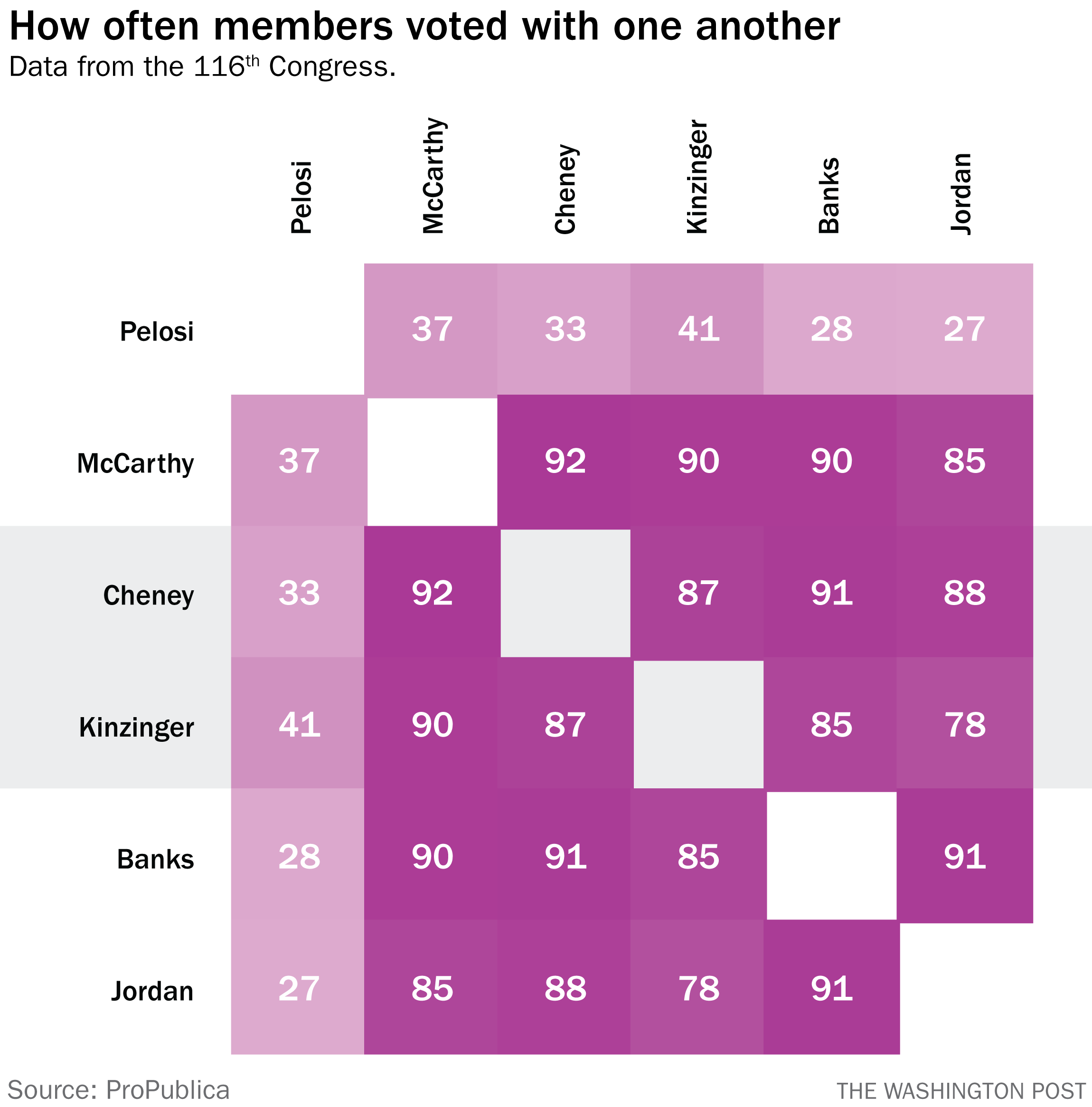
| Here's a horrible fact: As of your reading this, we have already burned through six of the 14 weekends we were allotted this summer. That deeply grim milestone gets worse: If you're reading this on Monday, which I'm just going to assume you are, you should know that summer is 38 percent over. The year itself is 56 percent over. [Footnote 1] The century is more than a fifth over, a staggering little bit of trivia for those of us who remembering fighting over when it began. It is also the case that my tenure writing this newsletter is half over as of today, meaning that you will soon be relieved of one particular burden and that the remaining dregs of this season will soon shine just a bit more brightly. And now, for some news. Imagine how irritated Kevin McCarthy is right now Just imagine it! Here's the House minority leader, the gentleman from California, trying to cast the House investigation of the Jan. 6 attack at the Capitol in partisan terms, and he has to deal with two members of the Republican caucus signing up to participate. Granted, Republicans had the chance to support the creation of a truly bipartisan panel but, out of palpable concern about offending supporters of former president Donald Trump, opted against it. The play was clear: Let the Democrats do their thing and then drop the whole thing into the overflowing trash can labeled "unacceptably partisan." But then Reps. Liz Cheney (R-Wyo.) and Adam Kinzinger (R-Ill.) accept invitations from House Speaker Nancy Pelosi (D-Calif.) to participate in the commission and McCarthy's strategy collapses. Ha ha. No, it did not. Like the Communist Party of old, partisanship claims can never fail; they can only be failed through lack of trying. And that is a not a failure that Kevin McCarthy was about to commit. At the White House on Monday, he was asked about comments from some Republicans who suggested that their party should participate more fully in the probe. "Who is that? Adam and Liz?" McCarthy replied casually, looking over his shoulder. "Aren't they kind of like Pelosi Republicans?" And there you go. Liz Cheney, of the Cheney Cheneys, is a "Pelosi Republican," not because she broadly sides with the Democratic leader on matters of policy but, instead, because she sides with Pelosi on the idea that the Capitol riot could use a bit more investigation. (My original idea for this newsletter, by the way, was to explore the outstanding questions that should be asked by the committee, but then Just Security did an annoyingly robust job with that, so that is also worth reading.) You know who voted with Pelosi more than Cheney in the 116th Congress? McCarthy. Data from ProPublica makes clear that McCarthy could be described as more of a "Pelosi Republican" than the representative from Wyoming based on votes in the last Congress. In 2019 and 2020, few members voted with McCarthy more often than Cheney. That includes his poison-pill nominees for the Jan. 6 commission, Reps. Jim Banks (R-Ind.) and Jim Jordan (R-Ohio). This congress has been a bit different, with several votes centered specifically on Trump and the events of Jan. 6 that have prompted more alignment between Cheney and the Democrats. But even in the 117th Congress, Cheney and McCarthy both voted with the Democratic majority about 27 percent of the time, including in 11 percent of votes in which a substantial number of Republicans voted in opposition. There's an obvious reason for that: Cheney was, until a few months ago, McCarthy's third-in-command in House Republican leadership. McCarthy also threatened Cheney and Kinzinger with losing their committee assignments, something that probably won't happen for reasons explained by NBC News's Jonathan Allen. But here, too, it's interesting to consider the message that McCarthy is sending. He supported stripping then Rep. Steve King (R-Iowa) of his assignments in 2019 after King told the New York Times that he didn't understand how language like "white nationalist" had become offensive. But that was then. Earlier this year, McCarthy declined to support a similar punishment for Rep. Marjorie Taylor Greene (R-Ga.) after her past expressions of support for violence against Democratic legislators were unearthed. Instead, he wants to levy that punishment against two Republicans whose offense wasn't racism (like King) or extremism (like Greene). Their offense, instead, was endorsing an effort that, by its very nature, will reflect poorly on Trump, the man whose grip on the Republican Party has grown no less strong over the past six months. They endorsed an effort approved of by Nancy Pelosi. A liberal. What more needs to be said? How to read this chart On Friday, I wrote about Florida Gov. Ron DeSantis, who finds himself lying in an increasingly uncomfortable bed that he and his party have made. For months, Republican leaders have been disparaging efforts to contain the coronavirus as unnecessarily oppressive. DeSantis has bet big on leveraging his opposition to mask mandates and distancing efforts as proof of his conservative bona fides. (Want to buy a "Don't Fauci My Florida" beer koozie? Head to his campaign website.) But with cases rising and vaccinations flattening, he and other governors now have to either get a lot more people vaccinated, see a lot more infections and illness — or backtrack on opposition to those efforts. Since the beginning of July, 1 in 5 new coronavirus infections in the country were detected in Florida. You can see the recent spike in infections on this chart, showing the shift in new cases per 100,000 residents in every state and D.C. since mid-June. That's the horizontal axis, the period from June 15 to July 22. The vertical axis goes from zero to 40 cases per 100,000, as indicated on the Alaska box. Also notice the coloration. States in orange have lower vaccination rates — and, predictably, disproportionately more cases. That's readily apparent from the graphic. States in purple have higher vaccination rates. But Florida, which lands in the second-most-vaccinated tier, also shows that the extent of vaccination even in better-vaccinated places isn't enough to stop spikes in cases. The point here is that my map shows North Carolina to the west of South Carolina, because it's hard to make a U.S.-looking map out of little boxes. And that's how you read that chart. Footnotes 1. This is unrelated to anything,[Footnote 2] but it struck me a few years ago that the Christmas season lands almost entirely in autumn, which is jarring. 2. I also realized a few years ago that anytime you're not actively eating, you're starving. That's also unrelated to anything, but more so. | 




 Email
Email