| First things first: Today's edition of The 5-Minute Fix is the last edition I'll be writing, for now. After a short break for the July 4 holiday, I'll be headed back to my regular job running The Post's political video team — though I plan to pop up on The Fix from time to time. Amber Phillips, the permanent 5-Minute Fix author, has been on parental leave this year. Then, her dad passed in June. She'll be back to writing this newsletter full time on Aug. 2, and you can send Amber your thoughts on what you want explained in the world of politics here. For the next month, brilliant reporters Aaron Blake and Philip Bump will be taking over The 5-Minute Fix. We'll meet you back here on Tuesday. In the meantime, have a great July 4 weekend. And speaking of July 4, while much of the country is in the process of reopening and readjusting to normal as we emerge from the coronavirus pandemic, the United States is still well short of President Biden's goal of getting 70 percent of American adults at least one vaccine shot before a weekend of fireworks, barbecues and parades. Biden specifically said his goal was to have 160 million Americans fully vaccinated. Instead, just over 156.3 million Americans have been fully vaccinated, less than 56 percent of the eligible population. Sixty-six percent have gotten at least one dose. Biden administration officials insist they're still making good progress, and have tried to claim the country is close to the 70 percent mark — but their math only adds up if you remove a large number of young people from the equation. "The goal is still what the president said," Surgeon General Vivek H. Murthy told The Post's Blair Guild this week, "which is to hit 70 percent, you know, of all adults by July 4. Now, we will hit that goal for the vast majority of the adult population — we've already hit that goal for 30 and up; we'll likely hit that goal for 26 and up." But vaccinating 70 percent of Americans age 30 and older isn't the same as vaccinating 70 percent of American adults — or 70 percent of the eligible population, which includes children age 12 and up. Murthy said the administration's focus is turning to vaccinating more Americans age 18-26. A big reason for that: Most Americans who want to be vaccinated already have been. And that was true months ago; in an April Washington Post-ABC News poll, almost one-quarter of U.S. adults said they either probably will not or definitely will not get vaccinated. 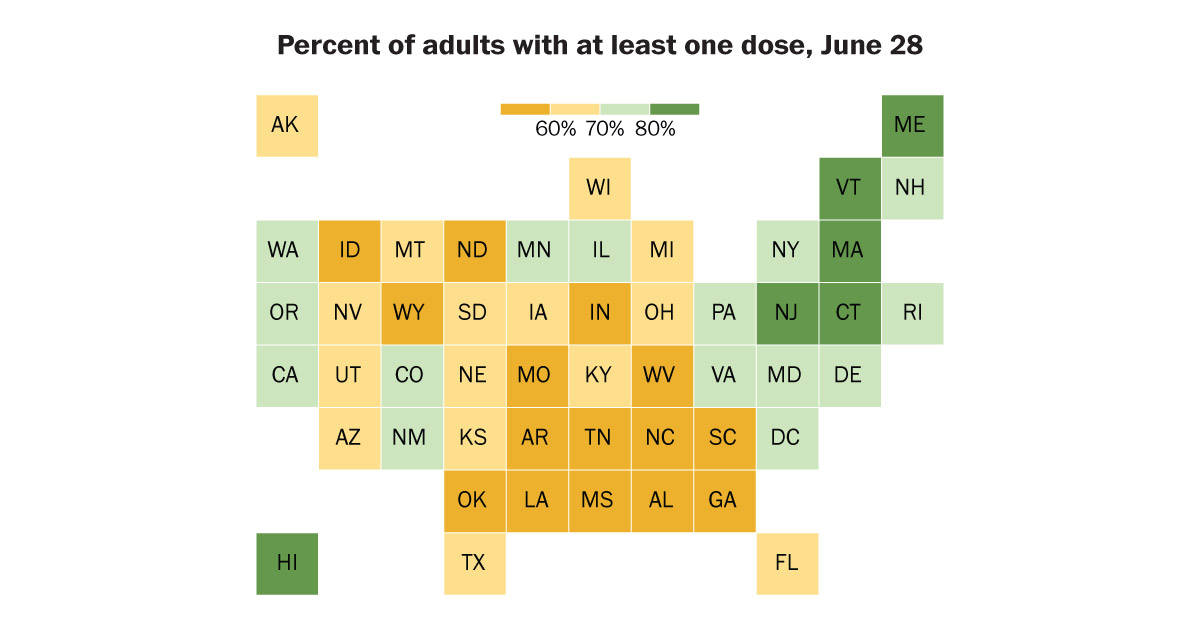 (Graphic: The Washington Post) | But the 70 percent number is important. That's at the low end of what experts say is needed to achieve "herd immunity," in which a large enough portion of the population is vaccinated that the virus can no longer effectively spread. It's become a political division; the states with the lowest vaccination rates are largely red states that voted for former president Donald Trump in the 2020 election, while the states with the highest vaccination rates largely voted for Biden. In that April Washington Post-ABC News poll, there was a clear link between political party and vaccine hesitancy; 40 percent of Republicans and Republican-leaning voters said they probably or definitely would not get vaccinated, while just 10 percent of Democrats and Democratic-leaning voters said the same. The Biden administration has made substantial progress on vaccinations, and in some ways, things are returning to normal, including in Washington. But it won't exactly be the victory celebration Biden hoped for. The Trumps push back against criminal charges in New York In the wake of the 15-count indictment against the Trump Organization and its chief financial officer, former president Donald Trump and two of his sons, both Trump Organization executives, have been loudly criticizing the charges their company faces. The Post's Philip Bump writes that defense attorneys usually don't like their clients speaking publicly in these situations — but with the Trump family, silence was never a likely outcome. Bump writes: Former president Donald Trump — whose actual relationship to the company is somewhat murky at the moment — released a lengthy, Trump-y statement about the indictment of CFO Allen Weisselberg. The first two words in the statement are "Radical Left." This is not surprising, given what we know about Donald Trump and his family. Trump's approach to criticism and investigations has always been denial and fighting back. But now things are a bit different: He and his sons are speaking not in the context of political wrestling but as parties to a criminal allegation. So when Eric Trump says things like "these are employment perks" about the compensation that Weisselberg is alleged to have received under the table — like "a corporate car, which everybody has" — he's not simply pushing back on an anti-Trump narrative, he's potentially making claims on behalf of a criminal defendant that could be cited in court. And we're not entirely sure that this week's round of indictments is where the investigations by Manhattan District Attorney Cyrus Vance (D) and New York Attorney General Leticia James (D) will end. But for now, it's clear the Trumps' public strategy on this is to attack the investigations as politically motivated. | By Cleve R. Wootson Jr. and Scott Clement ● Read more » | | | | 




 Email
Email 


