| Welcome to The Daily 202 newsletter! Tell your friends to sign up here. On this day in 1981, President Reagan announced he would nominate Arizona Judge Sandra Day O'Connor to become the first female justice on the Supreme Court. The seven-deadly-sins phase of coronavirus vaccine promotion seems to have come and gone, with large pockets of America apparently immune to the appeal of a shot at free beer, a dating app "vaccinated" hook-up, free cruises, buckets of cash or Super Bowl tickets if they would only get the jab. And promises of a return to life as it was before the pandemic — a wholesome "summer of joy," as President Biden tweeted last month — didn't keep the White House from falling short of its self-imposed deadline to have 70 percent of adults get at least one shot by July 4. If setting the deadline signaled Biden's single-minded focus on ending the pandemic, missing it highlighted how doing so isn't just a matter of public health but of political attitudes leading many Americans to shrug off the risks of the virus and resist the vaccine. The president, who promised in March to own pandemic-response failures, has been trying to find a way to get shots into the arms of Americans mistrustful of government and of him, personally. So yesterday, Biden promoted a presidential campaign-style drive enlisting local pharmacies, community leaders, family doctors and other trusted figures to extol the vaccine while volunteers go door-to-door to make the case the way they might for a ballot initiative. "We need to go to community by community, neighborhood by neighborhood, and oftentimes, door to door — literally knocking on doors — to get help to the remaining people," the president said. That reflects a consensus among public health officials that local leaders and personal outreach are generally better for vaccination advocacy than superstars and outside "influencers." (Before you get too excited, no, there's no centralized federal list of individuals who have or have not been vaccinated. A White House official told The Daily 202 on the condition of anonymity they use Centers for Disease Control data on vaccination rates in a given geographic area then "knock on every door there.") 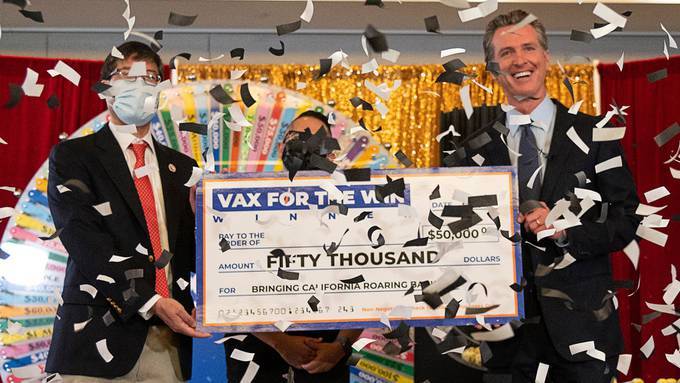 California Gov. Gavin Newsom, right, and State Sen. Richard Pan, left, hold a mock check with UC Davis assistant nurse manager Claudio Alvarado last month as part of a coronavirus vaccine promotion. (Paul Kitagaki Jr./Sacramento Bee) | The other four pillars of the strategy include getting more vaccines to family physicians, more vaccines to pediatricians to reach those 12-18 years old, setting up vaccination stations at workplaces and expanding mobile clinic outreach. These don't amount to a wholly new approach, administration officials said. Those tactics were central to Biden's efforts in June to get more Americans to get inoculated. But Biden also warned unvaccinated Americans endanger their communities, as well as their family and friends, and underlined the emergence of the so-called delta variant should make vaccine skeptics reconsider. "It seems to me that it should cause everybody to think twice," he said, especially "young people who may have thought that they didn't have to be vaccinated, didn't have to worry about it, didn't have to do anything about it up to now." As my colleagues Cleve R. Wootson Jr. and Tyler Pager put it: "Biden's tone was if anything more urgent than previously, as the country faces potential infection spikes in the fall. Standing in front of a backdrop that declared 'We can do this,' Biden sounded alternately like a salesman ('it's never been easier'), a supplicant ('please, please get vaccinated') and an Army recruiter ('it's a patriotic thing to do')." Part of the problem has been Republican resistance to vaccines, which were delivered well ahead of traditional timelines in part because of President Donald Trump's "Operation Warp Speed." 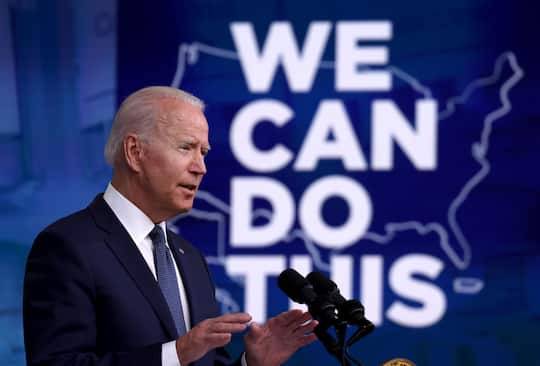 President Biden, speaking at the White House on Tuesday, urges Americans to get vaccinated in the face of the highly contagious delta variant. (Evelyn Hockstein/Reuters) | As my colleagues Dan Balz and Emily Guskin reported over the weekend: "President Biden has earned high marks for his handling of the coronavirus pandemic, but the government's effort to vaccinate as many Americans as possible continues to face hurdles, including resistance among people who identify as Republicans, according to a Washington Post-ABC News poll. … nearly 3 in 10 (29 percent) say they are not likely to get vaccinated, including 20 percent saying they will definitely not do so. The 29 percent who say they are not likely to take a vaccine compares with 24 percent who said that in April. … while 6 percent of Democrats say they aren't likely to get vaccinated, 47 percent of Republicans fall into that camp, with 38 percent of Republicans overall saying they will definitely not get shots against the virus." As if to underline the point, Rep. Marjorie Taylor Greene yesterday compared people carrying out the door-to-door vaccination effort to Nazi party militia. Asked whether Biden might seek to require vaccinations, White House press secretary Jen Psaki told reporters: "I wouldn't predict a federal mandate." "It is ultimately up to individuals, and we certainly recognize that as well," she said. "But we're going to continue to press as hard as we can to use the best practices to continue to increase the vaccination rates around the country." | | | What's happening now Haitian President Jovenel Moïse was assassinated overnight in his home by gunmen. "The assassination came amid escalating political instability, as Moïse, 53, resisted calls from the opposition to step down and armed gangs with hazy allegiances seized control over greater portions of a Caribbean nation terrorized by waves of kidnappings, rapes and killings. Haitian interim prime minister Claude Joseph said in a short statement Wednesday that Moïse was killed by unidentified assailants, some of whom spoke in Spanish and English in a Creole- and French-speaking country, raising the specter of an operation involving foreign mercenaries," Miriam Berger and Anthony Faiola report. Moïse's wife was wounded in the attack, which plunges the Western Hemisphere's poorest nation deeper into a mounting crisis that has seen it edge toward the status of a failed state. To start your day with a full political briefing, sign up for our Power Up newsletter. | | | Lunchtime reads from The Post - "Virginia 'Bible study' group was cover for violent militia plans, prosecutors say," by Rachael Weiner and Spencer Hsu: "After storming the Capitol on Jan. 6, a Northern Virginia man began forming his own militia-like group in the D.C. suburbs and building up a supply of explosives under the guise of a Bible study group, according to federal prosecutors. Fi Duong, 27, appeared in court Friday and was released to home confinement pending trial, over the objections of prosecutors who sought stricter terms. ... An undercover officer with the D.C. police first encountered Duong at the Capitol on Jan. 6, according to the government. ... They stayed in touch, and a week later Duong allegedly told the undercover officer he was part of a 'cloak and dagger' group ... He and others held 'Bible study' where they discussed firearms and other training, according to court documents."
- "From corporate America to conspiracy theory promotion: How a Minnesota man made a career out of anonymously amplifying dark plots," by Shawn Boburg: "Sean G. Turnbull displays many of the hallmarks of a successful upper-middle-class family man, a former film producer and marketing manager for one of the country's largest retail corporations who lives in a well-appointed home in this Minneapolis suburb. Former colleagues describe him as smart, affable and family-oriented. But for more than a decade, the 53-year-old has also pursued a less conventional path: anonymously promoting conspiracy theories about dark forces in American politics on websites and social media accounts in a business he runs out of his home."
- "Survivors of the Surfside building collapse worry: What's next?" by Lori Rozsa and Meryl Kornfield: " 'What do I do? Where do I go? How can I start over?' asked Maria Iliana Monteagudo, 64, who had lived in her condominium on the sixth floor of Champlain South for only seven months. 'My life, all my savings, are gone with that building. Gone, desaparecida.' Like many other survivors, Monteagudo is grateful that she survived. But she and others worry about what's next. Will they have to continue paying off a home that's been demolished, or a car that was crushed? How can they get the power company and the cable company to stop charging for services they can no longer use? It's possible that insurance money or lawsuits will cover some losses, but those are long processes with uncertain outcomes."
| | | … and beyond - "The struggle for power at UNC," by the Assembly's John Drescher: "In a meeting room in the red-brick, century-old Carolina Inn on a sweltering afternoon last week, Gene Davis, vice chair of the UNC-Chapel Hill Board of Trustees, found himself in a precarious spot. The board's chair was recovering from minor surgery ... [And] the board was to decide whether to grant tenure to journalist Nikole Hannah-Jones. ... Six days later ... Hannah-Jones announced her decision: She would not be coming to UNC-Chapel Hill. ... The heir-apparent to the chairmanship, who actively supported tenure for Hannah-Jones, tells the Assembly he is no longer running for the position, as a more confrontational board is expected to take over."
- "Hospitals often charge uninsured people the highest prices, new data show," by the Wall Street Journal's Melanie Evans, Anna Wilde Mathews and Tom McGinty: "Time and time again, the Journal's analysis revealed, cash payers are charged among the highest prices. Patients typically pay these cash prices either because they are uninsured or because some services aren't covered by their health plans. Hospitals generally offer financial aid, but policies vary widely and can be poorly promoted, leaving many uninsured, who are often also low-income, to struggle with unmanageable bills."
| | | At the table Today, we're having lunch with Jane McManus, director of Marist's Center for Sports Communication and a longtime sports columnist now writing at Deadspin. We're talking about significant shifts in the way NCAA athletes may get compensated as a result of a Supreme Court ruling and rules changes that let students make money from their name, image and likeness. Our conversation has been lightly edited for clarity and length. Knox: What is "name, image, and likeness" (NIL) and what's its significance to college athletics? McManus: What it means is that college athletes can finally make money from their name, image and likeness, while playing in college and without risking their eligibility (to play). The history of the NCAA has been one of amateurism, where athletes were supposed to play for the love of the game, for the ability to go to college in terms of tuition or room and board, but not for any revenue or salary. But in the 1980s the schools started to walk back the notion of amateurism when they started to make millions of dollars off these broadcast deals for college football and college basketball for the most part. You have the top coach in the game, Dabo Swinney at Clemson, who makes $8.3 million a year. The schools and the coaches have been making money off of what has become a hollowed-out system of amateurism. And the only adherents to it anymore were college athletes. Knox: How does the recent Supreme Court decision change revenue streams from college sports? McManus: I don't know that it changes, necessarily, revenue streams. What it does do is it allows schools to add additional benefits for students to sweeten the pot when talking to different athletes about what they can expect to receive. You can say 'well, we can also include tuition benefits for a graduate program' or 'we can offer school-related assistance to buy computers to use for classes,' or musical instruments. Ultimately, big picture, what the Supreme Court decision did was frame college sports in the context of commerce. When you read through the decision, it mentions other cases involving dental practices, needle companies, manufacturers. What that case made clear, and what the decision made clear, was there was going to be no amateur-sports carve-out for the NCAA. The Supreme Court was not going to come to the rescue to save the NCAA's business model. It made it such that the NCAA didn't have any choice but to carve out an NIL space for college athletes. Knox: There's some "this is going to destroy college sports" talk out there. How credible is that? McManus: That framing implies that college sports are in a good place right now. And I would counter that what has actually destroyed college sports is the institutional decision to take money and create so much revenue around college sports while not including college athletes in that revenue stream. So if it destroys college sports, it would be destroying a system that has become terribly one-sided. You have an incredibly unequal system that the idea of destroying it is not frightening to a lot of people. There needs to be a new financial model for the revenue-generating NCAA sports, one that takes into account the ability of college athletes to profit off their labor, one that takes into account Title IX, one that takes into account the amount of time that's required to actually get an education at these institutions. So I think that ultimately, this could be something that creates a much sounder economic system that benefits more of the people contributing. Knox: Another argument I've run into is that this will be great for the stars but will mean little for, say, the backup cornerback. What do you think? McManus: It'll probably mean more for the stars. But you just had a booster in Miami who wants to pay $500 a month to every member of the college football team there so that they can endorse his franchise of MMA [mixed martial arts] gyms. So that's going to benefit — potentially, if it's approved — every single member of that team. And I wouldn't be surprised if there weren't more deals like that, that were team-focused and in such a way that different players would be able to — especially in the revenue-generating sports — that different players would have access to the benefits that come with that. That might be true more likely in, like, volleyball. For example, there's a volleyball player in Nebraska named Lexi Sun. And she's launched an apparel line based off of her name, "Sunny." She's going to be able to make money off that. Now, is every member of the volleyball team going to create some sort of revenue-generating opportunity like that? Probably not. But the way that it's structured now doesn't eliminate anybody from making money off their name, image and likeness. It's not just the top players, but it's also the most creative players, the most economically motivated players who are going to be able to create these opportunities. Knox: Even though I found it on Twitter, this idea seems good: "Schools should start selling jerseys of former stars and the players should get their due cut." What's your assessment? McManus: I think that's a great idea — like wearing a Joe Namath jersey to a Jets game. At the same time, it does make you realize that all of those players who are going to be getting residuals off that, if it ever comes to be, it would be a pittance compared to what they could have made had this opportunity been available to them when they were actually playing. | | | The Biden agenda Pressure grows on Biden to curb ransomware attacks. - "A massive ransomware attack last week has intensified pressure on the Biden administration to demonstrate it is working to curb the threat, with top national security officials set to brief the president Wednesday on how the government can counter the costly and increasingly brazen assaults by Russia-based hackers," Ellen Nakashima reports. "While intelligence officials have not publicly attributed the latest attack, a group known as REvil, which U.S. officials say privately operates largely from Russia, has taken responsibility for striking up to 1,500 companies in the United States, Europe and Asia."
- "White House officials next week are to resume talks with Russian officials about the threat, a dialogue that began after President Biden warned Russian President Vladimir Putin that the United States would hold Moscow responsible for cyberattacks originating from Russia even if they cannot be directly linked to the Kremlin."
- "Wednesday's briefing will include top officials from the departments of State, Justice, Homeland Security and the intelligence community. The White House hopes to build a multifaceted strategy focused on hardening cyberdefenses, diplomatic outreach to American allies and potentially targeted offensive responses, including the disruption of computer infrastructure used by hackers, officials said."
States and cities are scrambling to spend a $350 billion windfall. - "The stimulus package that President Biden signed into law in March was intended to stabilize state and city finances drained by the coronavirus crisis, providing $350 billion to alleviate the pandemic's effect, with few restrictions on how the money could be used," the New York Times's Glenn Thrush and Alan Rappeport report. "Three months after its passage, cash is starting to flow — $194 billion so far, according to the Treasury Department — and officials are devoting funds to a range of efforts, including keeping public service workers on the payroll, helping the fishing industry, improving broadband access and aiding the homeless."
Biden is heading to Illinois today to pitch his proposed spending on social programs. - "Biden plans to travel Wednesday to Crystal Lake, Ill., a conservative area in a liberal state, to pitch his plans for boosting spending on education, child care and health care in a bill that the White House is angling to pass with the support of only Democrats," John Wagner reports.
| | | Quote of the day "Honestly, right now, for the next 18 months, our job is to do everything we can to slow all of that down to get to December of 2022, and then get in there and lead," Rep. Chip Roy (R-Tex.) is heard saying in a recently surfaced video about House Republicans as he discusses transportation and infrastructure proposals as an example of bills he won't vote for. | | | More on the pandemic From Wuhan to Paris to Milan, the search for "patient zero" continues. - "On Dec. 8, 2019, the accountant began to feel ill. He did not frequent Wuhan's Huanan seafood market, he would later tell World Health Organization experts investigating the coronavirus's origin," Eva Dou, Lyric Li, Chico Harlan and Rick Noack report. "He hadn't traveled outside of Wuhan in the days before his illness. If someone caught coronavirus by crawling in a bat cave, it wasn't him."
- "In the search for the pandemic's origin, the trail officially ends with Patient S01, China's first confirmed covid-19 case, whose sparse details were outlined in the joint WHO-China report released in March. He was not a seafood vendor, bat hunter or lab scientist. He was an accountant surnamed Chen who shopped at a very large supermarket."
Protesters who shut down a Utah school board meeting by yelling "No more masks!" are now facing charges. - "The commotion derailed the event, and now 11 people have been charged with disorderly conduct and disrupting a public meeting, Ben Horsley, a spokesman for Granite School District in Salt Lake City, said," Gina Harkins reports. "The misdemeanor charges could mean up to a year in county jail and a $2,500 fine. Many of the people charged weren't associated with the school district, Horsley said, which slowed the investigation."
All Marylanders who died of coronavirus last month were unvaccinated. - "The numbers come as experts try to persuade the vaccine-hesitant to get shots," Jenna Portnoy and Ovetta Wiggins report. "Across the region, the seven-day average of new infections was 256 on Tuesday, a number which has ticked up over the past three weeks, but is down from 331 one month ago, state and D.C. data show. Hospitalizations and deaths are also down."
Among unvaccinated Americans, 60 percent believe U.S. officials are exaggerating the delta variant's risk. - That is compared with 18 percent who say they are describing it accurately; 64 percent of vaccinated Americans say officials are accurately describing the strain, per a new Post-ABC News poll.
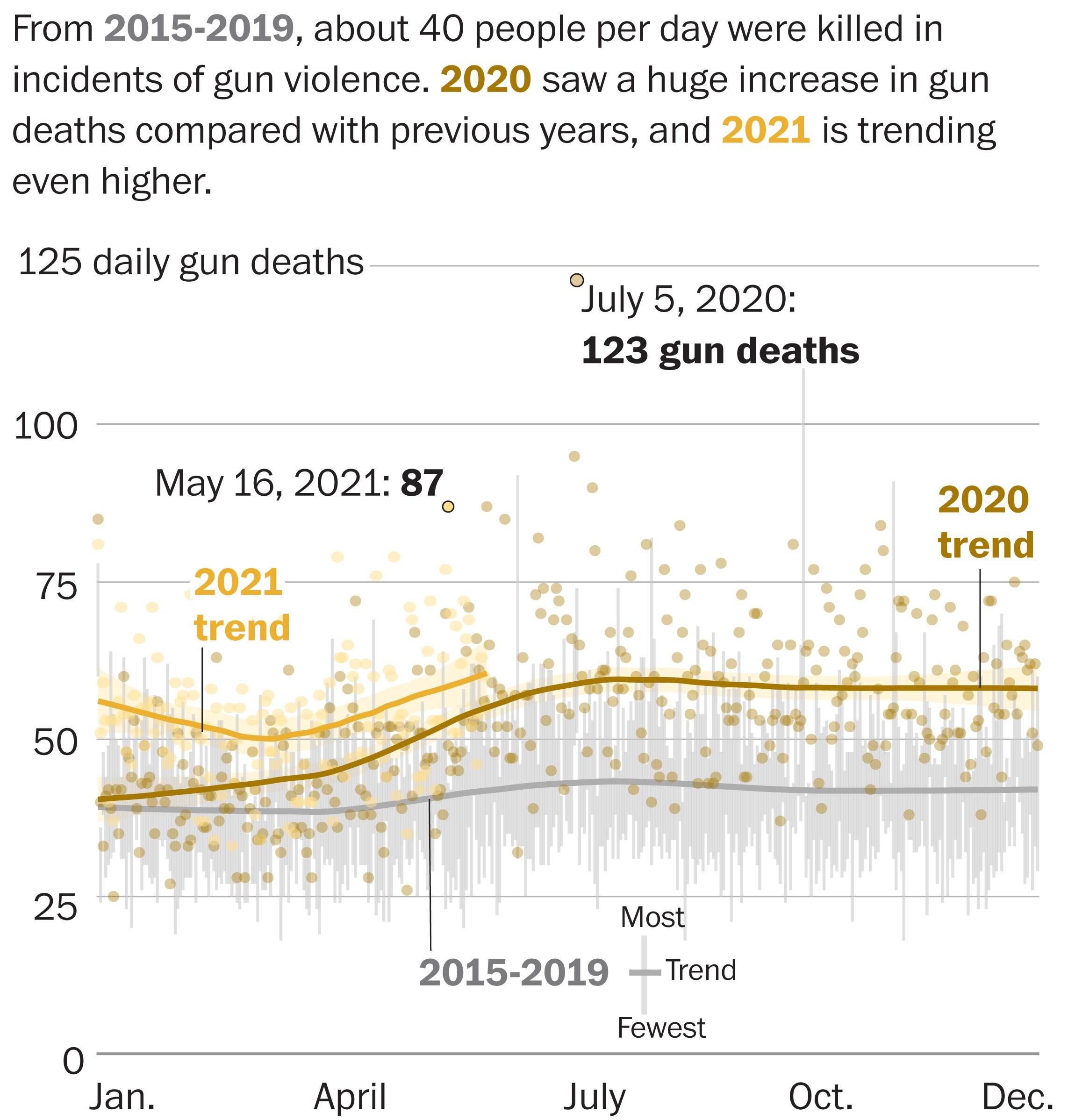
| | | Hot on the left Brooklyn Borough President Eric Adams, a retired police officer, is the projected winner of New York's Democratic mayoral primary, bringing to a close a chaotic election complicated by a debacle in the results' tallying. "Adams has held first place since the June 22 primary, but his lead narrowed considerably as ranked-choice ballots were analyzed, eliminating less-popular candidates and distributing their votes to a voter's second, third or fourth pick. The projection by the Associated Press came after updated results from absentee ballots were released Tuesday," Colby Itkowitz reports. "'While there are still some very small amounts of votes to be counted, the results are clear: an historic, diverse, five-borough coalition led by working-class New Yorkers has led us to victory in the Democratic primary for Mayor of New York City,' Adams said in a statement. ... "New York's new ranked-choice system allowed former sanitation commissioner Kathryn Garcia and civil rights lawyer Maya Wiley to chip away at Adams's lead. Under the rules, it would have been possible for them to overcome his margin had the absentee ballots broken their way. But after more than 100,000 absentee ballots were counted, Adams kept his lead, besting Garcia by a little more than 8,000 votes, or 1 percent of the vote, out of nearly 1 million cast." | Adams celebrated on Twitter: | 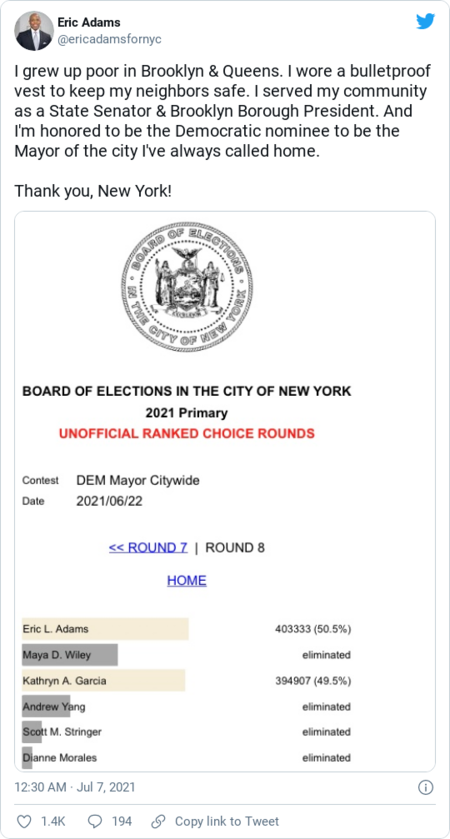 | | | | | | Hot on the right Rep. Mo Brooks (R-Ala.) says he can't be sued for citing the Capitol riot because he's a federal employee. "Brooks said in a motion Friday that he should be dropped as a defendant or represented by the Justice Department in the case, filed March 5 by Rep. Eric Swalwell (D-Calif.). The lawsuit names former president Donald Trump, Brooks, Donald Trump Jr. and Rudolph W. Giuliani and seeks damages in connection with their statements to a crowd near the White House that the former president told to march to the Capitol," Spencer Hsu reports. "Brooks told people in the crowd that they were victims of a historic theft and asked whether they were ready to sacrifice their lives for their country. ... In his filing Friday, Brooks invoked a 1988 law that protects federal employees from personal liability while acting within the scope of their office or employment. He argued that his speech, tweets and related conduct 'were indisputably made in the context of and preparation for' a joint session of Congress on Jan. 6 to confirm the results of the presidential election." | | | Gun violence in 2021, visualized By almost every measure, 2021 has already been a terrible year for gun violence. Many fear it will get worse, Reis Thebault, Joe Fox and Andrew Ba Tran report. "Through the first five months of 2021, gunfire killed more than 8,100 people in the United States, about 54 lives lost per day, according to a Washington Post analysis of data from the Gun Violence Archive, a nonprofit research organization. That's 14 more deaths per day than the average toll during the same period of the previous six years. This year, the number of casualties, along with the overall number of shootings that have killed or injured at least one person, exceeds those of the first five months of 2020, which finished as the deadliest year of gun violence in at least two decades." | | | Today in Washington Biden is heading to Crystal Lake, Ill., where he will tour McHenry County College and discuss how his agenda aims to help students and educators. He will deliver remarks at 2:05 p.m. | | | In closing | And the U.S. women's soccer team continues impressing: |  | | | | | | |


 Email
Email