| Welcome to The Daily 202 newsletter! Tell your friends to sign up here. Joyeux Anniversaire, France! Progressives eventually rallied behind President Biden during the 2020 campaign as their best hope of beating Donald Trump. They stayed in line to pass his first coronavirus relief bill. They haven't rebelled against any of his nominees. And so far, they haven't deserted the White House in the fight over infrastructure. But Democratic unity showed fissures yesterday after Biden's thumping voting-rights speech, which left many progressives hungry for more action. As Republicans push coast-to-coast to adopt election restrictions, the left wants Biden to signal support for ending the filibuster or at least carving out an exception for Democratic voting proposals. Biden needs Democrats to stay united if he is to have any hope of driving his agenda through the narrowly divided Congress. One test will be an infrastructure spending proposal announced last night, which comes in at a lower price tag than many on the left would like to expand America's social safety net. But progressives mainly focused their ire yesterday on Biden's approach to elections. 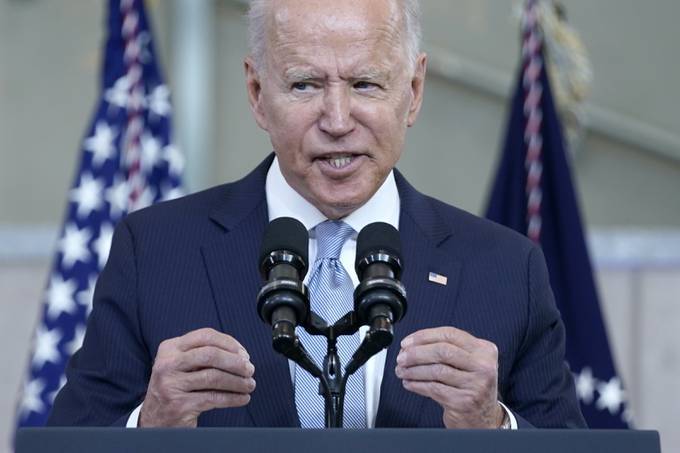 President Biden delivers a speech on voting rights at the National Constitution Center in Philadelphia. (Evan Vucci/AP) | "On voting rights, President Joe Biden is failing to meet the moment," said Adam Jentleson, who worked for former Democratic Senate Majority Leader Harry Reid of Nevada and now heads the Battle Born Collective, a progressive group. The problem isn't how Biden describes the threat he perceives from Republican efforts to roll back electoral practices they blame for their 2020 White House loss, partly by empowering their partisans to oversee and overrule the results. It's that he hasn't sided with the left in calling for an end, or a significant change, to the parliamentary tactic thwarting Democratic legislation in the 50-50 Senate — the filibuster, which requires 60 votes to get bills to passage. "There is a wide gap between his rhetoric and his leadership," said Jentleson. "He described the conservative assault on our democracy as an existential threat, yet he refused to endorse the obvious solution, which is to pass voting rights legislation and reform the filibuster to do so, if necessary." Adam is hardly alone. My colleagues Matt Viser, Seung Min Kim, and Marianna Sotomayor report: "Biden last week met with civil rights leaders at the White House for what the Rev. Al Sharpton described afterward as 'a very candid, no-holds-barred meeting.' 'Last Thursday, when we met with him, we said we wanted him to use his bully pulpit," Sharpton said. 'He used it today.' After the speech, Sharpton said he pulled Biden aside and urged him to drop his reluctance and start calling for changes to the filibuster. 'I said on the side to him, I'm still waiting on the filibuster. He said, 'We're still working through our position on that.' So he's noncommittal," Sharpton said. 'You've got to do a workaround or change the filibuster. Otherwise, all of what he said, and we've been saying, is at risk here.' … One of the more vocal critics — Rep. Mondaire Jones (D-N.Y.) — said he believes Biden should be doing more now to ensure the issue of voting rights is addressed this year before redistricting gets fully underway and ultimately, along with the loss of minority voters, prevents Democrats from possibly holding the majority over the next decade. 'It's like everyone understands that the path for Republicans being in control of the federal government again is voter suppression except for the one person who has the influence to do something about it right now in this moment,' Jones said in an interview." After Biden's speech, House Majority Whip James E. Clyburn (D-S.C.) — a close ally — renewed his appeals to Biden to embrace creating an exception to the filibuster. And the Rev. William J. Barber II, co-chair of the progressive Poor People's Campaign, pressed Biden not just to sign on to ending the filibuster but campaign in favor of doing so on the road. Lt. Gov. John Fetterman (D-Pa.), who is running for Senate, said Biden would not have needed "to give a speech on voting rights if Democrats in DC just voted like Democrats" by abolishing the filibuster. When it comes to transforming the filibuster in order to pass two sweeping Democratic elections bills, White House aides point to unforgiving Senate math: They don't have the votes, partly due to opposition from Joe Manchin III (D-W.Va.) and Kyrsten Sinema (D-Ariz.). "There's no magic solution to convincing Manchin and Sinema, but there wasn't a magic solution for LBJ to pass civil rights or for [Barack] Obama, Reid and [House Speaker Nancy] Pelosi to pass health care," countered Jentleson. "In both cases, what you had was a POTUS who was willing to spend every day working every angle, in close coordination with congressional leaders who knew he had their back, and would deploy whatever resources the WH has available to them to deliver a positive outcome. That is not currently the case on democracy reform." Marc Morial, head of the National Urban League, told The Daily 202 the civil rights community wants the voting rights bills to pass "by whatever means necessary, so if it requires a filibuster exception, so be it, and if 10 Republican votes can be secured for it, so be it." Morial noted the filibuster was not in the Constitution — "it's just a Senate rule. It's like my house rules for my kids. We've got some rules. I might change them tomorrow" — and described the conversation about a "carve out" as "a fluid situation." "We strongly support whatever it takes to pass voting reform," Morial said. "And I don't think you've heard the last from the president on this. I think today was the beginning." | | | Quote of the day "This is the most significant piece of legislation passed since the Great Depression, and I'm delighted to be part of having helped to put it together," Sen. Bernie Sanders (I-Vt.), chair of the Senate's Budget Committee, told reporters about Democrats' $3.5 trillion reconciliation package. "A lot of work remains." | | | What's happening now Trump Organization CFO Allen Weisselberg resigned from his positions at dozens of the company's subsidiaries late last month — several days before he was indicted on charges of tax fraud and grand larceny, David Fahrenthold and Shayna Jacobs report. "'Effective immediately, I, Allen Weisselberg, resign from each and every office and position that I hold' in the subsidiaries, Weisselberg wrote in the letter, dated June 25. What followed was a two-page list. The Trump Organization submitted the letter to New Jersey liquor regulators last week, asking to remove Weisselberg's name from the liquor licenses for two golf courses. New Jersey officials released it to The Post on Tuesday." To start your day with a full political briefing, sign up for our Power Up newsletter. | | | Lunchtime reads from The Post - "How Tucker Carlson became the voice of White grievance," by Michael Kranish: "This account of Carlson's years-long focus on racial grievance, and his rise to the top of the conservative media ecosystem, is based on a review of his books, broadcasts and writings over nearly three decades, as well as interviews with current and former associates, subjects of his on-air attacks and others who have observed his career. What emerges is a portrait of an ambitious television personality who came of age in privilege — having grown up in an upper-class enclave and attended private schools — but who, by his own telling, is a victim. ... Several people who have interacted with him over the years say they don't know what he really believes, but they say they are increasingly troubled by his influence as what one of his former mentors described as a 'very talented demagogue.' "
- "Drug overdose deaths soared to a record 93,000 last year," by Lenny Bernstein and Joel Achenbach: "The death toll jumped by more than 21,000, or nearly 30 percent, from 2019, according to provisional data released by the National Center for Health Statistics, eclipsing the record set that year. The increase came as no surprise to addiction specialists, drug counselors and policy experts who have watched the steady rise in deaths throughout the pandemic. But that did not make the statistics any less horrifying."
- "Inside the secret plan for the Texas Democratic exodus: A phone tree, a scramble to pack and a politically perilous trip," by Amy Gardner, Eva Ruth Moravec, Dan Roseznweig-Ziff and Nicole Asbury: "They activated the plan with a phone tree late Sunday: Pack your bags — and make sure they weigh no more than 45 pounds. Be ready to leave Austin at noon tomorrow. We'll tell you then where we're going. The Democrats in the Texas House of Representatives had been preparing for this moment for days. Gov. Greg Abbott (R) had called a special session last week to complete the year's unfinished business, including the passage of far-reaching legislation restricting voting access that had failed when House Democrats staged a walkout in May. They were ready to do the same this time around ... Dozens of Democratic lawmakers said goodbye to young children and aging parents, made arrangements to leave their homes and their jobs, potentially for weeks — and drew sharp rebukes for walking away from their responsibilities in the Texas legislature. They said they had no other recourse, and they admitted that they have no endgame, as Abbott promised to keep calling special sessions, over and over, until the election legislation has its day."
| | | … and beyond - "After Surfside, calls for building oversight grow," by the American Prospect's Amelia Pollard: "The generation of condos that erupted at that time is now collectively turning 40 — an age when many high-rise buildings start to show serious signs of wear. The decade was notorious for lax building codes, with Ronald Reagan's own Housing Department mired in scandal ... And with the decade's political winds dominated by deregulation, the self-governance of condos became popular. State building codes in an era of deregulation also were lacking."
| | | At the table Today we're lunching with Abraham Jiménez Enoa, a Cuban reporter based in Havana and Post Opinión columnist who's been covering the nation's protests. This interview, done in Spanish, has been translated and lightly edited for clarity and length. Alfaro: Why are these protests happening now? How is this different than anything you've seen before in Cuba? Jiménez Enoa: The first thing that must be said is that, in the 62 years that this dictatorship has been in place, there's never been protests with the magnitude of Sunday's, which in a way expanded to Monday and Tuesday in smaller explosions. On Sunday, the protests happened in 50 places. At a national level, that had never happened. In the past, the few times people showed up to the streets, it had always been in isolated places. But at a national level, never. So you can't see this protest as a logical progression. This is the mother of all protests in Cuba, and it happened, on one hand, because people are fed up with the lack of rights in this country, combined with the grave situation that there is no medicine in Cuba, no food. All this was exacerbated by the pandemic. The day to day is too hard. Besides, there are electric blackouts often. And then there's the repression, not only of the opposition, or journalists, but of the citizens in general. So what else can Cubans do but go out to the streets. That's exactly what's happening. There's this phrase — I don't remember where I got it from — but it goes: "Nos quitaron tantas cosas, que nos quitaron hasta el miedo." ("They took so many things from us that they even took fear away.") Alfaro: How did a demonstration of this magnitude start? Who planned something this big? Jiménez Eno: Therein lies the genesis of all this — the protests happened spontaneously, there wasn't a political movement that organized them, or a leader. Suddenly, demonstrations exploded in two spots, far away from each other. And people there started recording what was happening. They started sharing. That's where I open a parenthesis: All this was shared on the Internet. Each day, more Cubans are online, and this has changed the population. You can't explain what is happening in Cuba right now without explaining how the Internet has changed things here. So people went out to the streets, and they started recording each other, and people in other places saw these images and identified with them. And that's how the entire country stood up. Alfaro: As someone who's on the ground and who knows the history and context, what do you think these protests' impact will be, especially when you consider the international reaction? Jiménez Enoa: It's hard to tell, because, again, this has never happened before. I do think, because of the aggressive and violent way in which the regime responded, that massive protests won't be able to continue, even if they're still happening at a smaller scale outside Havana. But the thing is, Sunday changed everything. People now know there is no other way to bring change, that they have to put their bodies on the line for it, that they can go out on the streets. And they know what the regime is capable of. But I can't tell you that this rebellion and social explosion will end the dictatorship. I don't believe it, because this is an unarmed population facing a regime equipped with riot squads, ferocious dogs and armed officials. The protests have left so many dead. So, I don't think the dictatorship will end. It could. Hopefully I'm wrong. But I don' think that'll happen. I do believe that, once a protest like this happens, a bigger one follows. Last year, in November, a smaller protest drew hundreds. But hundreds is not what we saw on the streets on Sunday. That crowd, you can't quantify — mainly because there's been a technological shutdown in the country — but it is clear that thousands showed up, probably more than a million. We don't know the number of people injured, dead, missing, detained. We don't know, because the regime's first move was shutting down online access, because they know their number one rival is the Internet. Alfaro: What do you make of the U.S. and international reaction to what's happening in Cuba? Particularly the comparisons drawn between these protests and other Latin American uprisings? Jiménez Enoa: The difference between Cuba and all the other Latin American nations is that people in the other countries rise in protest all the time. But in Cuba, over the last 60 years, no one had marched like this. That speaks to the difference between the Cuban dictatorship and the rest of Latin America. What just happened in Cuba is, on one hand, is a symptom of the weakening of the regime and, on the other, of the desire Cubans have to change things. I know that, in the U.S., there's this massive community of Cuban Americans, in Florida mainly, the Marco Rubios and co., who have tried to move the matrix of intervention and such. I don't think that's the way out, because we know the U.S. doesn't just go intervene in a country and then leave. They go and they stay, as they've done all over the world. I know that what happens here has repercussions in the U.S., particularly during election time. We know Florida is fundamental. Biden and his administration have said Cuba isn't the priority, he's come out with a very diplomatic statement, saying it is important that Cubans express themselves and demonstrate and that liberties must be respected. But I believe that, in a sense, he should be more proactive. He has to figure out what he's going to do with Trump's legacy in Cuba. Before he was elected, he said he'd go back to Obama's doctrine. And he hasn't done that at all. Alfaro: Finally, as you venture into another day of coverage, what's the energy there now? Are people optimistic? Are they afraid? Jiménez Enoa: It's a mix of all that. Right now in Havana, where I am, it is more quiet. This is where the regime is, where there's a stronger police force and military presence. One goes out to the streets and you feel fear. But the other towns have been able to continue demonstrating, even if it is at a smaller scale. On Sunday, I saw so many powerful scenes. I saw the elderly on the streets, with plates on their hands, begging for food. Children and their parents. People with injuries, so many injuries. I saw the face of the repression. The image that stayed with me is that of David against Goliath. Someone who wants to get rid of a bully, but who doesn't have the physical strength to do that. | | | On the Hill Biden heads to Capitol Hill today in an attempt to rally Senate Democrats around his spending plans. - Biden's efforts will focus on his two separate but intertwined economic packages, including the newly announced $3.5 trillion package that is expected ot include new spending for federal health, education and safety-net programs, Tony Romm, Seung Min Kim and Mike DeBonis report.
- "One key moderate, Sen. Kyrsten Sinema (D-Ariz.), was still weighing the legislation. 'Kyrsten is committed to working with her colleagues and the administration on ways to create jobs and expand economic opportunities in Arizona and communities across the country,' Sinema spokesman John LaBombard said Wednesday. 'Those conversations are ongoing, and she will give careful consideration to any idea that can strengthen Arizona's economy and help Arizona families get ahead.'"
Blunt talk: Senate Majority Leader Chuck Schumer (D-N.Y.) launched a long-shot bid for legal weed. - "The measure floated by the New York Democrat — along with Sens. Cory Booker (D-N.J.) and Ron Wyden (D-Ore.) — proposes removing federal penalties on cannabis, expunging nonviolent federal cannabis-related criminal records and letting states decide if or how to legalize the drug," Politico's Natalie Fertig report. "Public opinion suggests there's widespread bipartisan support for liberalizing cannabis laws, but that shift hasn't translated to the Senate: Schumer has several reluctant members within his own caucus and will have to scrounge up at least 10 Republican votes for the legislation during an already chaotic Senate calendar filled with Biden administration priorities on infrastructure, police accountability and education."
- "Schumer would also need to corner President Joe Biden — who has supported decriminalizing marijuana but not legalizing it — to sign the bill. Still, he's projected confidence about his odds in the past."
Tensions surface as House incumbents plan a defense against far-left primary challengers. - Rep. Hakeem Jeffries (D-N.Y.), along with Problem Solvers Caucus co-chair Josh Gottheimer (D-N.J.) and New Democrat Coalition co-chair Terri A. Sewell (D-Ala.), has created the Team Blue PAC, which will raise money to defend incumbents against primary challengers in congressional races, Michael Scherer and David Weigel report. The effort sets up potential showdowns with a band of younger and more liberal House members, like Rep. Alexandria Ocasio-Cortez (D-N.Y.).
| | | The new world order George W. Bush said ending the U.S. military in Afghanistan was a mistake. - "You know, I think it is," Bush told German international broadcaster Deutsche Well. "Yeah, because I think the consequences are going to be unbelievably bad. And I'm sad. Laura and I spent a lot of time with Afghan women. And they're scared."
- "I think about all the interpreters and people that helped — not only U.S. troops, but NATO troops — and they're just, it seems like they're just going to be left behind to be slaughtered by these very brutal people," Bush added. "And it breaks my heart."
In Haiti, civic leaders hope that the country can find a way to reimagine itself for a better future. - "Teachers and religious leaders, lawyers and farmers, they are veterans of crisis who thought they had seen it all in recent years, looking on in outrage as the democracy they were fighting for was whittled away, gutted under the watch of President Jovenel Moïse. Then the gunmen struck, and a country that had been adrift now felt rudderless," the Times's Catherine Porter reports.
- "When the United States, long an outsize player in the country, sent a delegation here over the weekend, it met with the three politicians vying for power. But grass-roots activists working to improve things on the ground say they need to be part of the discussion. Some took heart from President Biden's call Monday for consensus. 'Haiti's political leaders need to come together for the good of the country,' Mr. Biden said. But the civic leaders meeting on Tuesday, known as the Commission, acknowledged that they needed more time to come up with a broader consensus about where the country needs to go."
China is set to launch the world's largest emissions-trading program. - The system "would create the world's largest carbon market and double the share of global emissions covered under such programs," the Wall Street Journal's Sha Hua reports.
- "The carbon market will help the country lower greenhouse-gas emissions and achieve its goal of reaching peak emissions before 2030 and carbon neutrality, or net zero emissions, by 2060, officials said at a news conference Wednesday. China is the world's largest carbon emitter."
Europe rolled out a vision for a carbonless future, but big obstacles loom. - "The political importance of the effort, pushed by the European Commission, the E.U.'s bureaucracy, is without doubt. It puts Brussels in the forefront of the world's efforts to decarbonize and reach the goal of a carbon-neutral economy by 2050. To force the issue, Brussels has committed to reducing its emissions of greenhouse gases 55 percent by 2030 compared with 1990 levels," the Times's Steven Erlanger reports.
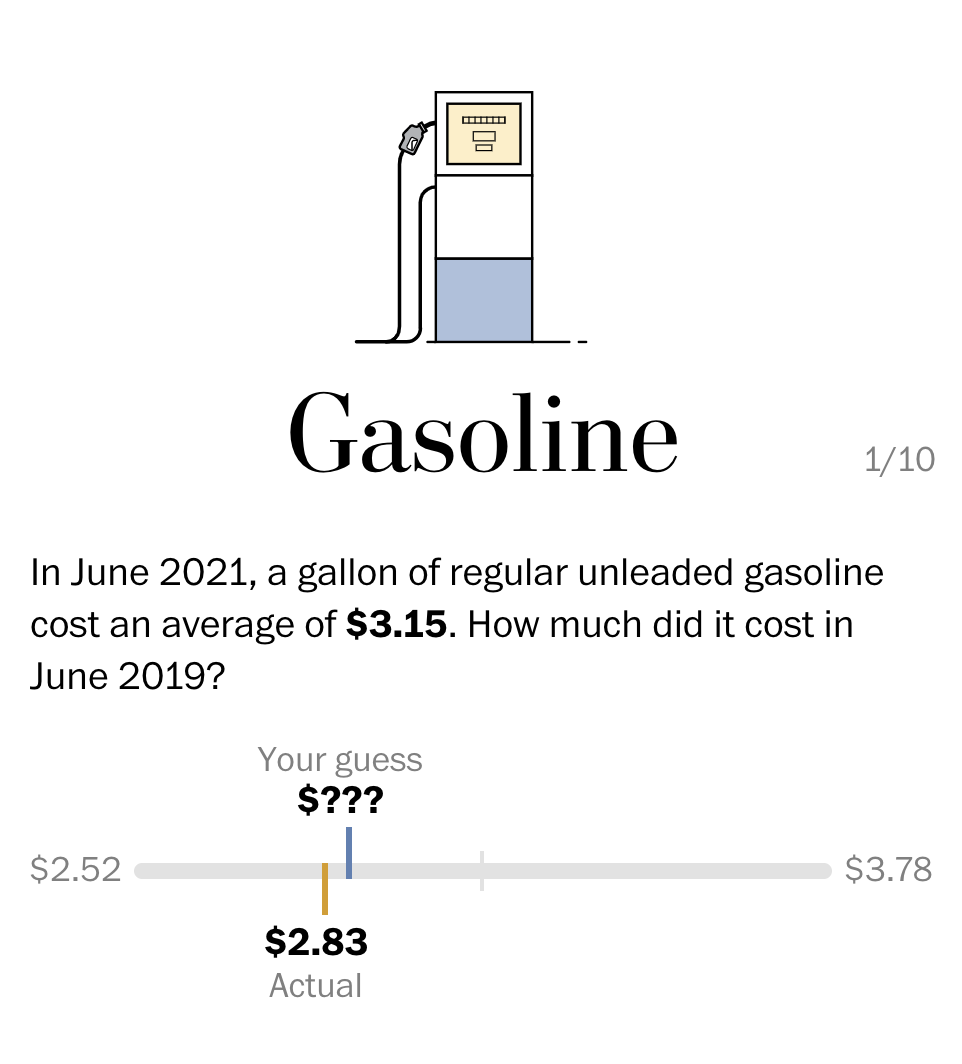
| | | Hot on the left Maine became the first state to shift costs of recycling from taxpayers to companies. Gov. Janet Mills (D) signed a bill yesterday establishing an "extended producer responsibility" program, which requires companies that create consumer packaging to pay for the costs of recycling it, Frances Stead Sellers reports. | | | Hot on the right Tennessee abandoned vaccine outreach to minors, and not just for covid-19. From the Tennessean's Brett Kelman: "The Tennessee Department of Health will halt all adolescent vaccine outreach – not just for coronavirus, but all diseases — amid pressure from Republican state lawmakers ... If the health department must issue any information about vaccines, staff are instructed to strip the agency logo off the documents. The health department will also stop all COVID-19 vaccine events on school property, despite holding at least one such event this month." | | | Quizzed on inflation, visualized Overall prices are up 6.1% since June 2019, but that isn't the case for every item. Expectations about inflation don't always match the evidence. Take this quiz to see for yourself how the prices of 10 everyday items have changed over the past two years. | | | Today in Washington Biden will have lunch with the Senate Democratic caucus today at 12:45 p.m. At 3 p.m., he will meet with a bipartisan group of governors and mayors to discuss his infrastructure plan along with Vice President Harris, Secretary of Commerce Gina Raimondo and Labor Secretary Marty Walsh. | | | In closing | Democratic Rep. Eleanor Holmes Norton, D.C.'s House representative, unveiled a 51-star flag during an interview with Stephen Colbert:  "When you add one star, you can't tell the difference," she said of the tweaked U.S. flag. "The only people who can tell the difference are the people who live in that state and I can tell you, we can't wait to tell the difference." | | | | |


 Email
Email