Your summer romance is waiting... 💕

 
 From steamy subway scenes to Bromance Book Clubs to Victorian love triangles —
More for your TBR list Fun & quizzes 
Read this if: You want a book so good, it makes you mad. 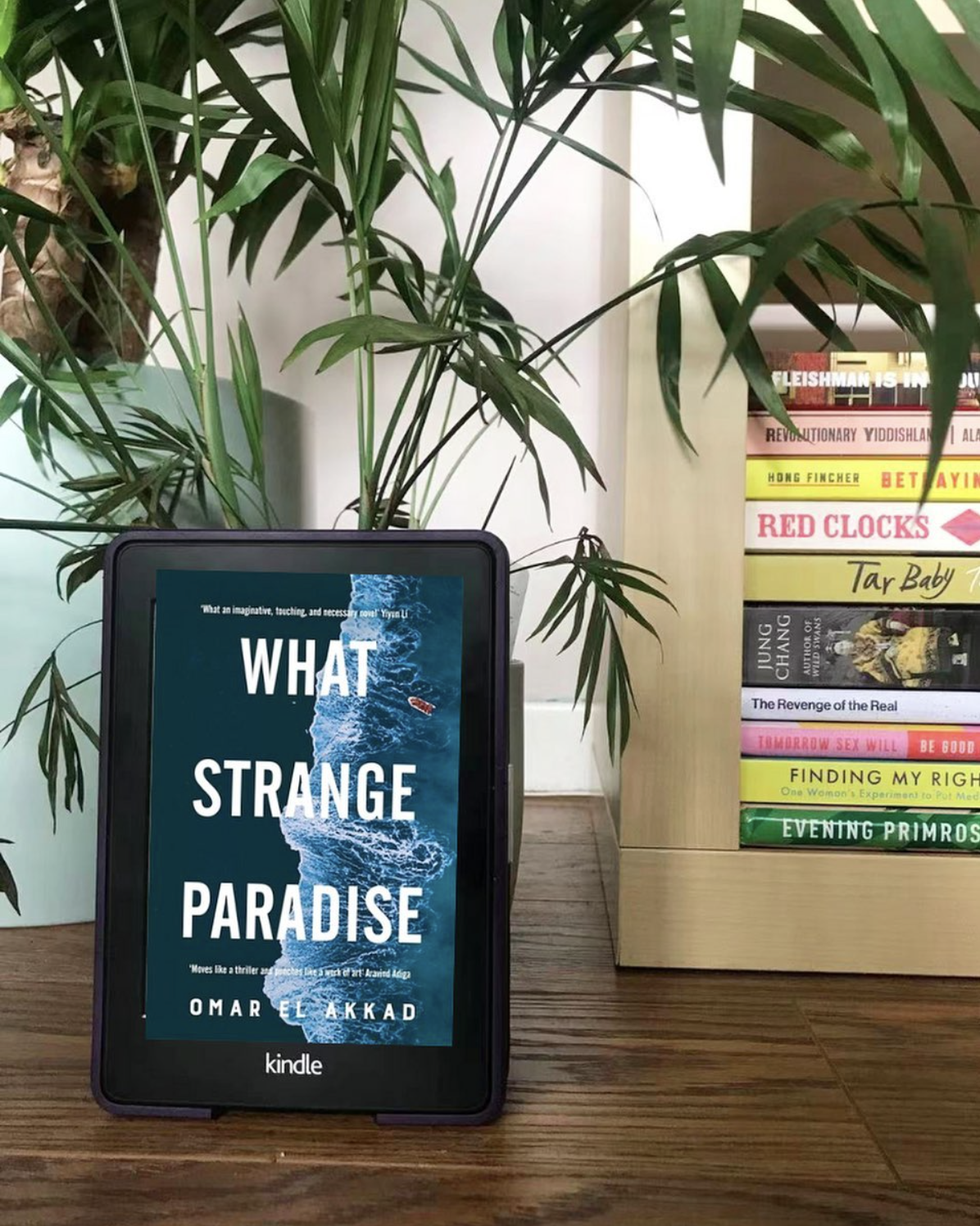 Credit: @books4chess What Strange Paradise by Omar El Akkad
There are a few writers I admire so much, whose work I love so much, that it makes me mad. Those books are rare: ones where I am furious about how good the writing is, how gracefully the plot presents itself on the page, and how delicate I feel after finishing the last page. Really, it's quite the hat trick — writing fiction that feels so vivid, and that affects the reader so intensely and personally feels like witchcraft.
These days, I feel confident in saying that no one makes me angier in this regard than Omar El Akkad. First he did it with 2017's American War, an expansive and impressive novel about a dystopian future where the country is facing its second Civil War. This summer, El Akkad is releasing his second book, What Strange Paradise, a novel somehow even better than his first. I finished reading it a month ago; I'm still recovering.
What Strange Paradise follows a 9-year-old Syrian boy, Amir, who has washed up as the sole survivor of a refugee boat that sank near a small island. He's rescued by Vӓnna, a local teenage girl, who seems to feel her own kind of displacement even at home. The chapters alternate between Amir's life before getting to the island and the journey he and Vӓnna take towards safety. In a little more than 250 pages, El Akkad manages to write a book about family, masculinity, migration, language, humanity (or a lack thereof), and innocence. Every word feels essential, and every chapter is quietly devastating until you reach the novel's conclusion, a chapter that I'm confident every reader will remember for the rest of their lives. The story is brutal but compassionate, one that humanizes migrants so often stripped of their humanity as soon as they become "migrants."
El Akkad is infuriating because his prose is perfect, and his characters are more vivid than some people I know in real life. It's devastating and, at times, hopeful, and even when his characters act without compassion, El Akkad always rights the ship back towards tenderness. What Strange Paradise cements El Akkad as one of the best writers alive today: clairvoyant, heartbreaking, and exceptional. Get your copy now. —Scaachi Koul Read this if: You don't plan on sleeping tonight 😱.  Credit: BuzzFeed News; Algonquin Books Read an excerpt from Dean Jobb's The Case of the Murderous Dr. Cream.
A man clad in a mackintosh to outsmart the day's showers, a top hat covering his bald head, turned up at the door of a townhouse at 103 Lambeth Palace Road. His name was Thomas Neill, he told the landlady, and he was in search of lodgings. He took the upper-floor room at the back. It was October 7, 1891, and Cream was back in Lambeth, one of London's poorest, dirtiest, and most crime-ridden neighborhoods. It was also considered the "most lurid and beastly" of the city's red-light districts. The neighborhood surrounding Waterloo Station, a magnet for streetwalkers, became known as Whoreterloo. Brickwork supports for the station's elevated tracks offered secluded spots where business could be transacted—the succession of "dark, damp arches," one resident complained, "encouraged the more disreputable of the population."
"The brothels are many of the perfect hells," Asker added. "Shrieks and cries, 'murder' and so on, frequently are heard." Prostitutes were described as "unfortunates" in the press, but some of the women working in the brothels, propositioning men on the street, or picking up clients at the Canterbury, Gatti's, and other Lambeth music halls considered themselves fortunate. Life was precarious for young women from poor, struggling families. A sudden misfortune—the death of a parent or husband, the breakup of a marriage or relationship, losing a low-paying job as a maid or toiling in a factory—could leave them to fend for themselves. Some working-class women turned to prostitution, the British academic Kathryn Hughes noted in an exploration of Victorian life and attitudes, when "the usual ways in which they got an income from their bodies—by working as a milliner, or a domestic or a factory hand—had come up short." Selling sex, even for a few weeks or months, might be their only option, and it offered something most women, regardless of their social standing, were denied in the Victorian world: income and independence. One Lambeth prostitute told Mayhew she earned as much as four pounds a week, far more than she had made "workin' and slavin'" as a servant in Birmingham. Prostitutes seemed to be everywhere in Lambeth. There were "more women in the street than ever, and they are more brazen and persistent," complained Rev. G. E. Asker of St. Andrew's Church. Even he was being propositioned as he walked through the neighborhood. "The brothels are many of the perfect hells," Asker added. "Shrieks and cries, 'murder' and so on, frequently are heard." For Lambeth's newest resident, it would be a perfect hunting ground.
She was leaning against a wall on Lambeth's Waterloo Road, opposite the redbrick turret of the Wellington Public House. A steady stream of people crossed in front of her, emerging from Waterloo Station or rushing in the opposite direction to catch a train. It was a wet, bone-chilling October night. Gales and heavy rain had battered London all day, ripping boats from their moorings along the Thames and uprooting trees in city parks. But Ellen Donworth seemed to take no notice of the weather. Men stopped, spoke to her, and then accompanied her to a house a few steps away on a side street. After fifteen minutes or so, she was back at her post. James Styles was standing outside the pub at quarter till eight when Donworth pitched forward onto the pavement. He ran to help. Her face was cut and bruised from the fall. A passing police officer stopped as well and asked if she needed medical attention. "I want to get home," she said. Styles walked her to her room at 8 Duke Street. She was in pain and staggered as they walked the third of a mile, past the tenement blocks lining Stamford Street. Her body trembled. Her face twitched. The spasms continued after she was put to bed. Donworth's landlady and Annie Clements, a fellow lodger, came to her aid. Sometimes she was "perfectly sensible," Styles recalled. Sometimes it took the three of them to hold her arms and legs as her body shook and lurched. "A tall, dark, cross-eyed man gave me something to drink," Donworth told Clements. The bottle contained "some white stuff." John Johnson, a medical assistant summoned from a nearby clinic, thought he recognized the cause of the severe, intermittent convulsions. Strychnine poisoning. "She had all the symptoms of it," he recalled. She had to be taken to the hospital. Immediately. "Let me die at home," Donworth protested. She was bundled into a cab for the half-mile ride to St. Thomas'. By the time the carriage arrived, she was dead.  More From BuzzFeed
BuzzFeed, Inc. We hope you love the products we recommend! Just so you know, BuzzFeed may collect a small share of sales from the links in this email. |