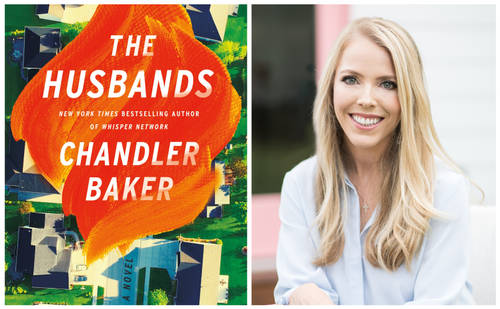
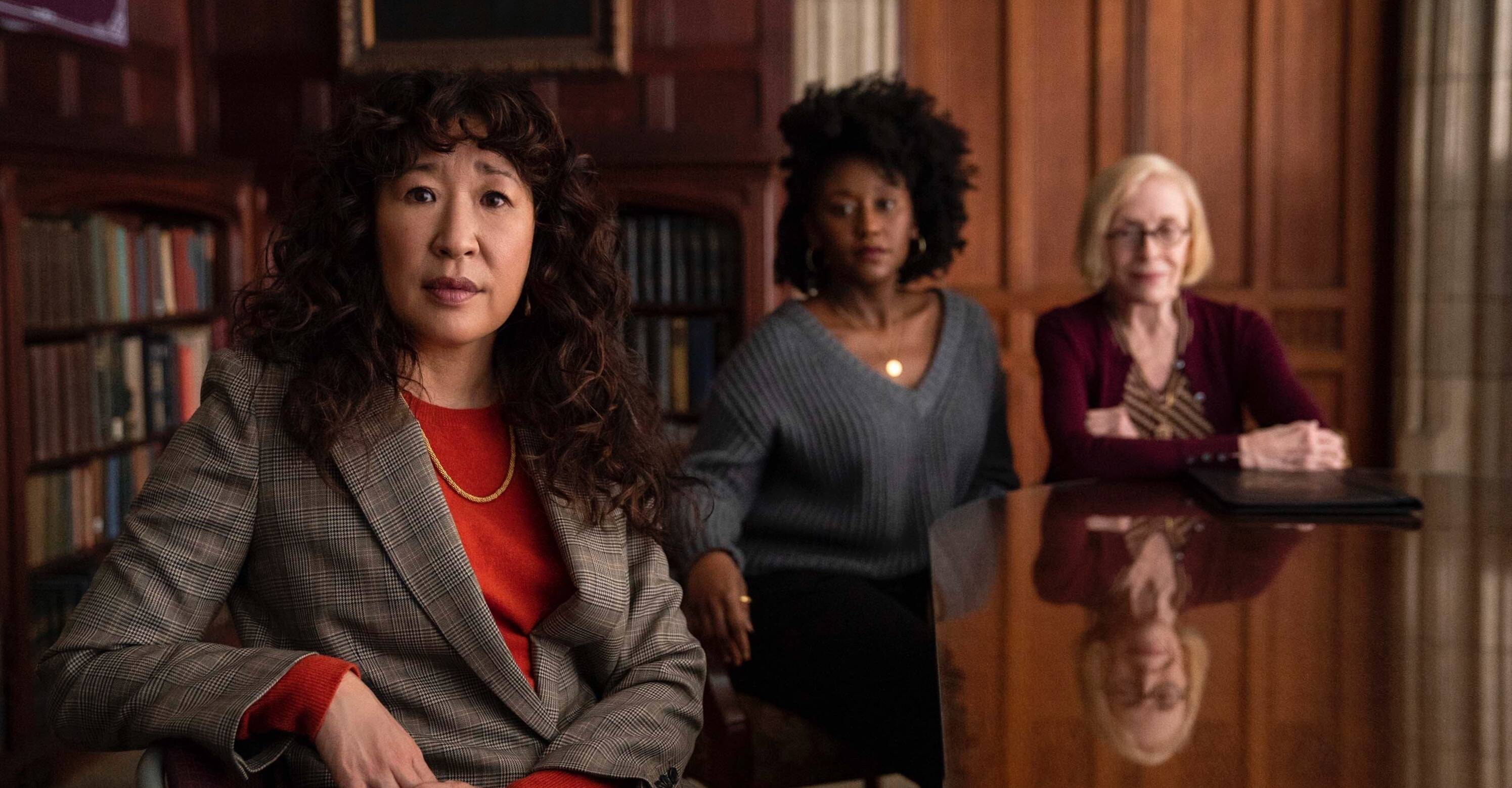
 Sandra Oh, from left, Nana Mensah and Holland Taylor in a scene from "The Chair." (Eliza Morse/Netflix via AP) | Long before I became a dysfunctional English professor, I adored novels about dysfunctional English professors. The first book review I ever sold was on Richard Russo's "Straight Man" (1997), about an English professor who threatens to kill the campus geese over a budget dispute. Since then, there have been so many academic comedies — largely telling the same hilarious, infuriated tale — that I've had to ration my access to them. In fact, comic novels about academia are such a reliable genre that it's surprising they don't show up more frequently on television. Which brings us to "The Chair," now streaming on Netflix (review). Sandra Oh, surely the most endearing actress on TV, plays the new head of the English department at a small liberal arts college. She faces all the usual challenges of declining enrollment, colleagues entombed in tenure and an administration that considers students "consumers." As current and former English teachers, Dawn and I gobbled up all six episodes like they were Krispy Kreme donuts in the faculty lounge. My favorite moment may be when an elderly medievalist — played to perfection by Holland Taylor — chases down a student who's been dissing her course online. "Now, you listen to me," she roars at the young man. "'The Canterbury Tales' is a work of genius: philandering husbands, horny housewives, farting. . . . You don't have to like me, but Chaucer has survived more than 600 years of literary criticism, and if you can't figure out that he's a badass, then just stay . . . out of my classroom!" Weirdly, the show's storyline is a discombobulated mix of liberal insights and reactionary cliches. One subplot explores the difficulty that minority female scholars face in academia. But another subplot lampoons rabidly woke students trying to cancel a beloved teacher. The destructive effect of political correctness on college campuses has become a tiresome right-wing boogeyman, but fortunately "The Chair" offers plenty of compensatory charms. No word yet on a second season, but I hope "The Chair" gets the grades necessary to earn a sophomore year.  Members of the Dorothy Parker Society with the new gravestone in Woodlawn Cemetery on Aug. 23, 2021 in New York. (Photo courtesy of Woodlawn Cemetery) | Dorothy Parker once quipped that her tombstone should read, "Wherever she went, including here, it was against her better judgment." This week, more than 50 years after she died, the legendary wit finally got a tombstone at Woodlawn Cemetery in the Bronx. But her family and admirers chose a different epitaph from her work: Leave for her a red young rose,
Go your way, and save your pity;
She is happy, for she knows
That her dust is very pretty. The strange story of Parker's cremated remains sounds like something her friend James Thurber might have written. When she died in 1967 at the age of 73, Parker had failed to specify where she wished to be interred. Her executor, the playwright Lillian Hellman, never resolved that question, so over the years, Parker's ashes were moved from one fresh hell to another — including a lawyer's filing cabinet. Eventually, gossip columnist Liz Smith wrote about this bizarre situation, which, naturally, led to a party at the Algonquin Hotel, which attracted even more attention. The Washington Post published a macabre bit of doggerel that begins: Your wit may dazzle all New York,
Your songs with passion burn,
But, like the dullest nerds in town,
You're headed for an urn. If you don't make, while time permits,
Provisions for yourself,
Your case -- indeed, your urn -- may end
Upon a lawyer's shelf. (full text) In the late 1980s, Parker's ashes were placed in a memorial garden at the headquarters of the NAACP, which owns her literary estate (story). But for the last 15 years, Kevin Fitzpatrick, founder of the Dorothy Parker Society, has been working with Parker's surviving relatives to have her brought to the family plot in the Bronx. Last year, that plan came to fruition, and her very pretty dust was interred in Woodlawn Cemetery, not too far from fellow New York writers Herman Melville and E.L. Doctorow. The only thing missing was a gravestone, but before the family could decide on one, Parker fans offered to contribute. The Al Hirschfeld Foundation and the New York Distilling Company, which makes Dorothy Parker gin, helped raise about $10,000 for a large stone. The memorial service at Woodlawn Cemetery on Monday was everything Parker fans could hope for. A five-piece band played jazz. Performers read Parker's poetry and sang her lyrics. Afterwards, the mourners — celebrants, really — walked out to see the new gravestone. In 1928, Parker published an essay for McCall's magazine about her hometown: "In New York," she wrote, "there is always the feeling of 'Something's going to happen.' It isn't peace. But, you know, you do get used to peace, and so quickly. And you never get used to New York." Rest in anticipation, Dorothy. 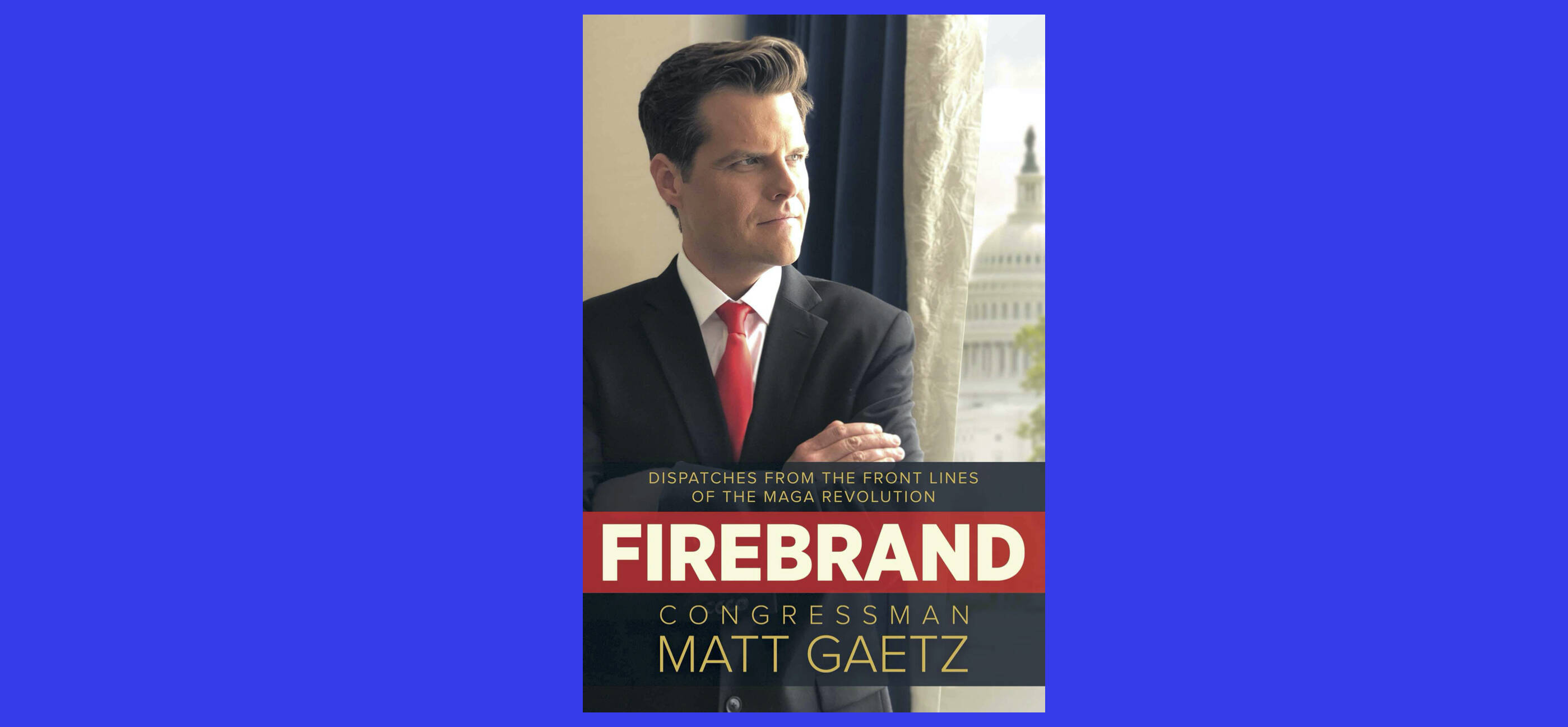 After being prodded by a Daily Beast reporter, Rep. Matt Gaetz (R-Fla.) filed an amended 2020 financial disclosure report showing that he earned $25,000 from his memoir, "Firebrand" (Bombardier Books/Post Hill Press, 2020). | Congressman Matt Gaetz, the greatest satire of Washington since "Veep," is in hot water again. According to a story in the Daily Beast, the Florida Republican failed to disclose how much money he made from his 2020 memoir . . . until after a reporter asked about it. Legal experts consulted by the Daily Beast say Gaetz is unlikely to face any real punishment for belatedly reporting his book income. For a man under investigation for sex trafficking, this is probably a rather minor concern. But the story of politicians and their books will surely continue to fester in Washington's sweaty atmosphere. Despite volumes of regulations, little has changed since 1989 when House Speaker Jim Wright (D-Tex.) resigned after allegations involving shady bulk purchases of his book "Reflections of a Public Man" (from our archives). Gaetz's initial failure to report his publishing income is inconsequential compared to a larger, more sophisticated and entirely legal maneuver: Politicians, parties and publishers — the Three Ps of Dupery — have perfected the art of using books as mutually enriching fundraising trinkets. In the usual scheme, a publisher pays a politician a huge advance. When the book comes out, the author's re-election committee buys thousands of copies and then offers them to supporters in exchange for a campaign donation. The publisher gets a guaranteed return on its investment, the politician chalks up books sales that will earn them an even bigger advance next time, and the campaign spins straw into gold. The only victims are the trees. And voters. 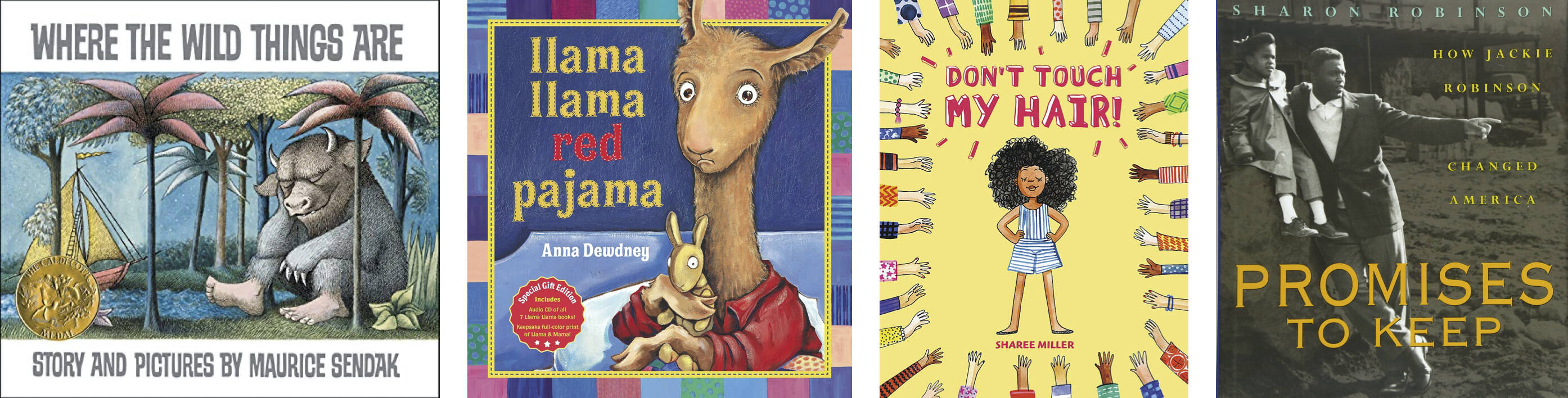 Florida children reading below grade level will soon be eligible to receive free books, like these on Florida Education Commissioner Richard Corcoran's summer reading list. (HarperCollins; Viking Books for Young Readers; Little, Brown Books for Young Readers; Scholastic) | In Florida, good news has been harder to find than a masked Republican. But here's something to celebrate: The Sunshine State is implementing an ambitious $200 million program to get books into the hands of kids who need them most. The New Worlds Reading Initiative — part of a bill that passed with bipartisan support — will send nine books a year to an estimated 500,000 children in kindergarten through 5th grade. The program will depend on schools to identify kids reading below grade level. Once parents agree to participate, free, age-appropriate books will be delivered directly to children's homes. A diverse list of books will be devised in consultation with the Lastinger Center for Learning at the University of Florida. Assistant Director of Strategy Stephanie Cugini tells me that the titles will cover a variety of genres and topics with an emphasis on books that are interesting to children. (Easy prediction: A contentious debate about the list will begin the moment it's released.) Participating families will be given some room to choose the kinds of books they want to receive. And the Lastinger Center will help provide parents and guardians with resources to make reading time fun and effective. Jacob Oliva, chancellor of Florida public schools, tells me, "We know oftentimes when working with families that have struggling readers, one of the obstacles that has been identified to promoting literacy is access to books in the home." Indeed, a study published in the journal Social Science Research found that growing up with a collection of books in the house boosts later educational achievement and occupational standing. And the most dramatic positive effects were found when books were added to homes with the smallest libraries. Over the course of six years, a child in the New Worlds Reading Initiative could assemble a collection of more than 50 titles. "We have a strong desire to get these books out the door and into our families' living rooms very soon," Oliva says. The first selections should start arriving in December. 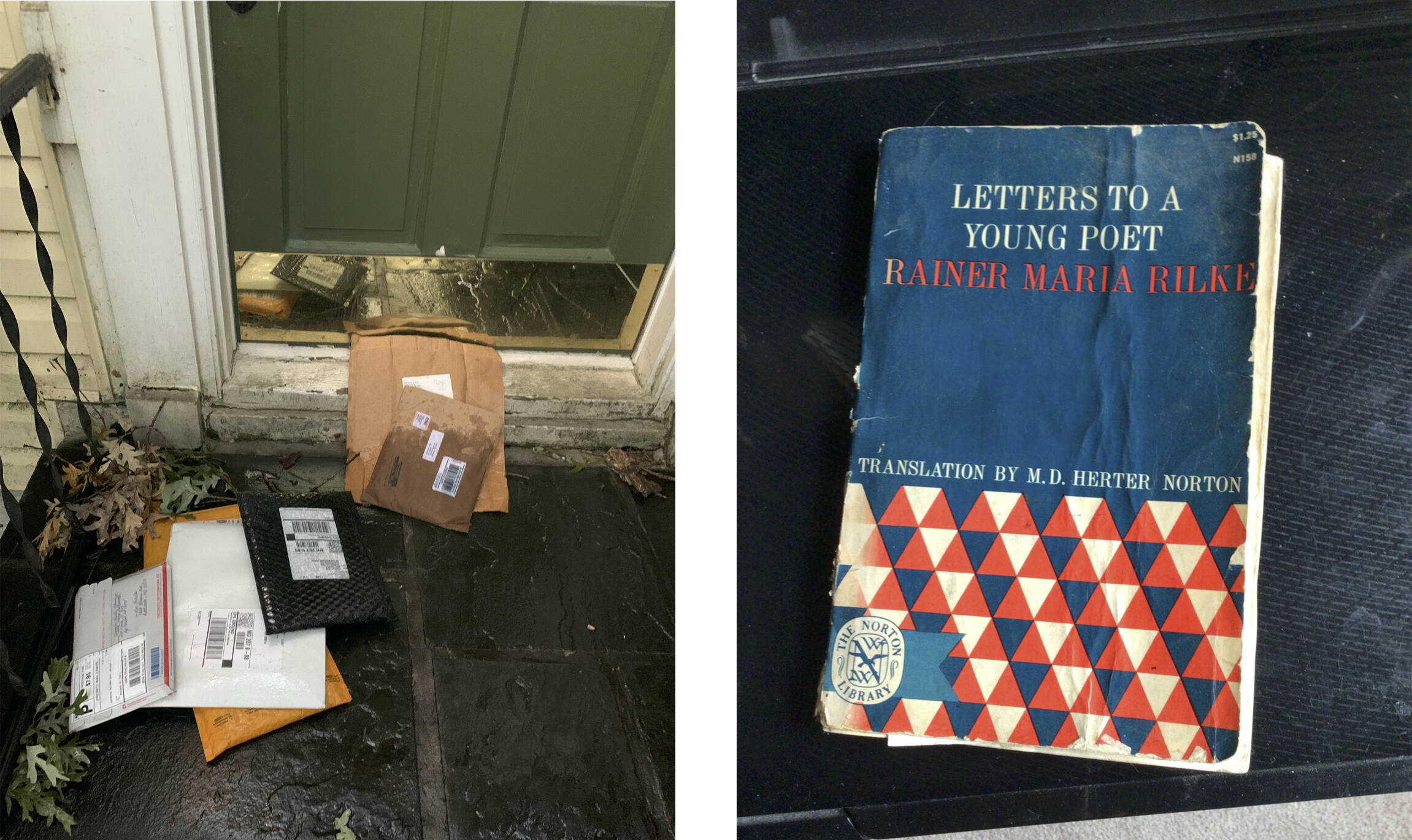 Soggy book mail left outside my door in early August. (Photo by Ann O'Donoghue) A recovered and dried copy of "Letters to a Young Poet," by Rainer Maria Rilke. (Photo by Betsy Robinson) | Last week, I asked readers for help with a few books that got wet in the mail. Your advice rained down. I was told to try a hair dryer, a microwave oven, paper towels and kitty litter (unused, I presume). A few people spoke of the beneficial effects of outdoor air and sunshine, but Washington's humidity makes that unlikely to work. Some Gentle Readers sounded thoroughly exasperated with me. Kathleen wrote, "For goodness sakes, man, install a large mail slot in your door. This cannot be the first time this has happened." Ruth said dryly, "There's a thing called Hold Mail." Perhaps the most radical advice came from Michael, who advised, "If you don't want wet books, do not leave home." Several readers reminded me of the desiccating effect of freezing, which I should have remembered from Susan Orlean's "The Library Book." She tells a fascinating story about how hundreds of thousands of books were restored after the Los Angeles Central Library fire in 1986 (review). Current and former librarians informed me that the real enemy is not so much water as mold, which starts ruining wet books within 48 hours. Meghan directed me to a helpful set of instructions from the Library of Congress (here). And finally, New Yorker Betsy Robinson told me a story that anyone who has lost and found a cherished book can appreciate: In her 20s, Betsy used to give away copies of "Letters to a Young Poet" to people she thought needed more Rilke in their lives. One night, after reading her own copy, she left it on the windowsill, and it fell into the neighbor's wet yard. "As early the next morning as I judged it humane to knock on a neighbor's door," she writes, "I woke said neighbor, and being a reader herself, she was incredibly kind and fetched the soggy book for me." A few days on the radiator left "Letters to a Young Poet" stiff and cracked. "The spine died and pages are loose, but it is quite readable, and because of its condition, I've never given it away. And I kind of love owning this book that survived a five-story fall and a night in the rain." And if the world has ceased to hear you,
say to the silent earth: I flow.
To the rushing water, speak: I am. — Rainer Maria Rilke  Remember when book events were in person? Me neither. (Photo illustration by Ron Charles) | How I Stopped Worrying and Learned to Love the Webinar. Last year when the pandemic closed the book on literary events, many authors, teachers and booksellers pivoted to streaming presentations. With crystal-radio audio and cadaveric lighting, these virtual events were pretty dreadful — "Sir Salman, you're muted!" — but at least they proved that we could persevere. Eighteen months on, though, online book talks have shed their Dr. Who ambience and acquired a whole new reputation: They're no longer just a Zoomy stop-gap measure to tide us over till the real book talks can start again. Consider the 92nd Street Y Unterberg Poetry Center. Since 1939, this nonprofit organization has offered readings, writing classes and literary seminars featuring famous authors. When covid-19 struck, all that was imperiled. At first, 92Y shifted some of its classes to conference calls and then, later, to online platforms. The results have been extraordinary. Enrollment for the center's literary seminars has soared from 2,000 in a typical year to a record-breaking 15,000. Colm Tóibín's seminar on the novels of Henry James is a case in point: Pre-covid, about 15 New Yorkers would have signed up. This year, Tóibín's streaming classes drew 300 people from around the world. In addition to attracting more students, the Poetry Center has found it can bring in a whole new group of teachers from beyond New York. "For me, it's never been a compromise," says Ricardo Maldonado, the Poetry Center's managing director. With online classes, he says, "I find myself in rooms with people all over the world." Instead of feeling like something's missing, he feels as though these classes are radically enhanced by the extraordinary new diversity of the participants. I start to object, to mourn the loss of in-person interaction, but Maldonado won't have it. "We're meeting students at all stages of their careers, people from all walks of life," he says. "And the way that people around the world read and the way in which they reflect on their own experiences through what we're reading have taught me a lot about literature." Obviously, I need to stop pining for what's past and embrace these new opportunities. Enrollment for fall classes at 92Y is open. You'll find offerings from Rachel Cohen on Jane Austen, Adam Gopnik on Moliere, Colm Tóibín on Thomas Mann and many more (full list). 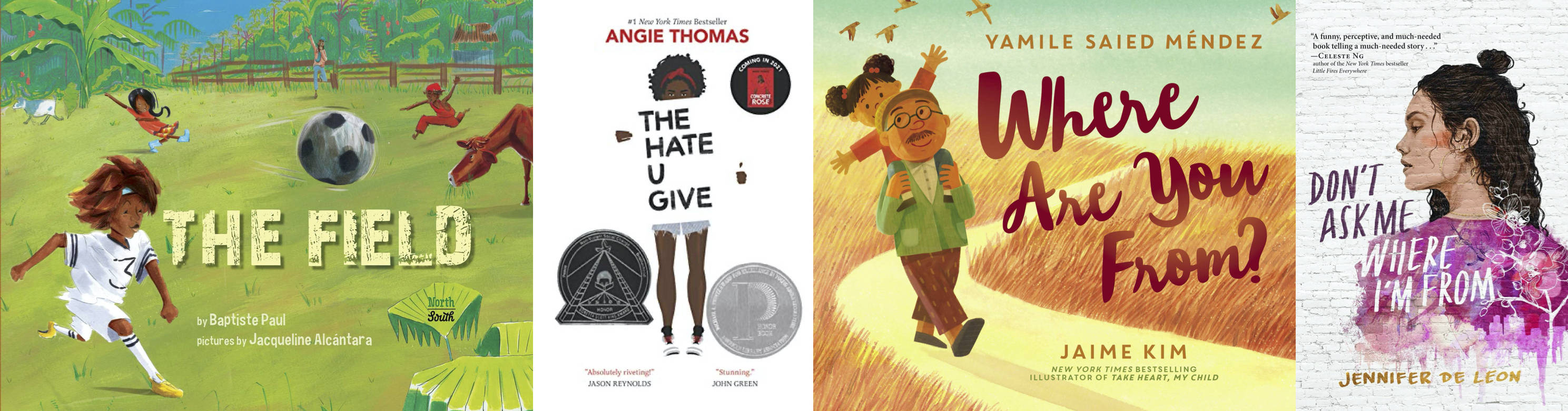 Previous winners of WNDB's Walter Grants have included Jacqueline Alcántara, Angie Thomas, Yamile Saied Méndez and Jennifer de Leon. (NorthSouth Books; Balzer + Bray; HarperCollins; Atheneum) | Opportunities for financial support with deadlines around the corner: - We Need Diverse Books will award $2,000 Walter Dean Myers grants to eight unpublished diverse writers or illustrators who are working on books for children or young adults. (Applications due by Aug. 31.)
- The American Folklife Center at the Library of Congress has launched a major new initiative called Of the People: Widening the Path. As part of this program, the Center is offering 10 grants up to $60,000 each to individuals or nonprofit organizations documenting "diverse, often underrepresented communities in the United States." (Applications are due Sept. 7.)
 Harper; Wesleyan University Press | On this day in 1963, W.E.B. Du Bois died at the age of 95 in Ghana. I've been thinking a lot lately about that great scholar, the legacy he left and why he left America. This week, I reviewed an extraordinary novel called "The Love Songs of W.E.B. Du Bois," by Honorée Fanonne Jeffers (rave). It's about one extended family — an example of what Du Bois called "the talented tenth." Less than 24 hours after my review went up, Oprah chose "The Love Songs of W.E.B. Du Bois" for her book club. Coincidence? Think what you will. Last year, Jeffers published a book of poetry called "The Age of Phillis," which was longlisted for a National Book Award. It's currently a finalist for the George Washington Prize, which will be announced Oct. 20. The collection moves through the life of Phillis Wheatley, who was kidnapped from her home in West Africa as a child and sold to John and Susanna Wheatley in Boston. They taught her to read and write, and in 1773 she published a celebrated book of poetry. In the poem below, look how Jeffers interrogates the impossibly conflicted nature of Susanna Wheatley's relationship with this little girl. Susannah Wheatley Tends to Phillis in Her Asthmatic Suffering
Boston, January 1767 When you own a child,
can you treat her the same?
I don't mean when you birth her,
when you share a well of blood.—
This is a complicated space.
There is slavery here.
There is maternity here.
There is a high and a low
that will last centuries.
Every speck floating in this room
must be considered.
I don't want to simplify
what is breathing—
choking —
in this room, though there are those
of you who will demand that I do.
Either way I choose, I'm going
to lose somebody.
I want to be human,
to assume that because Susannah
had three offspring who died as children—
the details gone
about coughs that clattered
on, rashes that scattered across
necks or chests,
air that did not expel,
never exhaled to cool tongues—
that Susannah would be desperate
to cling to a new little girl.
Her need to care, her fear,
would rise into Psalms.
When Phillis's face
was not her mirror,
would that have mattered?
When water did not drench
Phillis's hair, but lifted it high
into kinks,
would that have mattered?
Can I transcribe the desire
of a womb to fill again?
That a daughter was stolen
from an African woman and given
into a white woman's hands?
And did Susannah promise the waft
of that grieving mother's spirit
that she would keep this daughter safe
yet enslaved—
and this
is the craggiest
hill I've ever climbed. From "The Age of Phillis," by Honorée Fanonne Jeffers (Wesleyan University Press, 2020). Reprinted with permission of the publisher. All right reserved. 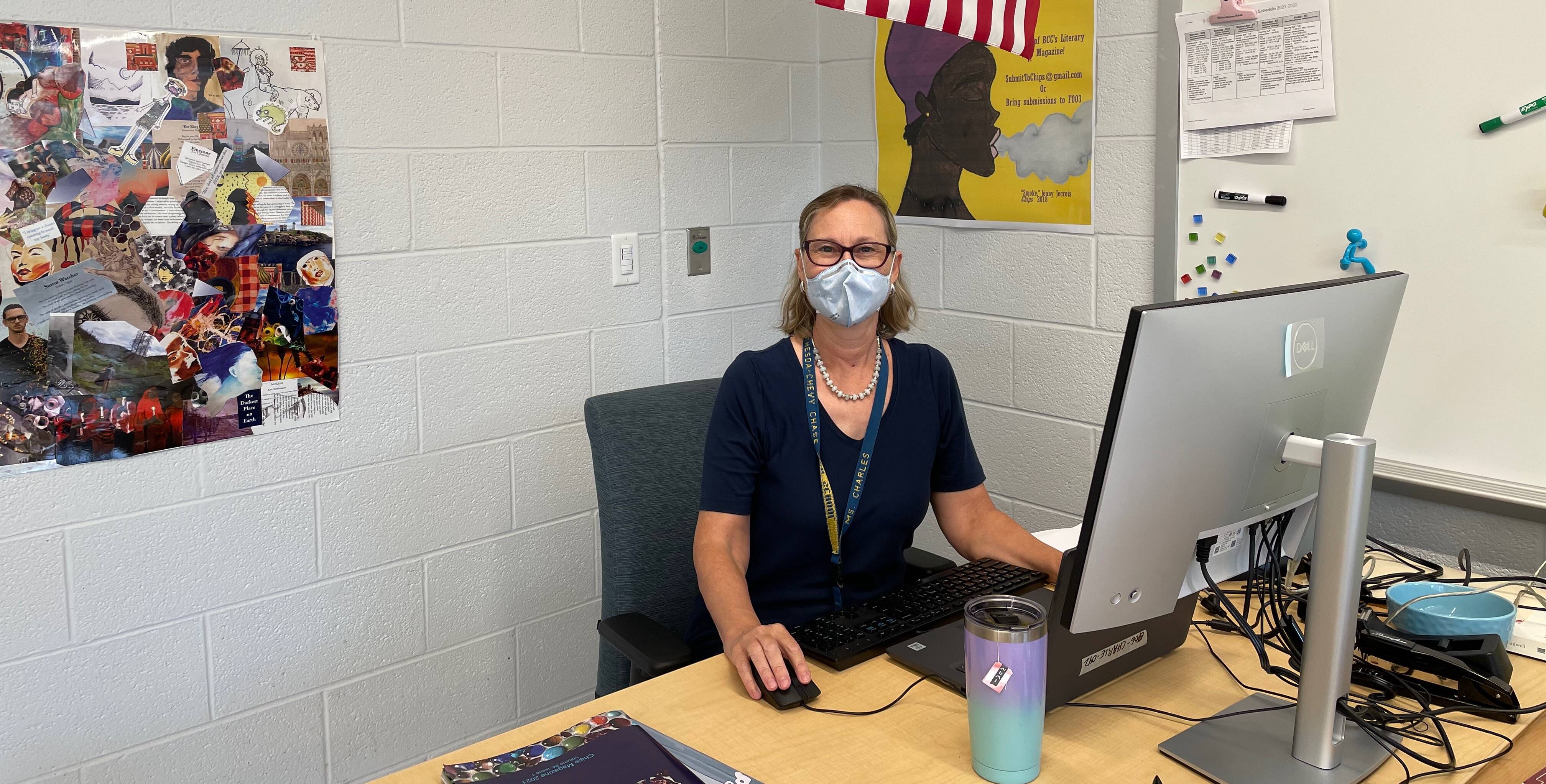 Ms. Charles is masked and ready for her 11th grade English classes to start in Bethesda, Md. (Photo by Ann O'Donoghue) | On Monday, Aug. 30 — after a week of faculty meetings — Dawn will start school. It's been 531 days since my wife faced a classroom full of students. They'll all be masked, of course, though earlier recommendations to keep the desks six feet apart have been abandoned. With 33 kids, her classroom would need to be at least twice as large. In one pre-service meeting, the faculty members were told, "Be ready to turn, pivot, crouch, crawl, run, etc., as we turn COVID's corners." I have begun thinking of my wife as the star in an educational thriller called "Crouching Teacher, Hidden Dawn." Despite all the attendant anxieties, though, she can't wait to see the students. She's particularly excited about a creative writing course she'll be teaching for the first time. Those kids don't know how lucky they are. Meanwhile, send any questions or comments about our book coverage to ron.charles@washpost.com. You can read last week's issue here. And if you know friends who might enjoy this newsletter, please forward it to them and remind them it's free! To subscribe, click here.
Interested in advertising in our bookish newsletter? Contact Michael King at michael.king@washpost.com. |





 Email
Email