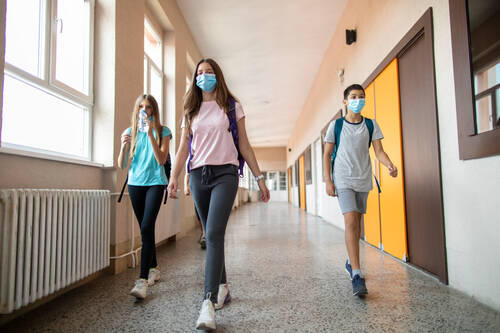
Your questions, answered "What type of mask is most protective for kids going back to school?" — Jennifer in Maryland Great question. To help protect against the coronavirus, the Centers for Disease Control and Prevention (CDC) and the American Academy of Pediatrics (AAP) both recommend that anyone older than 2 wear a mask indoors at school — regardless of vaccination status. The general guidance from the CDC is to choose a mask that has two or more layers of washable, breathable fabric and a nose clip to ensure a good fit — meaning that the nose and mouth are completely covered and there are no gaps around the sides of the face. Some health experts have even suggested upgrading to an N95 or KN95 amid concerns about the highly contagious delta variant. But for children, the most important thing is to find a mask that your child is comfortable in so that he or she will keep it on throughout the school day, said Sara Bode, chair-elect of AAP's Council on School Health. Of course, it should also fit properly. Bode said to shop for masks that are child sized — 5x10 inches — and to try different types at home where you can assess the fit and your child can get accustomed to wearing them. Although not necessary, Bode said some children, particularly those who wear glasses, may prefer face coverings with the adjustable nose clip to hold the mask in place and keep the child's glasses from fogging up. And even though KN95s are not officially recommended, some parents may prefer the higher-quality coverage. Bode said it is not wrong to buy them for your children, but you do need to ensure they fit well. "If you were going to use one of those, you would want to make sure to have your child try it on and even have it checked by your pediatrician to make sure it's the right fit for your child," she said. Bode said the only masks that are discouraged are neck gaiters — the loosefitting masks that are designed to be worn around the neck and then pulled up over the nose and mouth. Gaiters tend to gape open at the sides and the bottom, "so they really don't provide as much protection," she explained. Once you find the right mask for your child, make sure he or she knows how to wear it and remove it. Children should wash their hands before putting on their masks and after taking them off, and should avoid touching the masks while wearing them, according to Healthy Children, an online magazine published by AAP. When removing the masks, they should pull them off from behind, being careful not to touch the front, the association said. | 




 Email
Email