| There's been pretty major infighting recently among House Democrats. The divisions among Democrats are troublesome enough that they could derail the rest of President Biden's legislative agenda. The most recent battle was narrowly resolved Tuesday for a key vote to pass a big budget plan that Democrats hope will define their party's control of Washington. House Speaker Nancy Pelosi (D-Calif.) cut a deal with moderate Democrats to assure them of getting an infrastructure vote, even as she pleased liberals by holding a vote on the budget bill this afternoon.  House Speaker Nancy Pelosi (D-Calif.) narrowly avoided the collapse of a budget deal this week. (Jonathan Ernst/Reuters) | But it's a tenuous deal that could fall apart in the weeks to come amid debate on spending and votes on infrastructure. Here's what's going on and the players involved. The background: Democrats have a chance to send two bills to Biden's desk over the coming weeks: - A bipartisan infrastructure bill to repair the nation's roads, bridges, pipes and broadband
- A partisan spending plan for the next decade that drastically expands government programs and aid for Americans. It was engineered by Congress's most liberal voices, such as Sen. Bernie Sanders (I-Vt.)
Both already passed the Senate. That was supposed to be the hard part. But the legislation hit an unexpected snag in the Democratic-controlled House. The dilemma: Moderates wanted the bipartisan infrastructure package to get a vote first. Liberals wanted the big budget plan to get a vote first. - Both sides threatened to withhold their votes unless they get what they want.
- That was more than enough to sink both pieces of legislation, since House Democrats can only afford to lose a handful of votes and still pass bills over Republican objections.
- Pelosi and the White House spent August trying to convince moderates to fall in line. Today, they reached a cease-fire that will allow the budget process to go forward and infrastructure to get a vote next month.
- Both sides are temporarily appeased, but there is still lots of wrangling to come. Democrats will spend the next few weeks in the House and Senate turning their budget into an actual, detailed spending plan. (Then they'll vote on this all over again and send it to Biden to sign into law.) And liberals warn they may not vote for the infrastructure bill when it comes to a vote in September.
The background: Things are so tense among Democrats right now because they worry they only have a limited amount of time to get stuff done. In the 2022 midterm elections, Democrats could lose their slim majorities in Congress. The party as a whole is hoping that all this legislation gives them a chance to keep their handle on power and gives Biden something good to talk about. (He could use the win after a tough summer, with a coronavirus surge and a bungled withdrawal in Afghanistan.) Individually, each lawmaker wants their agenda accomplished before they're up for reelection. That's where it gets complicated. Let's look at the bright side for Democrats: They are close to passing trillions of dollars worth of new legislation. "This is a healthy debate," White House press secretary Jen Psaki told reporters Monday " … In some ways this is a high class problem." And most of this feels like political posturing more than actual threats by Democratic lawmakers to vote against Democratic bills. Democrats aren't as hard line as the conservative House Freedom Caucus was, which carried through on its threats to sink Republican bills. "Nobody believes for a second" that Democrats would vote against their own legislation, said a Democratic operative with experience in House and Senate leadership. But the legislative impacts of political posturing are real. Democrats are running out of time to get all this done to make an impact on voters before the midterms. Since this isn't going away anytime soon, let's meet the players and hear their demands. Centrist Democrats  U.S. Rep. Josh Gottheimer (D-N.J.) (Jonathan Ernst/Reuters) | Who they are: Ten Democrats from moderate or even conservative districts all over the country, from Hawaii to Texas. The Democrat most out in front on all this is Josh Gottheimer of New Jersey. What their demands were: They wanted the House to vote on and pass the infrastructure bill before Democrats vote on the $3.5 trillion budget package designed by liberals. They've accused their party of holding the infrastructure bill "hostage" and of being "misguided" in prioritizing the liberal budget first. Left unsaid is that many of these Democrats need the political cushion provided by voting for a bipartisan bill before they vote for a partisan one. Republicans are already eager to campaign on the massive "Bernie Sanders budget" to win back the House. How firmly they've drawn their line: It seems more wobbly now than ever. This moderate group surprised Washington a few weeks ago by saying they wouldn't vote for the budget package until infrastructure gets a vote. They got a lot of heat from more liberal Democrats and even pressure from the White House to fall in line. But now, enough of them have agreed to vote for the budget with a relatively small concession, a repeated promise from Pelosi that the infrastructure bill would get a vote within the next month. Liberal Democrats 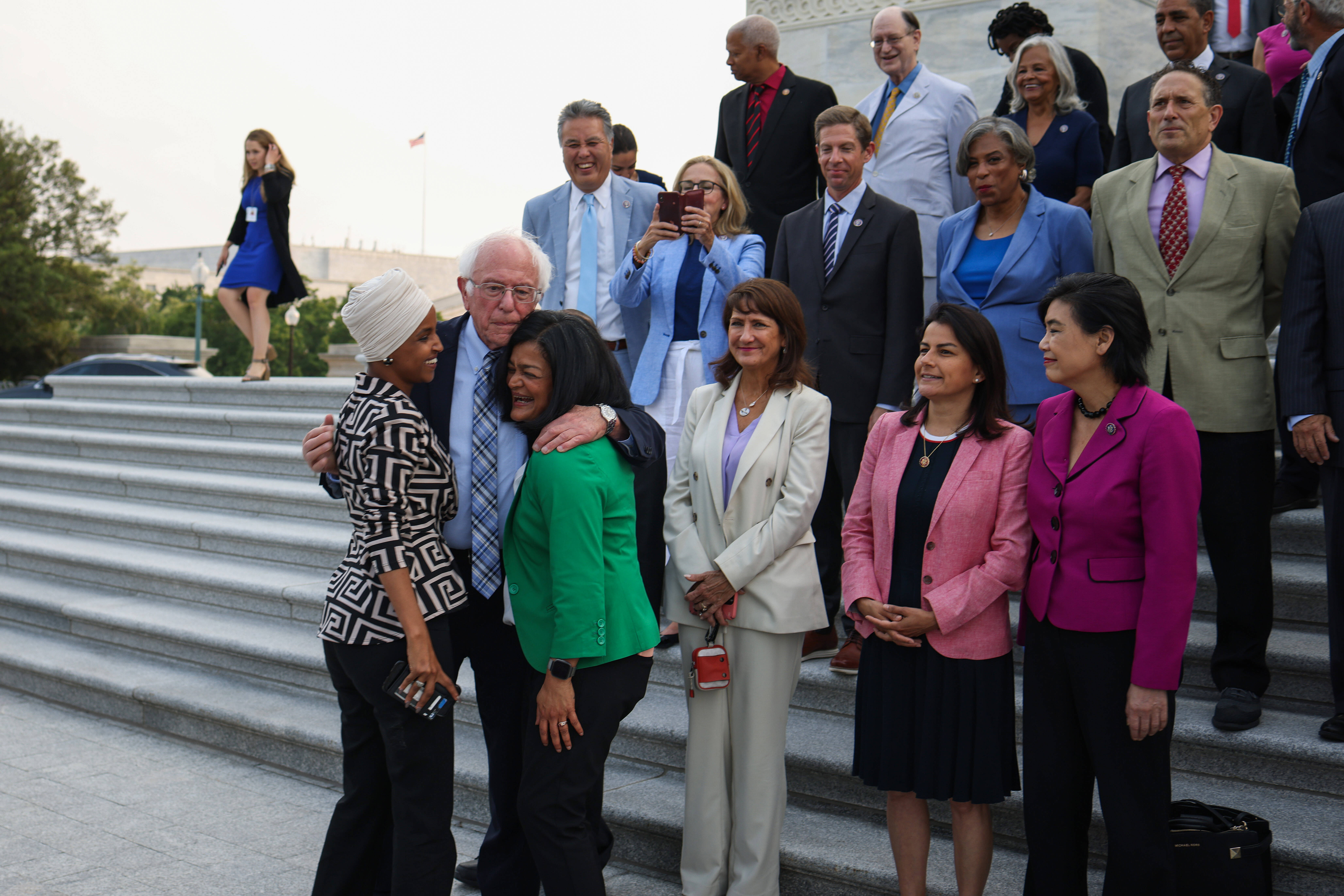 Sen. Bernie Sanders (I-Vt.) greets Reps. Ilhan Omar (D-Minn.) and Pramila Jayapal (D-Wash.) (Anna Moneymaker/Getty Images) | Who they are: They're a coalition a few-dozen strong; a growing and ever-strengthening group in the House. One of their leaders is Rep. Pramila Jayapal (D-Wash.). What their demands were: This group was the original demand-maker. Members said they wanted to get going on this budget before voting for infrastructure. That's because to win over Republican votes in the House and Senate, the infrastructure bill is drastically scaled down from what liberals — and the president — had originally wanted. How firmly they've drawn their line: Firmly enough that House Democratic leadership and Biden spent weeks trying to stick with their wishes, and to convince the moderates to get in line. It worked this time. What will happen with the next big legislative fight? | 




 Email
Email 


