| I'm Amber, the original author of this newsletter, and I'm back from family leave. I'm glad you're here. In this newsletter, we'll better understand politics together in five minutes or less every weekday afternoon. Let me know what you want to explore. The pressure is growing for Congress to do something to combat Republican voting restriction efforts across the country. The Texas Democrats who fled their capitol three weeks ago to temporarily stop a GOP voting restriction bill are still in Washington, D.C. On Monday, lawmakers in more than 20 states joined them to ask Congress for help. Voting rights activists are holding regular demonstrations on Capitol Hill, including one Monday. 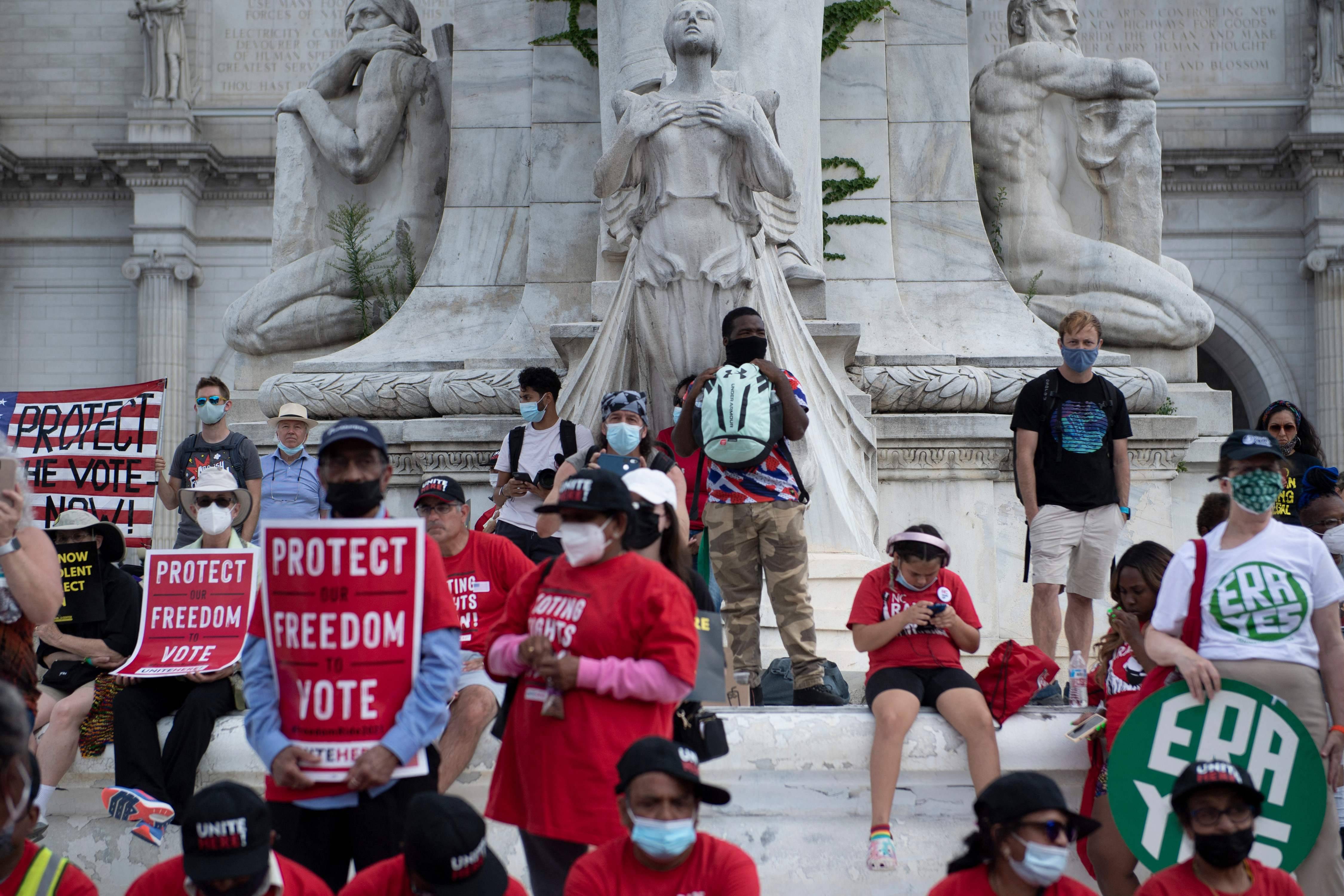 People gather near the U.S. Capitol on Monday to push Congress to pass voting rights laws. (Brendan Smialowski/AFP via Getty Images) | The thing is, if expanding voting rights were easy to do, Democrats in Washington would have done something by now. Instead, they have several not-so-great options before them. Here are maneuvers they are considering, ranked from least likely to work to most likely. 5. Least likely: Battle it out in the states Georgia, Florida, probably soon Texas. These are just three major political battlegrounds that have moved to significantly restrict how people vote since the 2020 election. Democrats don't have much leverage to fight back because they don't have much power in key state legislatures, period. In 2020, they were hoping to pick up as many as half a dozen chambers and ended up with none. Republicans hold total legislative control in 61 percent of state legislatures, according to the nonpartisan National Conference of State Legislatures. This year, 18 states — almost all Republican controlled — enacted laws that restrict voting, according to the Brennan Center for Justice. As for those Texas Democrats? Next week they will have to return home, where all they can likely do is watch Republicans pass the bill they're in Washington to protest. "If we don't get this Congress to act … then I'm very worried about the ability of everyday Floridians to have their voices heard in the election process," Florida state Rep. Anna V. Eskamani (D) told The Washington Post this weekend, illustrating how dire the situation is in her state for Democrats. 4. Go around state legislatures with ballot initiatives Democrats could take the debate to voters and ask them to change voting laws via ballot initiatives. Democrat Rahm Emanuel, a former Chicago mayor, threw this idea out recently with The Post's Dan Balz. Other voting rights activists are pushing ranked-choice voting as a way to reform how people pick candidates, even if they can't change regulations around who can vote. But these ideas require an extremely heavy lift of energy, time and money, and national Democrats have yet to lean into them. Even winning isn't a guaranteed triumph: State lawmakers have shown a willingness to undercut ballot initiatives after they pass. 3. Try to get Republicans on board with expanding voting If you can't beat 'em, can you work with them? Theoretically, there is room for bipartisan compromise on how to create an effective ballot system in a post-pandemic world. In Congress, Senate Democrats are working on a bill that seems aimed at getting some Republican support by potentially requiring everyone in America to present an ID to vote, reports The Post's Mike DeBonis. But the politics make compromise nearly impossible right now. Both sides consider the voting battle a great way to animate their base. Former president Donald Trump has talked openly about how making voting easier could hurt Republicans' chances to win elections. Not a single Republican in Congress has supported expanding voting rights in the manner Democrats have proposed, arguing that it's up to the states to govern how they vote. There's little reason to think their position will change before an election where Republicans could regain control of Congress. 2. End the filibuster The frustrating thing for Democrats is that one bill from Congress could obviate what Republicans are doing in a dozen-plus states. Were it not for the filibuster. With it, a minority of senators can block a majority. In June, Republicans used this tool to block a voting rights' bill. Democrats and Republicans have weakened the filibuster over the years, but Democrats would probably need to get rid of it entirely to pass a voting law over GOP objections. And key Democratic senators are outright opposed to that. Biden, as far as we can tell, also remains skeptical of ending the filibuster. Still, we leave this on the table because Biden could decide that blowing up the filibuster is the only way to get something done, and he could put major pressure on skeptical Senate Democrats to join him. At least, Democrats coming together on voting rights is more likely right now than Democrats and Republicans agreeing on what to do. 1. Most likely: Just motivate more people to come out and vote despite the restrictions This is what Vice President Harris wants to get done. "It's about turning out voters," she said in a July interview on NPR about how to combat voting restrictions. That doesn't mean Democrats are done fighting to change Republican voting laws, but it is telling that trying to live in a world with them is what they're talking about at the highest levels. | 




 Email
Email 


