| The Republican Party is a home for vaccine skeptics. While many GOP governors have urged people to get the shots, plenty of prominent voices on the right (like pro-Trump youth activist Charlie Kirk) are pushing the false dichotomy that getting the vaccine means giving up one's freedom. Layered onto that are even more prominent voices fighting mask mandates — or opposing masks, period. So how to get more people vaccinated? About 1 in 5 Americans are resistant to getting the shots now. It's a tricky balancing act, as demonstrated by the different approaches in Washington to pushing vaccines. Here's the range of what officials are trying: Get forceful Like, really forceful. President Biden said this week "it's still a question" on whether the federal government can mandate that all Americans get vaccinated, a comment that underscores that he's thinking about it. He can (and did) order federal workers to get vaccinated or face repeated testing. A widespread vaccine mandate may be a pie-in-the-sky dream for Biden. The Post's Annie Linskey and Tyler Pager talked to a top White House official who said they don't think they have the power for a nationwide mandate. (Legal murkiness didn't stop Biden on instituting an eviction ban this week, though. And recent polls show a vaccine mandate seems to be more popular than mask mandates.) Linskey and Pager report the Biden administration is also considering withholding federal money from all sorts of institutions and businesses — like nursing homes, cruise ships and universities — until they force more employees to get vaccinated.  President Biden steps off Marine One. | Have doctors champion the vaccine over, say, celebrities Motivated by research suggesting people are most likely to heed those they already trust, the administration enlisted local pharmacies, community leaders and family doctors to promote the vaccine. Public health officials agreed that local leaders and personal outreach are generally more effective with vaccine advocacy than celebrities or famous "influencers." Use a bit of tough love Or some might call it an insult? "[I]f you're not vaccinated, you're not nearly as smart as I thought you were," Biden said last week. Talk a lot about vaccines 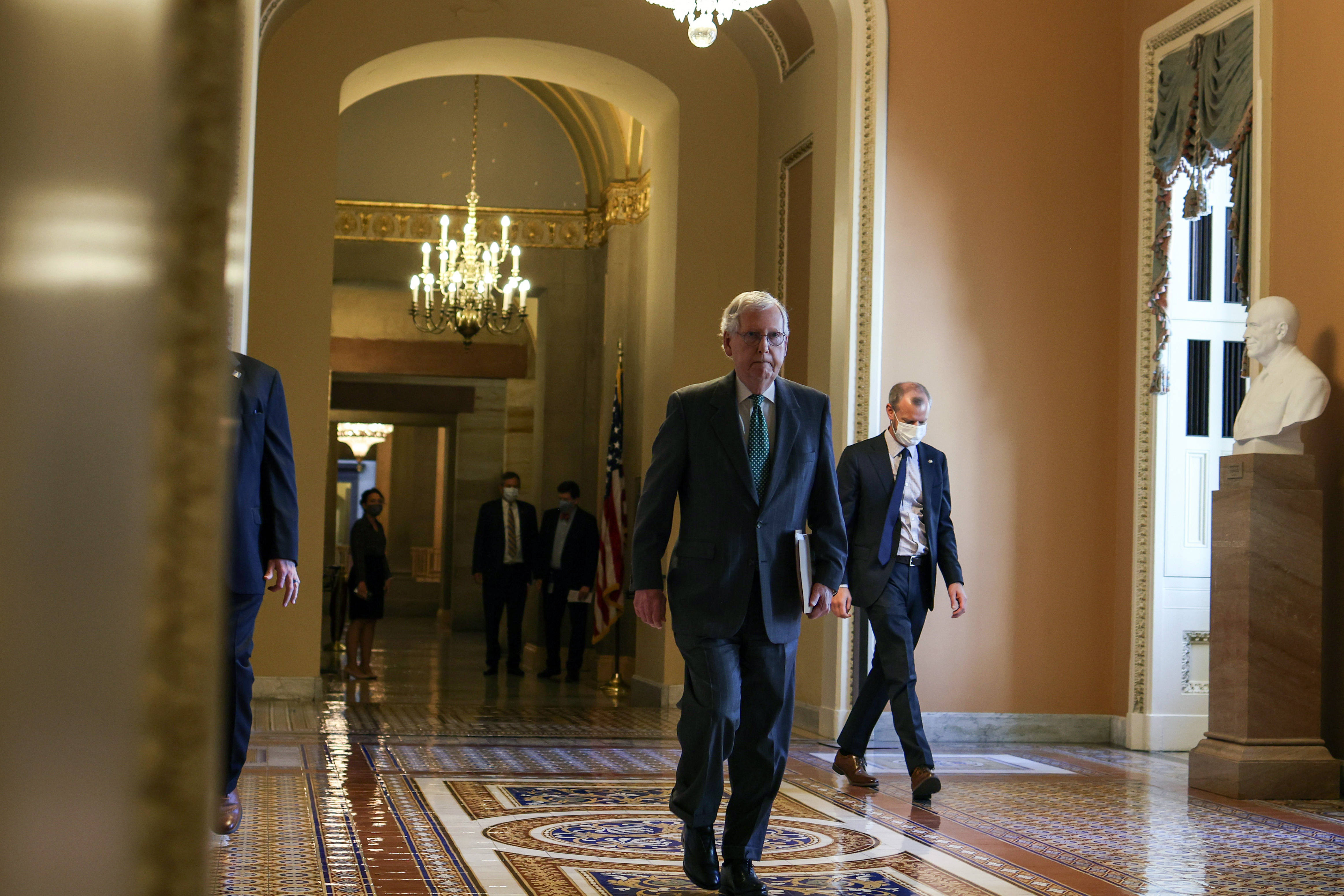 Senate Minority Leader Mitch McConnell (R-Ky.) is paying for ads in Kentucky to urge people to get vaccinated. (Anna Moneymaker/Getty Images) | This is the strategy being led by top congressional Republicans, who arguably understand the vaccine-hesitant constituency a little better than Democrats. Here's Senate Minority Leader Mitch McConnell (R-Ky.) at a news conference recently: "I want to encourage everybody to [get vaccinated] and to ignore all of these other voices that are giving demonstrably bad advice." McConnell started running pro-vaccine ads in Kentucky, Politico reports. When Sen. Lindsey O. Graham (R-S.C.) announced this week that he tested positive for coronavirus, he made sure to say this: "I am very glad I was vaccinated, because without vaccination I am certain I would not feel as well as I do now." A vaccine-hesitant Rep. Steve Scalise (R-La.) recently got his first shot and said he was happy he did, reported my colleagues. But is talking about getting the vaccine enough when many of these same Republican leaders have not strongly rebuked the vaccine skeptics in their own party?, writes The Fix's Aaron Blake. Play it cool Sen. Josh Hawley (R-Mo.) told Politico that making the vaccine a major conversation could backfire in his part of the country. "I say, 'I decided to get vaccinated because I thought the vaccines were very effective, we've got young children at home and a young baby.' I try to personalize it," he said. Give up pushing it Sen. Marco Rubio (R-Fla.) — a major mask skeptic as his home state rages with new coronavirus cases — told Politico that he thinks it's not the government's job to push people to get vaccinated: "It's up to them to decide whether they want to be vaccinated. And I just know people are not going to be vaccinated, no matter what." So why won't people get vaccinated?  People attend a talk by an anti-vaccine activist in California on Thursday. (Robyn Beck / AFP via Getty Images) | Gallup and the Kaiser Family Foundation have spent the past few weeks surveying Americans who are hesitant about the vaccine. Here are some common reasons they hear about why: I want to wait to see if it's safe and effective. This group is more hesitant than resistant, but it's a relatively small chunk of the unvaccinated. Kaiser found that just one-fourth of unvaccinated adults say they'll probably change their status by the end of this year. There are almost as many Black and Hispanic Americans as White Americans in this group. The majority of unvaccinated Americans are White, and they largely tend to say they're definitely not getting the vaccine. I don't trust vaccines generally, is a common statement Gallup heard. It's right up there with people saying they have antibodies because they already had coronavirus, which is what the No. 2 House Republican, Scalise, had been saying before he changed his mind and got the shot. I'm not afraid of getting coronavirus. Right along with this are concerns that the vaccine poses a bigger risk than getting the virus, which is, of course, demonstrably false. More than 615,000 people in the U.S. and counting have died of covid-19. A quick Andrew Cuomo update: Could the New York governor get arrested? Cuomo was accused this week by the state's attorney general of being a serial harasser. He's facing impeachment by his own party, and now it's possible the Democratic governor could get arrested. An accuser filed a criminal complaint with a sheriff's office in Albany, and that sheriff told the New York Post that if they substantiate the claim, they could arrest the governor. | 




 Email
Email 


