| We've talked in this newsletter about how important passing voting-rights legislation is for the health of the Democratic Party. Here's a deeper look at why, and why times is running out for Democrats to act. In a matter of months, Democrats could be locked out of power in key states, and possibly the House of Representatives, for a decade. States across the country start redrawing their maps as soon as next week to decide which lawmakers represent different communities. It's a process known as redistricting. States do it every decade based on new census data, which just got released Thursday so states can start drawing maps. The data showed that, nationally, White people are declining as a portion of the population for the first time in centuries. That can help boost Democrats' strength in suburban swing districts because voters of color lean blue.  On Wednesday in Indianapolis, people protest against gerrymandering. The obscure process is getting more attention. (Kelly Wilkinson /The Indianapolis Star via AP) | But Republicans get more say in what happens next Most states hand the redistricting process to legislatures, and Republicans have spent the past decade engineering themselves into power in state legislatures across the country precisely for this purpose. That means they get to carve up the 2020 Census's population data in many battlegrounds to create new state legislative and congressional districts. And that means Republicans have an opportunity to gerrymander their way back into power at a national level and find ways to keep a hold of their power in states. It's bad for Democrats It's possible that if Democrats lose control of the House of Representatives in next year's elections, they could be locked out of power for another decade under Republican-drawn maps that make it hard for Democrats to win in swing districts. Democrats would have to wait until the next census and hope they're in a better position of power to redraw the lines. Gerrymandering is really effective at getting political power. Before Pennsylvania was carved up in 2010 by Republican lawmakers, Democrats won 56 percent of the vote in a midterm election and 11 congressional seats. Today, they'd only win six in such a scenario, Michael Li with the Brennan Center wrote. That could get even worse in 2022 with a GOP legislature in charge of maps. In 2022, Republicans can conceivably win back the House majority just by gerrymandering. They only need to flip five seats in elections to take the majority. 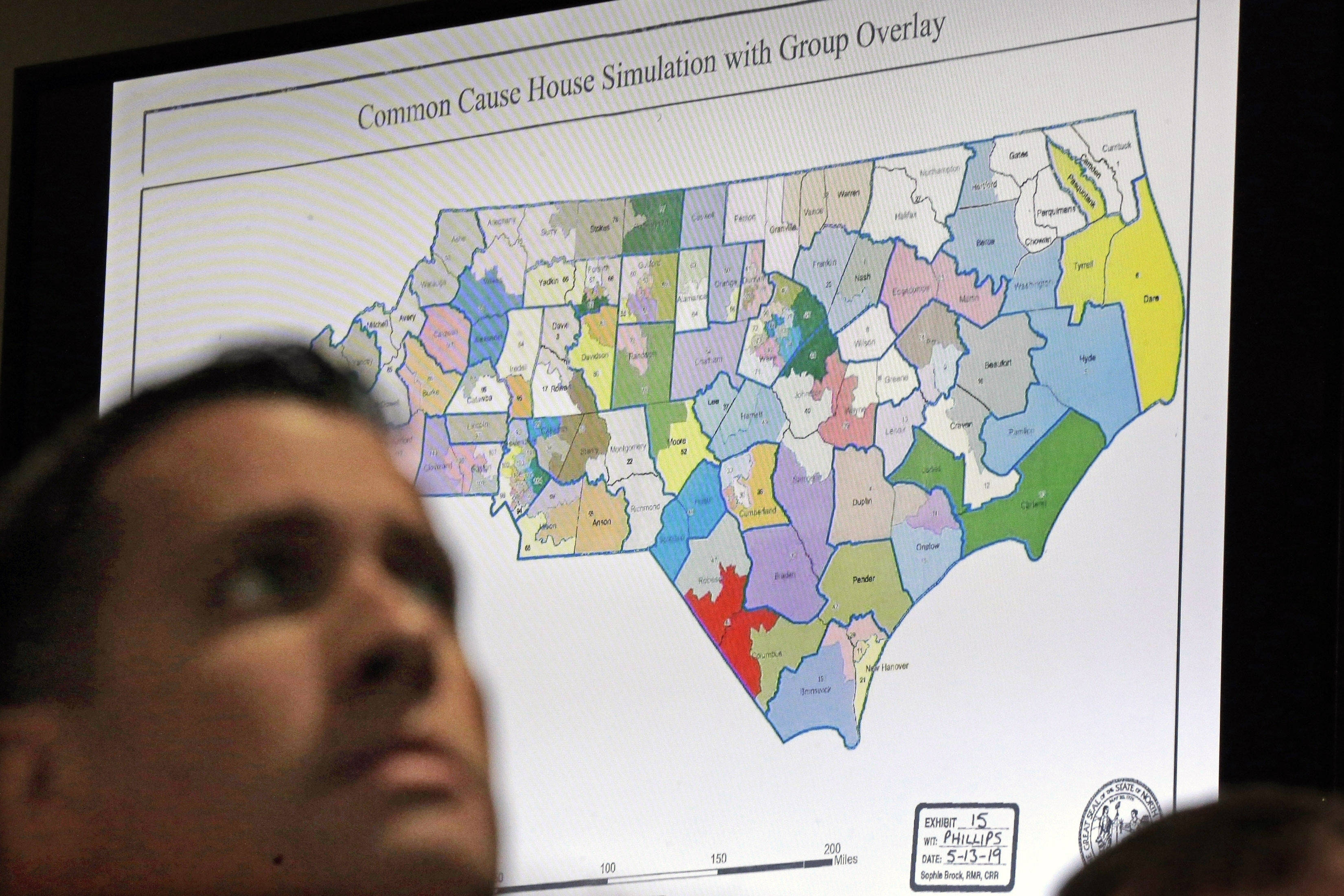 North Carolina congressional districts have been challenged in court for how sliced up they are. (AP Photo/Gerry Broome) | And it's happening now The whole process starts as soon as next week in some states and could be done in many by the end of the year. "There is real urgency on redistricting," said Michael Waldman, president of the Brennan Center for Justice, a public policy institute that advocates for fairer maps and voting rights. "There is real urgency on the voting laws. Some people say we can out-organize the voter suppression. You cannot out-organize a well-done gerrymander." What can Democrats do? A few options, none of them surefire. Win state legislative elections: They knew this was coming and tried to preempt some of it by regaining state legislatures and governorships in 2020. But they failed at that. Sue the maps in court: Which in many states is their only recourse to stop these maps from becoming law. They've already filed lawsuits in key states before the map-drawing has even begun, The Washington Post's Colby Itkowitz reported. U.S. Attorney General Merrick Garland has warned states that the Justice Department will challenge voting laws that it thinks run afoul of federal discrimination laws. But that's also reactionary; elections will likely be held under many GOP-drawn maps. Get rid of the filibuster and pass a voting rights bill. A voting rights bill passed by the Democratic-controlled House would ban redistricting to benefit one party over another, essentially eliminating both sides' ability to gerrymander. But it's stopped up in the Senate. Republicans argue that states should get to set their own policies. Beneath the surface, of course, is a realization that ending partisan gerrymandering would take away much of the GOP's power in key swing states. So in the Senate, they're filibustering the legislation, which means Democrats need 60 votes to overcome it. They only have 50. When put to the voters, such changes to the redistricting process have generally been popular. In 2020, Virginia voters approved an independent redistricting commission over the objection of Democrats in power. But there is zero chance Republicans in Congress will change this, and other voting laws. Democrats need to find a way to convince Sens. Joe Manchin (D-W.Va.) and Kyrsten Sinema (D-Ariz.) to end the filibuster, since they're the two main hold outs. And they're working on that, but it takes time. And time isn't on their side. "These things are hard," Senate Majority Leader Charles E. Schumer (D-N.Y.) told the New York Times's Ezra Klein in April. "Passing big comprehensive legislation … is difficult. And, so, there's no set path." | 




 Email
Email 


