| Welcome to The Daily 202 newsletter! Tell your friends to sign up here. On this day in 1934, the first wave of civilian prisoners arrived at the high-security prison known as Alcatraz. Republicans used to reliably exalt the military, line up with the private sector against regulation and extol the virtues not just of a government that governs best by governing least but of local control over top-down fiats. No more. A look at the carnival ride that is Republican politics in 2021 shows the GOP at odds with institutions and principles that used to be written into the party's DNA, perhaps especially the idea government closest to the people knows best. Instead, the so-called culture war — fights against "Big Tech," policies and ideas seen as "woke," and national efforts to promote coronavirus vaccines and other efforts to mitigate the resurgent pandemic — is now dominating the GOP and drives its parade of potential 2024 presidential contenders. Florida Gov. Ron DeSantis is, in some ways, the poster politician for the trend of trying to wrest control over local decisions from local officials — though he has stiff competition from Texas Gov. Greg Abbott. 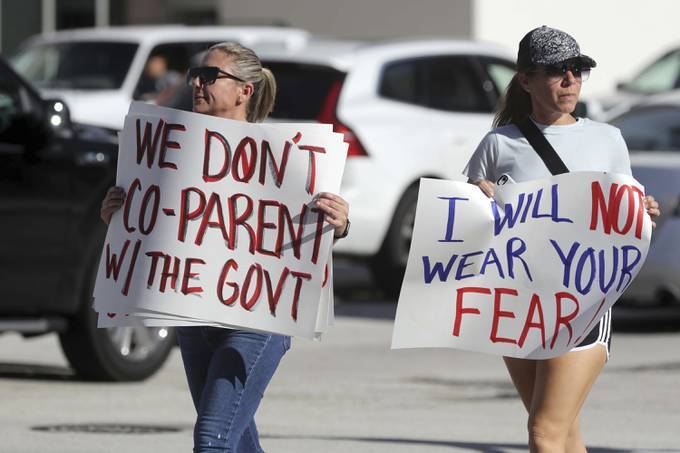 Christy Pavlish, left, and Lauren Birkins display signs outside a Broward County School Board meeting in Fort Lauderdale, Fla., on Aug. 10 to discuss a possible mask mandate when school starts next week. (Amy Beth Bennett/Sun-Sentinel/AP) | DeSantis and President Biden have been waging a long-distance war of words for days over the former's handling of the pandemic, even as cases and hospitalizations have soared in the Sunshine State. At the core of the dispute, the governor's order banning local authorities from mandating masks for children in school, and threatening financial sanctions for administrators and school boards who don't comply. (My colleague Greg Sargent has noted the mandate is porous: Kids can skip the face-covering if they have a note from a qualified medical professional.) "We can either have a free society or we can have a biomedical security state and I can tell you, Florida, we're a free state," DeSantis memorably said at a press conference last week. Whatever the outcome of his fights with Washington and with Florida school officials, DeSantis is clearly not embracing the traditional local-knows-best approach. The Florida governor is also an interesting test case for the newfound Republican enthusiasm for dictating to the private sector in ways that would make traditional laissez-faire market-economy Republicans blanche. He has signed a law imposing considerable economic punishments on private businesses that try to require proof of vaccination from potential customers — putting him at odds with the cruise ship industry, a major driver of Florida's economy. And he signed another law meant to punish "Big Tech" if it removes a politician in keeping with a platform's rules (for obvious, politically convenient reasons, the law exempts any such platform "operated by a company that owns and operates a theme park"). Constitutional experts contend the law violates the First Amendment. None of this starts or ends with DeSantis. Republican Gov. Brian Kemp of Georgia banned cities from mandating masks last summer. Abbott in June signed into law a measure aimed at punishing private businesses that require proof of vaccination. And it's also a bit simplistic, sanding down significant intraparty differences. Once and potentially future GOP presidential candidate Sen. Rand Paul (R-Ky.) has been a reliable critic of the Pentagon, and of U.S. use of force overseas, for instance. But there's little doubt which political figure supercharged each of these issues and made them into a test for politicians with aspirations to sit in the Oval Office. Former president Donald Trump spent four years berating private businesses, deployed federal agents to quell local protests in Portland, played down the severity of the pandemic, tried to unravel tech companies' speech protections, and ran in 2020 as the champion of reopening the country at all costs. Trump also waged a frontal assault on traditional Republican reverence for the military, famously dismissing the late Sen. John McCain's (R-Ariz.) time as a prisoner of war and accusing Pentagon leadership of waging wars to goose arms-makers' profits. In 2021, however, GOP attacks on the military have tended to focus on accusations of excessive sensitivity to the social minefield of race relations. These issues have obvious resonance among GOP voters, but it's also easy to make too much of them. Trump ran against the Republican establishment and won, but two of his most significant legacies — the 2017 tax law and seating scores of conservative judges on federal benches — reflected Republican orthodoxy. On the other hand, Republican voters have shown no appetite for punishing leaders for breaking with traditional party beliefs. | | | What's happening now "Prices rose 5.4 percent in July compared to a year ago, as policymakers at the Federal Reserve and Biden administration grapple with how long — and how high — inflation could climb as the economy rebounds," Rachel Siegel and Taylor Telford report. To start your day with a full political briefing, sign up for our Power Up newsletter. | | | Lunchtime reads from The Post - "How Cuomo's flexing of political power became his undoing," by Josh Dawsey and Michael Scherer: "Hours after the state attorney general released a scorching report last week that found New York Gov. Andrew M. Cuomo had sexually harassed 11 women and his staff had unlawfully retaliated against an alleged victim, the Rev. Al Sharpton said he received a call from the governor. 'Al, I'm telling you this is all a setup. You know setups when you hear them,' Cuomo said, according to the civil rights leader. 'He was in a fighting mood,' recalled Sharpton, who said he told the governor that while he was willing to hear his case, he thought the report appeared thorough. ... 'He didn't sound angry,' Sharpton said ... Cuomo's decision Tuesday to step down from office was not driven by a sense of penance or contrition, aides said, but rather by a recognition that his fate was set."
- "U.S. officials warn collapse of Afghan capital could come sooner than expected," by Dan Lamothe, John Hudson, Shane Harris and Anne Gearan: "The Biden administration is preparing for Afghanistan's capital to fall far sooner than feared only weeks ago, as a rapid disintegration of security has prompted the revision of an already stark intelligence assessment predicting Kabul could be overrun within six to 12 months of the U.S. military departing ... One official ... said Tuesday that the U.S. military now assesses a collapse could occur within 90 days. Others said it could happen within a month. Some officials said that although they were not authorized to discuss the assessment, they see the situation in Afghanistan as more dire than it was in June."
- "Affordable naloxone is running out, creating a perfect storm for more overdose deaths, activists say," by Meryl Kornfield: "An affordable antidote for opioid overdoses has become more difficult to obtain amid a fatal epidemic, in what advocates have called a 'perfect storm' with deadly consequences. After a manufacturing issue halted Pfizer's production of the single-dose injectable naloxone in April, groups that distribute a significant amount of the lifesaving medicine say they are facing an unprecedented obstacle to reverse drug overdoses as they reach an all-time high. Organizers say the insufficient supply has been felt unequally across the country."
| | | … and beyond - "Federal prosecutors came to suspect Trump Org CFO Allen Weisselberg lied, and considered charging him with perjury," by CNN's Erica Orden and Kara Scannell: "New York federal prosecutors came to suspect the Trump Organization's chief financial officer, Allen Weisselberg, lied in testimony during their investigation of former Trump personal attorney Michael Cohen three years ago ... Despite their suspicions, federal prosecutors did not pursue perjury charges against Weisselberg, but his past interactions with them could now become relevant to the Manhattan district attorney's office as it seeks his cooperation in a tax fraud case brought against Weisselberg and the company last month."
| | | At the table Today we're lunching with Mayor Jim Brainard (R) of Carmel, Ind., to talk about his successful vaccination campaign in a red state where inoculations lag behind the national average. The conversation has been lightly edited for clarity and length. Knox: Mr Mayor, what percentage of Carmel residents has been vaccinated as of today? Brainard: Eighty-one percent of eligible residents [people over 12 years old]. Knox: Did you encounter significant resistance at any point? If so, from whom? Brainard: There are a group of people that disagree that we should be requiring new hires, for instance, for the city of Carmel to be vaccinated and others who — unfortunately, they're everywhere — believe some of these crazy conspiracy theories, that we read on illegitimate websites. 'There's a chip in the vaccine so you can be tracked by Bill Gates," on and on, real crazy things. Knox: In your experience, what strategies best overcome vaccine hesitancy, or skepticism, or resistance? Brainard: Carmel, Indiana is fortunate in that 78 percent of our adult population holds a university degree, about 102,000. Forty percent of our population holds a graduate degree. Because of the good fortune these folks had to go to university and do graduate work, they're probably in a better position to analyze the information they receive and evaluate it properly. In addition to that, though, we've had our fire department out, providing public education; EMS workers, the people that have to take dying covid patients to the hospital. They've been very effective. They've set up tents now for months in parking lots of major stores, grocery stores, and so on, and provided public education on the vaccine, and how to stay safe from the virus before that. We've done testing, very seriously, to see how the levels go up and down and shared that information with the public, you know, encourage them, saying 'we can get this under control.' Provided good local data for them. We have done pop-up vaccine clinics at public concerts, outdoors, all sorts of other events. And then of course the city has provided a lot of good information on its websites and social media sites and so on. And we've encouraged people to talk to the medical professionals. Those things, cumulatively, have all made a difference. Knox: It seems some of the stiffest resistance is among Republicans. How do you overcome that? I have a pile of statements from former president Trump in my in-box, but not one includes an appeal to get vaccinated. Wouldn't it help for him to take a more active role? Brainard: I do not believe that he should continue to be involved in public policy questions at this point. However, I think that there are many Republican leaders that need to speak out. I represent a city that is majority Republican, yet we have an 80 percent plus vaccination rate. So I don't think it has to be about politics. I think it is much more about educational level, demographics, training tand local culture than it is about who you vote for. Knox: What are the best things the federal government could do to convince more Americans to get vaccinated? Brainard: Simple, clear, messaging from all the various agencies. Those of us who have suffered through graduate-level science courses know that there's always nuances and lots of shading in any field of study at a high level. But because of that and the, I think failure is the right word, early on of those involved in the governmental scientific community to bring down the message to a very understandable, clear, concise, easy message to understand, we've suffered. It's very simple. We've all been vaccinated for other diseases, terrible diseases in the past. Probably we should be talking more about how we beat polio, and diphtheria and typhoid and some of those scourges of the past. And talking about, you know, 'I hear that 5,000 people suffered from some strange, unique side effect' [after getting vaccinated]. That seems like a lot of people to a lay person. But that's out of hundreds of millions of people who've taken the vaccine. That sort of message is not getting out of this, the smallness, quite honestly. The fact that covid is far, far more dangerous than any potential side effect. And just the messaging from the scientific community, the government, has not been good. It has been as if they're reaching out to other scientists, nuancing and hedging everything they say. Well, that scares the average guy or woman that is not a scientist. | | | On the Hill Senate Democrats adopted a sweeping $3.5 trillion budget — opening the door to health, education and tax reforms – hours after the chamber advanced the bipartisan infrastructure bill. - "The 50-49 vote came early Wednesday morning, after lawmakers sparred in a marathon debate over the proposed sizable increase in spending and its potential implications for the federal deficit. Its passage marked another critical milestone in Democrats' complex economic agenda, which includes new public-works investments that Republicans support — and a slew of additional policy proposals that the GOP does not," Tony Romm reports.
- "Chiefly written by Sen. Bernie Sanders (I-Vt.), the $3.5 trillion blueprint sets in motion Democrats' plans to expand Medicare, combat climate change and boost federal safety net programs, including those that target children and low-income parents. It paves the way for universal prekindergarten and new family leave benefits, and it aims to help immigrants obtain legal permanent residency status."
- "Democrats aspire to finance the array of new initiatives through tax increases targeting wealthy families and profitable corporations."
- "Lawmakers still must translate their newly adopted budget into fuller legislation, meaning the more difficult fights over its exact contours are set to begin in earnest in September. Adding to the challenge, one of the Senate's most pivotal swing votes, Sen. Joe Manchin III (D-W.Va.), said hours after he voted on the measure that he has 'serious concerns' about its price tag."
- "For now, though, the successful adoption of the budget still unlocks for Democrats the next step in the process: a legislative move known as reconciliation. The maneuver allows the party, once ready, to bypass a Republican filibuster in the narrowly divided Senate — but only if the caucus remains united."
- "The coupling of the two spending plans also reflected the simmering tensions within the Democratic caucus, since some party lawmakers see the infrastructure deal as insufficient ... House Democrats have drawn the firmest lines in the sand, a position driven by the 96-member Congressional Progressive Caucus, without which House Speaker Nancy Pelosi (D-Calif.) cannot move either proposal through the chamber."
- "But Democrats are not entirely in lockstep on the path ahead. Some moderate lawmakers in the House, for example, do not want to wait for reconciliation to advance infrastructure reform."
- "The GOP's opposition also threatens to spill beyond the budget, as lawmakers led by Senate Minority Leader Mitch McConnell (R-Ky.) have said they are unwilling to supply any votes to address the debt ceiling, the statutory limit on how much money the United States government can borrow. McConnell said an increase or suspension of that borrowing limit should be a part of reconciliation, an approach Democrats have opted not to take, putting the Senate on a potential collision course ahead of a key deadline this fall."
- "Reaffirming their stance, a group of 46 Republicans late Tuesday published a public letter saying they would 'not vote to increase the debt ceiling' in any way."
The GOP is hoping Manchin and Sen. Kyrsten Sinema (D-Ariz.) pare back their party's spending bill. - "After 19 GOP senators boosted a bipartisan infrastructure plan past a filibuster and onto the House, Republicans are yearning for results from their cooperation with Manchin and Sinema's effort. Namely, they're hoping to persuade the [two] to buck their party and shave down the social spending bill by holding out their votes," Politico's Burgess Everett reports.
- "Republicans who speak frequently to the duo are realistic about their chances, acknowledging it's highly unlikely Sinema and Manchin would end up blocking their party's biggest priorities altogether. ... Sen. Susan Collins (R-Maine), who is close to both senators and is trying not to overtly pressure them, said 'each of them is fiscally responsible and are people of courage. And so I hope they will break on this enormous expansion of government.' "
The Senate adjourned until September without advancing voting rights legislation. - "Under mounting pressure to advance the issue, Senate Democrats moved to set the stage for a new round of procedural votes in mid-September after Republicans objected to the immediate consideration of several voting bills in the wee hours Wednesday," Mike DeBonis reports.
- "But the path to enactment of federal voting standards appears no clearer now than it did in June, when Republican senators blocked consideration of sweeping elections, ethics and campaign finance legislation known as the For the People Act. Speaking on the Senate floor Wednesday, McConnell called the legislation a 'ridiculous, go-nowhere bill' written to advantage Democrats over Republicans. Democrats, he said, should expect no different result in the future."
| | | Quote of the day "I've never felt that we ought to be perceived as being opposed to everything," McConnell told Mike DeBonis yesterday, before commenting on the slim Democratic congressional majorities, then rattling off bipartisan bills that passed during his time as party leader under two previous presidents. "My point is, the Senate has never been dysfunctional," he added. "It's only called dysfunctional when liberals are in the majority and they can't get what they want." | | | The Biden agenda Biden will convene a summit of democracies in December. - "Biden will convene dozens of elected world leaders in December for a virtual summit that celebrates democracy and explores ways that like-minded nations can link arms against authoritarianism, fulfilling a campaign promise," Anne Gearan reports. "The event will take place Dec. 9 and 10, and invitations will go out within weeks."
- "The official, who spoke on the condition of anonymity to describe the event ahead of the announcement, said the list of invitees is not final and will depend in part on which nations appear receptive. The person would not confirm whether particular leaders were likely to receive invitations but said the goal was to convene a mix of established democracies and "emerging" ones."
Experts are warning Biden to "act now" on global vaccines to stop more variants. - "More than 175 public health experts, scientists and activists on Tuesday demanded that President Biden take urgent steps to confront the global spread of the coronavirus, warning that without immediate action to inoculate the rest of the world, newer variants are likely to emerge — including ones that may evade vaccines' protection," Dan Diamond and Yasmeen Abutaleb report.
- "We urge you to act now," the experts wrote in a joint letter to senior White House officials Tuesday and shared with The Post. "Announcing within the next 30 days an ambitious global vaccine manufacturing program is the only way to control this pandemic, protect the precious gains made to date, and build vaccine infrastructure for the future."
The Biden administration is looking for ways to pay Florida educators if Gov. Ron DeSantis withholds their salaries over mask mandates. - "The announcement Tuesday was a sharp response to DeSantis (R), who has threatened to withhold the salaries of superintendents and school board members who defy his executive order banning classroom mask mandates," Annie Linskey reports. "The White House is also considering using the federal government's spending power to push entities such as long-term-care facilities to require that their employees get vaccinated."
- "On Tuesday, President Biden took aim particularly at GOP leaders like DeSantis who, he said, deride mask mandates as government overreach but have no problem imposing their own will on local school districts. 'I find that totally counterintuitive and frankly disingenuous,' Biden said."
Hundreds of migrants expelled from the U.S. to Mexico have been pushed to a remote village in Guatemala. - "Last week, the Biden administration began the expulsion flights to the southern Mexican city of Villahermosa in a bid to deter repeat border crossers. Mexico agreed to accept those flights and said it would allow those who feared persecution in their home countries to apply for asylum," Kevin Sieff reports. "But the migrants — mostly from Honduras, El Salvador and Guatemala — who have arrived in the remote Guatemalan border town of El Ceibo describe a chaotic series of expulsions, first from the United States in planes and then from Villahermosa to Guatemala by bus. They say they were not given an opportunity to seek refuge in Mexico."
| | | Hot on the left The Texas House Speaker Dade Phelan (R) signed arrest warrants for the Democrats who broke quorum over voting restrictions. "The move followed approval of a House motion to send for absent members, which enabled Phelan to issue the warrants. The Texas Supreme Court on Tuesday also stayed a trial court judge's ruling that would have protected absent Democrats from arrest," Eva Ruth Moravec and Elise Viebeck report. "Phelan spokesman Enrique Marquez said warrants were signed for 52 Democrats who failed to return during the fourth day of the House's second special session, leaving the chamber eight members short of a quorum. … While lawmakers would not be jailed if arrested, they may be brought into the Capitol by law enforcement once the warrants are delivered to the House sergeant-at-arms to be served." | | | Hot on the right "Republicans have found a new boogeyman in the battle for the House: the nation's top public health agency," writes CNN's Melanie Zanona: "As Republicans head back to their districts for the August recess, they are hammering the CDC and seizing on the backlash to new mask and vaccine mandates — part of a GOP-wide effort to use the fears and frustrations of Americans worried about another round of school closures and lockdowns as cudgels against their Democratic opponents. ... Minority Leader Kevin McCarthy (R-Calif.) continued to beat that drum on Tuesday, firing off a new letter to the Capitol physician and saying in a separate statement that Biden has 'threatened a return to lockdowns and government-mandated restrictions for American citizens.' Meanwhile, 'Fire Fauci' — a reference to infectious disease expert Dr. Anthony Fauci — has become a new rallying cry on the right, with some campaigns even selling anti-Fauci merchandise. And Sen. Rand Paul (R-Ky.), a doctor, recently went on a tirade against the CDC and brazenly called on the public to defy health protocols." | | | Growth in America's developed areas, visualized The United States added 14,000 square miles of new land development since 2001. Search our map to see how your area changed. | | | Today in Washington Biden is meeting with business, university and health-care leaders to discuss strategies to get more Americans vaccinated. At 1:15 p.m., Biden will deliver remarks on his plan to create jobs and generate economic growth. At 3 p.m., he will meet virtually with governors, mayors and other state and local officials to discuss the importance of the infrastructure bill. | | | In closing | Stephen Colbert said Andrew M. Cuomo gave himself a two-weeks notice:  | | | | And an expert debunked a vaccine misinformation video with an impressive amount of patience: |  | | | | | | |


 Email
Email