| Welcome to The Daily 202 newsletter! Tell your friends to sign up here. We're going to be a little light for a few days, as the mighty Mariana Alfaro is out. And "At The Table" is on hiatus this week. For now, forget the drones and special forces raids. President Biden and staunch U.S. allies are pivoting to diplomatic and economic levers to pressure the Taliban to let people evacuate beyond the Aug. 31 deadline for a full U.S. withdrawal. British Prime Minister Boris Johnson, who failed to convince Biden to extend that timetable, insisted after leading a virtual summit of the Group of Seven (G7) rich democracies that America and its partners have "huge leverage" over the Islamist militia. "The No. 1 condition we're setting as G7 is that they've got to guarantee right the way through, through August 31 and beyond, safe passage for those who want to come out," Johnson said. "Some of them will say that they don't accept that, some of them I hope will see the sense of that, because the G7 has very considerable leverage, economic, diplomatic and political," he said. Biden promised yesterday to keep his deadline — conditional on the Taliban letting people reach the airport in Kabul, and with "contingency" plans to extend it — amid warnings sticking to the plan could strand Americans, citizens of friendly nations and Afghans who helped the 20-year war effort, like interpreters. But his well-known eagerness to leave Afghanistan has precipitated conversations in Washington and other world capitals looking beyond the military presence. Leaders are pondering other means of convincing the Taliban not to roll back gains on issues like girls' education made there in the two decades since U.S. forces shoved them from power. 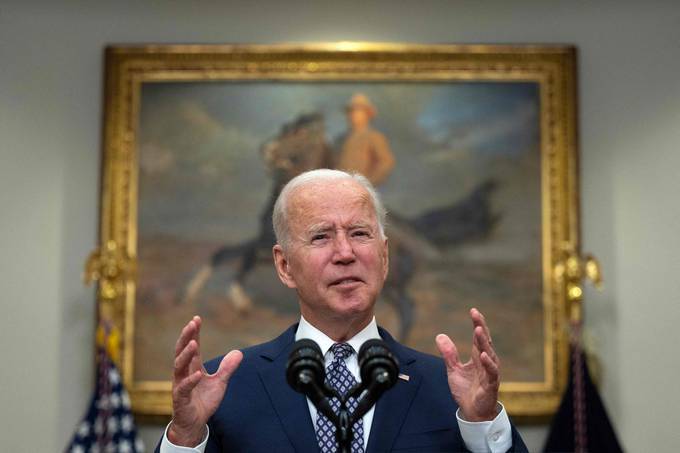 President Biden promised to keep his deadline for the U.S. withdrawal from Afghanistan — conditional on the Taliban letting people reach the airport in Kabul, and with "contingency" plans to extend it. (Jim Watson/AFP/Getty Images) | To the degree the public keeps its attention on Afghanistan — and that's far from a sure bet — some U.S. officials worry images of violent repression, a hallmark of the previous Taliban regime, could weigh on voters' assessments of the withdrawal, potentially shaping elections in 2022 and beyond. Whether the prospect of international aid and recognition can actually move the Taliban will be seen in the coming weeks and months. Ironically, the departure of American forces will deprive Washington of what may be its single biggest lever: The Taliban's profound eagerness for U.S. troops to be gone. Military force remains on the table as an option for smothering any terrorist scheming to attack America. But when it comes to other interests, other levers, like granting or withholding diplomatic recognition and international aid, are increasingly getting attention. Biden, who has not ruled out formally recognizing the Taliban-run government as legitimate when it's eventually set up, seemed to allude yesterday to that diplomatic prospect. "The legitimacy of any future government depends on the approach it now takes to uphold international obligations, including to prevent Afghanistan from being used as a base for terrorism," he said. "None of us are going to take the Taliban's word for it." A joint statement by the G7 leaders, including Biden, declared "our immediate priority is to ensure the safe evacuation of our citizens and those Afghans who have partnered with us and assisted our efforts over the past twenty years, and to ensure continuing safe passage out of Afghanistan." It did not mention Aug. 31. At the Guardian, Dan Sabbagh, Peter Walker, Aubrey Allegretti and Daniel Boffey reported the British prime minister laid out "conditions for unfreezing billions of dollars in aid." " 'If those huge funds are going to be unfrozen eventually for use by the government and people of Afghanistan, then what we're saying is Afghanistan can't lurch back into being a breeding ground of terror, it can't become a narco state, girls will be educated up to the age of 18, and so on,' he said." "Britain is among nations pushing to establish whether a civilian-run airport in Afghanistan could be used after 31 August, possibly operated by Turkey, in the hope that those at risk from the Taliban — including human rights activists, judges, prosecutors and LGBTQ+ advocates — will be able to find a route to safety," they reported. "Separately, the EU announced it was freezing €1bn in development aid it has set aside for Afghanistan over the next seven years as Brussels sought to use its financial leverage to secure assurances over the treatment of women and minority groups," the Guardian said. (Interestingly, Secretary of State Antony Blinken spoke to his Turkish counterpart yesterday "to discuss our continuing cooperation in Afghanistan and our efforts to ensure the safe and orderly evacuation of our citizens, allies, and partners," according to the State Department.) Yesterday wasn't the first time Biden or his top aides have faced the question of international legitimacy for the Taliban. On Sunday, he said a future Taliban government is "going to need everything from additional help, in terms of economic assistance, trades, and a whole range of things." "The Taliban has said — we'll see whether they mean it or not — they're seeking legitimacy. They're seeking legitimacy to determine whether or not they will be recognized by other countries," he said. On Aug. 17, national security adviser Jake Sullivan brushed aside the question of whether Washington recognized the Taliban as the legitimate governing power in Afghanistan. "Ultimately, it's going to be up to the Taliban to show the rest of the world who they are and how they intend to proceed. The track record has not been good, but it's premature to address that question at this point," Sullivan added. Asked two days before that whether the Biden administration would ever consider recognizing the Taliban, Blinken laid out the case for and against in a way that made clear Washington sees it as leverage. "A future Afghan government that upholds the basic rights of its people and that doesn't harbor terrorists is a government we can work with and recognize," he told Jake Tapper. "Conversely, a government that doesn't do that — that doesn't uphold the basic rights of its people, including women and girls; that harbors terrorist groups that have designs on the United States or allies and partners — certainly, that's not going to happen," Blinken said. "And beyond that, to the extent that the Taliban has a self-interest if it's leading the government in Afghanistan of assistance from the international community, support from the international community, none of that will be forthcoming. Sanctions won't be lifted, their ability to travel won't happen if they're not sustaining the basic rights of the Afghan people and if they revert to supporting or harboring terrorists who might strike us." Whatever the results, Biden plainly wished for another outcome in Afghanistan. Asked Feb. 23 whether the president would be okay with the Taliban in control there, White House press secretary Jen Psaki replied: "No, I don't think he would say he'd be okay with that." | 


 Email
Email