| Welcome to The Daily 202 newsletter! Tell your friends to sign up here. On this day in 1945, the United States became the first and only country to use an atomic weapon in wartime, dropping a bomb dubbed "Little Boy" on the Japanese city of Hiroshima. The United States will learn a lot about itself next Thursday. Then politicians will immediately get to fighting about what the precise political implications should be. The Census Bureau announced yesterday it will release detailed findings of the constitutionally mandated, once-a-decade population count on Aug. 12. The data will flesh out the who, what and where of the 331,449,281 people who live in the United States. As my colleague Tara Bahrampour reported: "The files will show how the ethnic, racial and voting-age makeup of neighborhoods have shifted over the past decade. It is the data most state legislatures use to redraw political districts for the next 10 years." And it's that process that will probably turn into the biggest political battle of 2021, perhaps even the fiercest fight before the 2022 midterms. 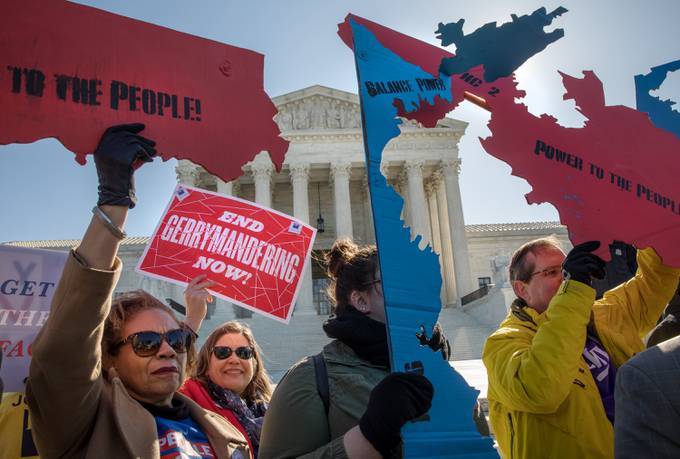 Demonstrators protest against gerrymandering at a rally at the Supreme Court. (Evelyn Hockstein for The Washington Post) | The GOP enjoys several advantages heading into the process. Red states have enjoyed population growth, some major blue states have seen their numbers drop, and Republicans have control over more of the state legislatures that will draw the new lines. But Republicans and Democrats predict redistricting alone could pave the way for the GOP to regain control of the House, where President Biden's party has a razor-thin majority. And its effects will be felt through the next census, in 2030. Earlier this year, the New York Times's Reid J. Epstein and Nick Corasaniti reported: "Republicans hold total control of redistricting in 18 states, including Florida, North Carolina and Texas, which are growing in population and expected to gain seats after the 2020 census is tabulated. Some election experts believe the G.O.P. could retake the House in 2022 based solely on gains from newly drawn districts. Already, Republicans are discussing redrawing two suburban Atlanta districts held by Democrats to make one of them more Republican; slicing Democratic sections out of a Houston district that Republicans lost in 2018; and carving up a northeastern Ohio district held by Democrats since 1985." And that was before the early Census Bureau data showed which states gained or lost House seats as a consequence of ten years of demographic changes. California, Illinois, Michigan, Ohio, West Virginia, Pennsylvania and New York each shed one seat. Oregon, Montana, Colorado, North Carolina, and Florida each gained one seat. Texas picked up two. In some cases, it was a very near thing, as Tara, Harry Stevens, Adrian Blanco and Ted Mellnik reported back in April: "A couple of the shifts were by razor-thin margins, with New York losing a seat by just 89 people and Minnesota holding on to one by just 26 people." That piece, which I cannot recommend enough, also noted U.S. population growth over the past decade slowed to its slowest rate since the 1930s, the second most sluggish since the first census in 1790. "Unlike the slowdown of the Great Depression, which was a blip followed by a boom, the slowdown this time is part of a longer-term trend, tied to the aging of the country's White population, decreased fertility rates and lagging immigration. It resulted in fewer seat shifts than anticipated, with Texas and Florida gaining just two and one, respectively, and Rhode Island holding on to its second seat." A House district must have roughly the same population as the other House districts in the same state.  The Texas State Capitol in Austin. (AP Photo/Eric Gay, File) | Shaping the outcome of an election by drawing district lines for partisan advantage is basically as old as the republic. The most famous instance, from 1812, gave us the term gerrymander, named for Massachusetts Gov. Elbridge Gerry and a district that supposedly resembled a salamander. (Trivia: The "G" in Gerry was a hard "G," like "get outta here with that crazy district, governor.") And it's not just about the House — state legislatures will also be affected, with potentially huge ramifications, election experts Alex Keena, Michael Latner, Anthony McGann and Charles Anthony Smith wrote in The Washington Post in May: "The GOP's redistricting advantage could ensure Republican control of dozens of state legislatures for the next decade. In a few state legislatures, Republicans could draw themselves supermajorities, giving them the votes to override a governor's veto." The 2020 census was the subject of partisan fighting almost from the start. As Tara, Kate Rabinowitz and Ted wrote in April: "Decennial census data is used to determine the apportionment of House seats, redistricting and $1.5 trillion a year in federal funding, so the release of its data is always closely scrutinized. But this time, perhaps more than ever, the count faced unprecedented hurdles. They included underfunding, attempts by the Trump administration to add a citizenship question and exclude undocumented immigrants from apportionment, the coronavirus pandemic, and natural disasters that struck just before the count ended." And the redistricting fight, too, technically began months ago — within hours of the Census Bureau releasing apportionment results, Roll Call's Michael Macagnone reported. My colleague Colby Itkowitz reported this week on "lawsuits filed in nearly a dozen states, signaling how intense the fight for partisan power in the states and Congress will be in the coming year. Many of the early moves have been made by Democrats, who are scrambling to make up a historic deficit when it comes to the bare-knuckle redistricting process that Republicans used in 2011 to cement their dominance at state and national levels." As Colby notes, the fight over state legislatures has taken on added importance this year, as Republicans have been rewriting election rules in states they control to make it easier for those lawmakers to take control of election results — notably in the 2024 presidential contest. | | | What's happening now The U.S. economy added 943,000 new jobs in July as the labor market's recovery boomed, Eli Rosenberg reports. "The unemployment rate fell to 5.4 percent from 5.9 percent, a sizable monthly drop. It was the highest number of jobs added since last August, and surpassed June's impressive numbers, which were revised up in the latest report to 938,000." To start your day with a full political briefing, sign up for our Power Up newsletter. | | | Lunchtime reads from The Post - "Washington's hottest club is Joe Manchin's houseboat," by Ben Terris: "Generally speaking, the first rule of visiting Joe Manchin III's houseboat is don't talk about Joe Manchin's houseboat. This week, however, when Sen. Lindsey Graham (R-S.C.) tested positive for the coronavirus after attending a weekend cruise on Almost Heaven — named after the opening line of John Denver's elegy to West Virginia, 'Take Me Home, Country Roads' — it's all anyone in Washington wanted to discuss. News releases began pouring out from the offices of Sens. Mark Kelly (D-Ariz.), Jacky Rosen (D-Nev.) and Catherine Cortez Masto (D-Nev.) admitting that the senators had been onboard but emphasizing that they'd followed public-health guidelines about testing and masking. Rumors spread throughout Capitol Hill that Sen. John Thune (R-S.D.), a regular on the boat, had been spotted wearing a mask outside of the Senate physician's office (his office later said he tested negative).
"Some lawmakers made efforts to tamp down any sense of scandal or indulgence. 'It was a cookout,' Sen. Christopher A. Coons (D-Del.) said ... 'There's no 'parties,' ' Manchin himself said of the semi-mysterious doings onboard his precious vessel. 'Basically, there's gatherings we have on Almost Heaven. We know each other and talk to each other.' ... So far, nobody beyond Graham has reported a positive test. But the notion that Almost Heaven might become the Diamond Princess of the Potomac put a spotlight on what has become a crucial destination for members of Official Washington." - "Cryptocurrency brawl bogs down infrastructure bill, as Yellen and White House fight changes," by Jeff Stein and Jacqueline Alemany: "The Biden administration is pushing back against a last-minute effort by a bipartisan group of senators to limit a proposal in the infrastructure bill to increase federal regulation of cryptocurrencies. The fierce lobbying push helped stall plans to finish voting on the bill Thursday night, and now it appears debate will stretch into the weekend."
- "Dixie Fire destroys much of California town as officials warn: 'You MUST leave now,'" by Paulina Firozi, Bryan Pietsch and María Luisa Paúl: "Now the largest wildfire the state has faced this year, it has burned for more than three weeks and is now 35 percent contained. It grew to more than 361,812 acres as of Thursday evening amid a red-flag warning — indicating the risk of 'extreme fire behavior' caused by hot, dry and windy conditions. ... The U.S. Forest Service said it anticipates more concerning fire behavior, predicting it will torch down the landscape's trees. The inferno's urgency, size and extreme behavior have led authorities to consider it 'top priority' — with 25 percent of the country's firefighting resources distributed to the Dixie Fire operation."
| | | … and beyond - "The weird, sustainable booze of the future tastes ... Good?" by Wired's Adam Rogers: "Empirical makes a half-dozen spirits, and only one of them fits the classic dozen or so categories you'd see on signs above the aisles in a BevMo. Their newest, Ehime, is definitely bourbon-like — brown, made from grain, aged in a barrel. (It's also partially fermented with koji, the fungus that makes sake.) ... It's weird, yeah — but maybe the weirdest thing about all this atypical, unclassifiable booze is how normal it actually is. Spirits are going through a kind of a biotechnical revolution, an application of new methods and a rediscovery of old ones, applied to classic and unfamiliar ingredients alike."
- "How Trump stiff-armed Congress — and gaslighted the courts — to build his wall," by Politico's David Rogers: "Pentagon records obtained by POLITICO paint the clearest picture yet of how far the Trump administration went to get around Congress and speed the diversion of military construction funds to build its border wall in 2019. The diversion, totaling $3.6 billion, disrupted scores of improvements for military operations and the quality of life for troops and their families. The newly released documents provide the first-ever look at the inner workings of how that money was moved around — and it's not a pretty sight for congressional committees, which were left in the dark and denied basic answers about the accounting maneuvers."
| | | The Biden agenda Despite Biden's vaccine order for federal workers, the surge of the delta variant is causing some back-to-work plans to be scrapped. - "The Biden administration is selling its new order that 2.1 million civilian federal employees get vaccinated or face repeated testing as a bold step that will allow the government to safely bring its workforce back to the office and resume normal operations, even as the highly contagious delta variant surges," Lisa Rein and Eli Rosenberg report.
- "But for many federal agencies, the White House's public stance and its internal communications with civil service unions — committing to a return to the office for hundreds of thousands of employees and contractors still logging in to work from the safety of their homes — belies the reality on the ground."
- "Carefully developed plans to begin phasing staffs back after Labor Day are now in jeopardy, officials say privately, with the Pentagon sending thousands of employees home on Monday — just three weeks after recalling more people to the building. Meanwhile, leaders at the Department of Veterans Affairs are in daily discussions about whether to tell their teleworking staffs they should not return after the holiday after all, officials said."
- "Federal managers say they have little idea how to roll out a massive, first-of-its-kind plan to ask employees whether they're vaccinated, impose testing as frequently as twice a week if the answer is no and move to dismiss them if they're found to be untruthful. ... An official with the Office of Management and Budget said guidance on how the vaccine plan should roll out will be coming to federal agencies 'in the near future.'"
Samantha Power has long championed humanitarian intervention. Ethiopia's crisis is putting her to the test. - "Amid allegations that Ethiopian troops and their allies have committed war crimes and ethnic cleansing and have driven parts of Tigray into famine, the United States has already withheld security assistance and effectively banned travel for top officials," Max Bearak and John Hudson report. "But Power, who is in charge of the U.S. Agency for International Development, or USAID, holds the biggest American lever of influence over Addis Ababa: more than $1 billion in annual aid ranging from health and education support to food and emergency humanitarian response, which makes the United States the largest aid donor to Ethiopia."
- "It's a moment seemingly made for Power, the former U.N. ambassador under President Barack Obama who came to prominence in 2002 with her book 'A Problem From Hell,' which excoriated American inaction during mass killings in Rwanda and the Balkans in the 1990s, Europe during World War II and the Ottoman Empire during World War I."
- "Power's one-day trip Wednesday to Ethiopia, which didn't include a meeting with Prime Minister Abiy Ahmed, was a test of whether she can restore faith in America's role in preventing mass atrocities beyond its borders. So far, the U.S. measures curtailing security assistance and sanctioning officials have had little effect beyond turning Ethiopian sentiment against Washington."
 Samantha Power, Administrator of the United States Agency for International Development, speaks at a hotel in Sudan's capital Khartoum on August 3. (Photo by ASHRAF SHAZLY / AFP) | | | | Quote of the day "It wasn't dissent. It wasn't debate. It wasn't democracy," Biden said as he signed legislation awarding the Congressional Gold Medal to police who defended the Capitol on Jan. 6. "It was insurrection. It was riot and mayhem. It was radical and chaotic, and it was unconstitutional. Maybe most important, it was fundamentally un-American." Florida Gov. Ron DeSantis is sticking to a hands-off covid approach as hospitalizations hit a record high. - "Florida is the epicenter of a summer coronavirus spike fueled by the highly transmissible delta variant, reporting a fifth of all new U.S. infections and current hospitalizations. New cases and admissions have surpassed last summer's Sun Belt surge. Florida is center stage of a dangerous phase of the pandemic where a new strain spreads more rapidly in a fully reopened society, attacking young and middle-aged adults and filling up hospital beds faster than ever," Fenit Nirappil, Brittany Shammas and Lori Rozsa report.
- "Florida also illustrates a new dynamic in the pandemic now that vaccines are widely available: Some Republican leaders have decided new surges are tolerable and do not require a robust response to quell. Some, including DeSantis, are treating a return of mask mandates and shutdowns as the greater threat."
- "'We can either have a free society or we can have a biomedical security state and I can tell you, Florida, we're a free state,' DeSantis said at a Wednesday news conference. 'People are going to be free to choose to make their own decisions about themselves, about their families, about their kids' education, about putting food on the table.' DeSantis, running for reelection next year, has dug into an approach that rejects restrictions that disrupt a tourism-heavy economy and treats public health measures as individual choices."
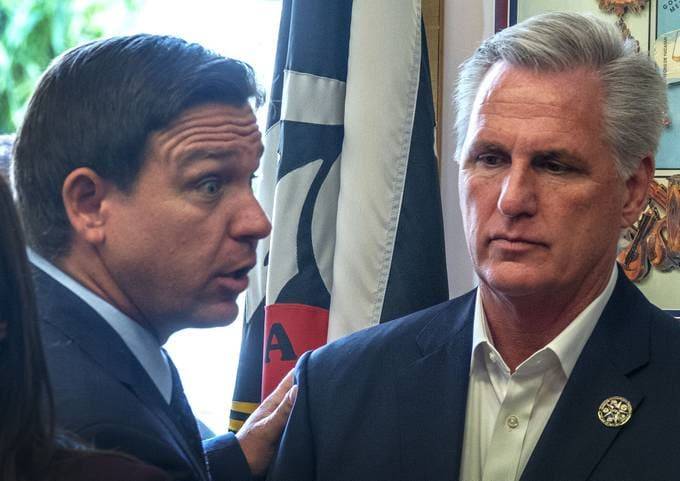 Florida's Governor Ron DeSantis speaks with the House Minority Leader Kevin McCarthy during a meeting with members of the Cuban exile in Miami in Hialeah Gardens, Florida on Thursday. Mandatory Credit: Photo by CRISTOBAL HERRERA-ULASHKEVICH/EPA-EFE/Shutterstock | Rep. Ralph Norman, one of the congressional Republicans suing House Speaker Nancy Pelosi over a House mask mandate, said he has coronavirus. - "Norman, who has said he has been fully vaccinated since February, tweeted that he began experiencing minor symptoms of COVID-19 on Thursday, tested positive for the virus that day and would quarantine for 10 days," the AP reports. "Representing South Carolina's 5th District since 2017, Norman is part of a federal lawsuit against Pelosi over a mandate earlier this year that members wear masks while on the House floor."
United Airlines became the first carrier to mandate vaccines for U.S.-based employees. - "The company's mandate will apply to all 67,000 of its active, U.S.-based employees, the company said," Lori Aratani reports. "It's not clear whether other airlines will follow United's lead, but at least one carrier ruled it out this week."
- "American Airlines chief executive Doug Parker said Thursday on a New York Times podcast that he hoped $50 gift cards and an extra vacation day in 2022 to employees who are vaccinated by Aug. 31 would be enough of an incentive."
CNN fired three workers who turned up to work unvaccinated. - "Jeff Zucker, the cable network's president, wrote in a Thursday memo obtained by The Washington Post that CNN was 'made aware' in the past week of three employees violating its policy that only fully inoculated people work from its buildings," Andrew Jeong reports. "'All three have been terminated. Let me be clear. We have a zero-tolerance policy on this,' Zucker wrote. He added that staffers working with colleagues in the field must also be inoculated, even if they do not enter an office owned by the network."
- "CNN had been using an honor system to monitor its employees' vaccination status, although Zucker said that might change in the coming weeks. Zucker's note did not indicate how the company learned of the vaccination statuses of the fired employees, which it did not name, or include further details."
Will students get the vaccine? Some colleges aren't keeping track. - "A Washington Post survey of a number of prominent universities found several that publicize vaccination rates, even among schools that are not mandating shots," Nick Anderson and Susan Svrluga report. "Health experts and education leaders lament that political pressures often limit how colleges respond to the pandemic. Many aren't allowed to require coronavirus vaccines or surveillance testing for the virus, and they face major hurdles in gathering student vaccination records."
- "'State actions that prevent the use of established and effective public health tools at the same time as covid-19 cases increase is a recipe for disaster,' the American College Health Association said this week in a joint statement with the American Council on Education."
The pandemic is ravaging hospitals in Tennessee, and pediatric hospitals won't escape the crisis, the state's health chief said. - "Dr. Lisa Piercey said the delta variant is rapidly spreading among children — who are quickly showing symptoms after possible exposure, possibly amounting to a much faster incubation time than previous versions of the virus," the Tennessean's Natalie Allison and Brett Kelman report. "Children's hospitals in Tennessee are on pace to be completely full by the end of next week, the Department of Health projects."
- "'All of them,' an exasperated Piercey said ahead of a luncheon at the Governor's Conference on Economic and Community Development... 'Never in my career have I seen hospitals full in the summer,' she said, also noting the increase the recent increase in hospitalizations and ICU stays for younger adults."
- "Meanwhile, Lt. Gov. Randy McNally, speaker of the Senate, says the decision about mask requirements in school should be left to local education boards."
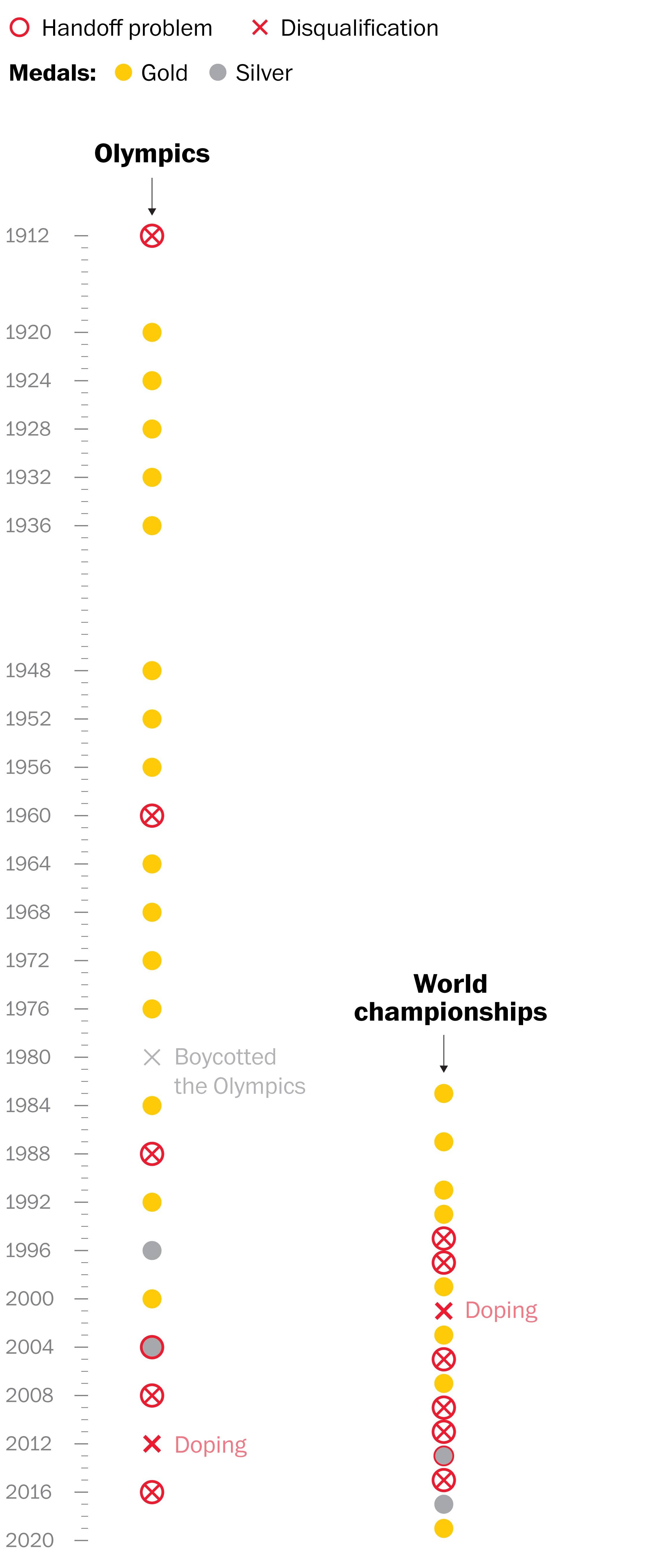
| | | Hot on the left "It is time for Congress to act again to protect the right to vote," writes Attorney General Merrick Garland in a Post op-ed. "Fifty-six years ago Friday, the Voting Rights Act became law. At the signing ceremony, President Lyndon B. Johnson rightly called it 'one of the most monumental laws in the entire history of American freedom.' ... The Civil Rights Act of 1957 marked Congress's first major civil rights legislation since Reconstruction. That law authorized the attorney general to sue to enjoin racially discriminatory denials of the right to vote. Although the Justice Department immediately put the law to use, it quickly learned that bringing case-by-case challenges was no match for systematic voter suppression. ... On this anniversary of the Voting Rights Act, we must say again that it is not right to erect barriers that make it harder for millions of eligible Americans to vote. And it is time for Congress to act again to protect that fundamental right." | | | Hot on the right "The anti-vaxx herp derp," by the Bulwark's Chris Truax: "As it's become increasingly clear that the obstacle to ending the pandemic is now people flat-out refusing to get vaccinated, I've struggled with how to characterize and address the arguments these anti-vaxxers are making. But on Friday, I had an epiphany when I read this quote from Larry Cosme, president of the Federal Law Enforcement Officers Association, who was pushing back against Joe Biden's plan to require federal employees to be either vaccinated or have a current negative COVID test. 'Forcing people to undertake a medical procedure is not the American way and is a clear civil rights violation no matter how proponents may seek to justify it.' 'Aha!,' I said to myself, 'Herp derp!' Herp derp originated, as do so many important philosophical concepts, on South Park. It's now become an internet meme for something that is just complete nonsense. Larry Cosme's statement is a textbook example." | | | Today in Washington Biden will travel to Wilmington, Del., today at 12:30 p.m. He and Vice President Harris will receive the weekly economic briefing at 2 p.m. | | | U.S. men's sprinters medals, visualized In the past 109 years, the U.S. men's team has run the 4x100 relay 40 times in Olympics and world championships, and every race has gone one of two ways. Either the Americans won a medal (27 times) or were disqualified (13 times). Nothing in between. | | | In closing Here are some Olympic updates from our colleagues in Tokyo: - "Allyson Felix took bronze in the women's 400 meters Friday, giving her a 10th Olympic medal in the final individual race of her Olympic career and tying her with Carl Lewis for the most all-time in U.S. track and field," Adam Kilgore reports.
- The United States' Ariel Torres edged Venezuela's Antonio Diaz on Friday to win the country's first medal in Olympic karate, a new sport at this year's Tokyo Games.
- American freestyle wrestler Gable Steveson won gold in his 125 kilogram match against Georgia's Geno Petriashvili with a stunning takedown at the buzzer to win, 10-8.
- The U.S. men's 4x400-meter relay team advanced to Saturday night's final.
- "The U.S. women's basketball won't accept anything less than gold," Ava Wallace writes.
The United States still leads the medal count: | | | |


 Email
Email