The Peloton appeal and how to cover influencers who won’t mask up

 Influencers Are Getting Followers By Sharing Harmful Anti-Vax And Anti-Mask Views. Should We Just Ignore Them? 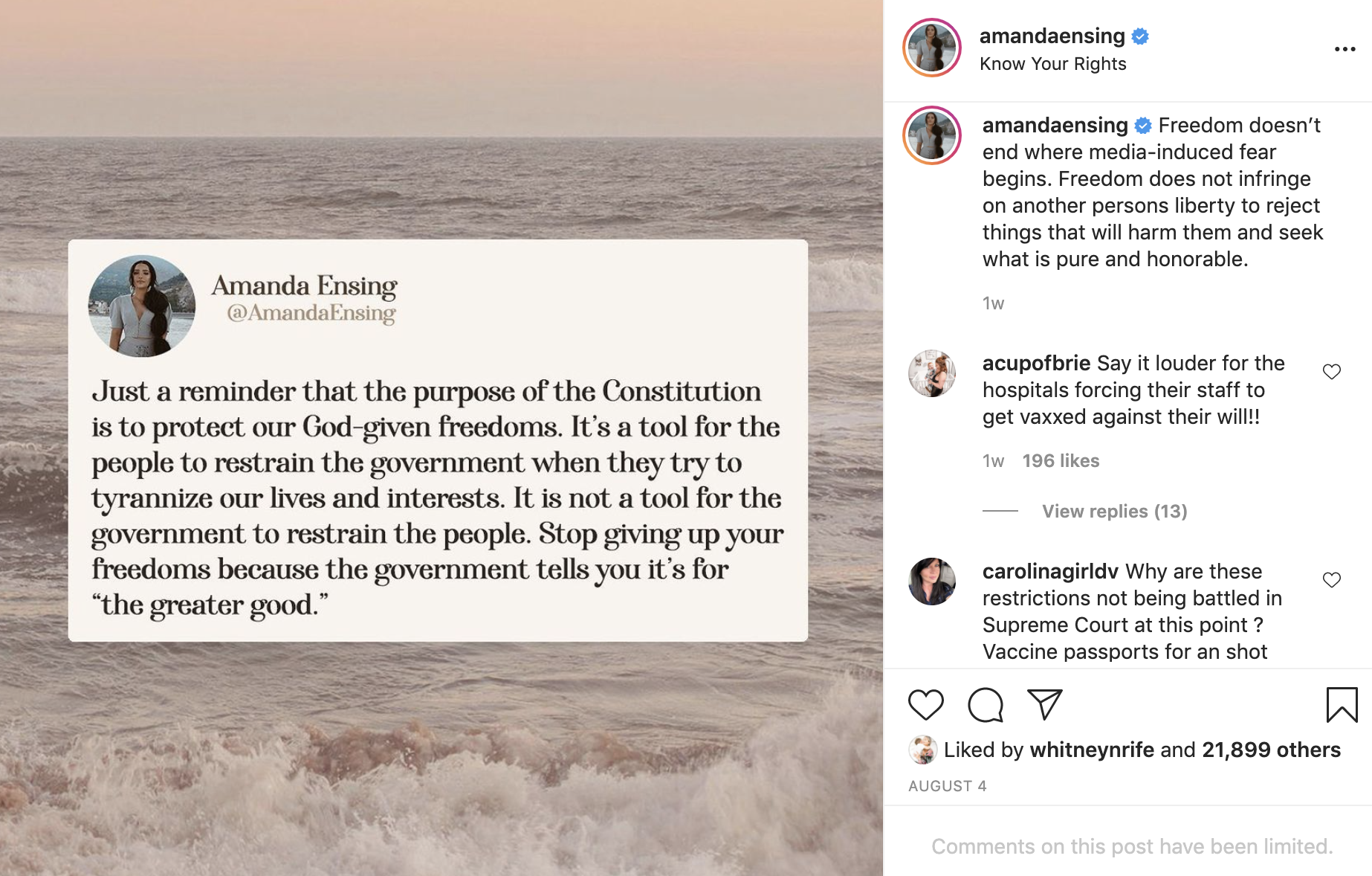 Instagram / @amandaensing The adage that there's no such thing as bad publicity has been on my mind this week as I struggle to responsibly cover influencers who are sharing dangerous and misleading information about the COVID-19 vaccine and masking requirements.
As I wrote shortly before the 2020 election, influencers can no longer be apolitical online. Followers want to ensure they are supporting people who share their values, and influencers who remained silent during the election were seen as fake or cagey. This doesn't only apply to elections, though. Amid the upheaval of 2020 and the politicization of everything from climate change to vaccines, influencers have been taking a stance on a variety of issues, heeding fans' pleas to use their influence for good.
Earlier this year, I wrote about big influencers who are sharing that they got the COVID-19 vaccine even though they face relentless abuse from anti-vaxxers who brigade their comments en masse. Influencers are so effective at encouraging their followers to get vaccinated that state and city governments around the US have been hiring them to promote vaccine safety. Big pharmacy chains like Walgreens are also partnering with influencers on current campaigns, even though many of the women got vaccinated months ago. In her post as part of the Walgreens campaign this week, Lindsay Silberman told her 180,000 followers that although she got her shot in April, she thinks it is still important to talk about vaccines. "If you haven't yet made a vaccine appointment, now's the time," she wrote.
However, as the weeks go on, I have been disappointed to see some influencers post with increasing regularity about why they aren't getting the vaccine, or that they are against policies like mask mandates. Many of these women are not big names. Most have around 100,000 or fewer followers, making them respectable but small potatoes in the influencer ecosystem. Yet, these small names are being buzzed about online because of their harmful viewpoints. After watching one woman post more and more about her anti-vax thoughts this week, I began to wonder, Is this a grift?
I've gotten a lot of Instagram messages asking me to "call out" some of these people. One woman in particular has been flagged to me multiple times since she went on a few rants this week against masking in schools. She is a low-level blogger with around 100,000 followers, which gets her brand deals, for sure, but doesn't make her a huge name. (I am not naming her on purpose.)
Her Instagram stories about masks, though, seem to be good for her bottom line. According to Social Blade, she has gained 540 followers this month. Her supporters are also blowing up her comments, telling her she is a hero for standing up for the rights of kids.
But is it the right move for me to call this woman out by name, publicly? I could name her in this newsletter, exposing her to a huge BuzzFeed News audience and beyond, and call her out on my Instagram. One of her sponsors may see the story and drop her. But I may just cement her as a leading voice in the anti-mask ecosystem, driving more supporters to her cause. By trying to raise awareness about individuals behaving badly on a platform that does little to regulate their harmful rhetoric, am I helping them get more famous?
Take the case of Amanda Ensing, a makeup YouTuber who made headlines last year when she began to publicly share her support of then-president Trump and other conservative causes. (One headline from Glossy reads, "What happens when a major beauty influencer supports the Capitol mob?" Yikes!)
Amanda's pivot to a pro-Trump, right-wing influencer has actually been great for her. She now has around 1.45 million followers, about 20,000 more than she did in June 2020 (and that's after losing a fair amount in January 2021, when she openly supported the Capitol mob). She lost around 50,000 YouTube subscribers in that time — but, considering that her content has completely changed (she now goes on rants about cancel culture), that still is pretty impressive.
Amanda has also found a new career as a young, hot, and anti-woke liberal crusader for conservatives, who cheered her on when she launched a boycott against Sephora earlier this year for canceling her contract over her actions surrounding the Capitol riot. She's also made appearances on Newsmax and Fox News. Amanda may have damaged her influencer career, but she has a new, potentially even more lucrative one as a conservative star.
The truth is that people will unfollow an influencer who shares harmful anti-vax and anti-science beliefs, but there are just as many people who will follow them for "speaking out" about these exact beliefs. When dealing with low-level influencers, I'm just not sure calling them out is a net positive. When someone already isn't that influential, it seems better to ignore them.
That's not to say there is nothing we can do to make sure people with a substantial following and harmful viewpoints face consequences. Reaching out to sponsors works. Reporting people to Instagram works. Unfollowing them works. In general, though, I think starving bad actors of oxygen is the best policy. The best way to ensure these harmful viewpoints don't spread is to ignore them as best we can.
I admit, though, I am struggling with this one. I would love your takes. Feel free to email me by responding to this newsletter, or shoot me a DM on Instagram.
—Stephanie McNeal Peloton is becoming a surprisingly good pipeline to the influencer industry 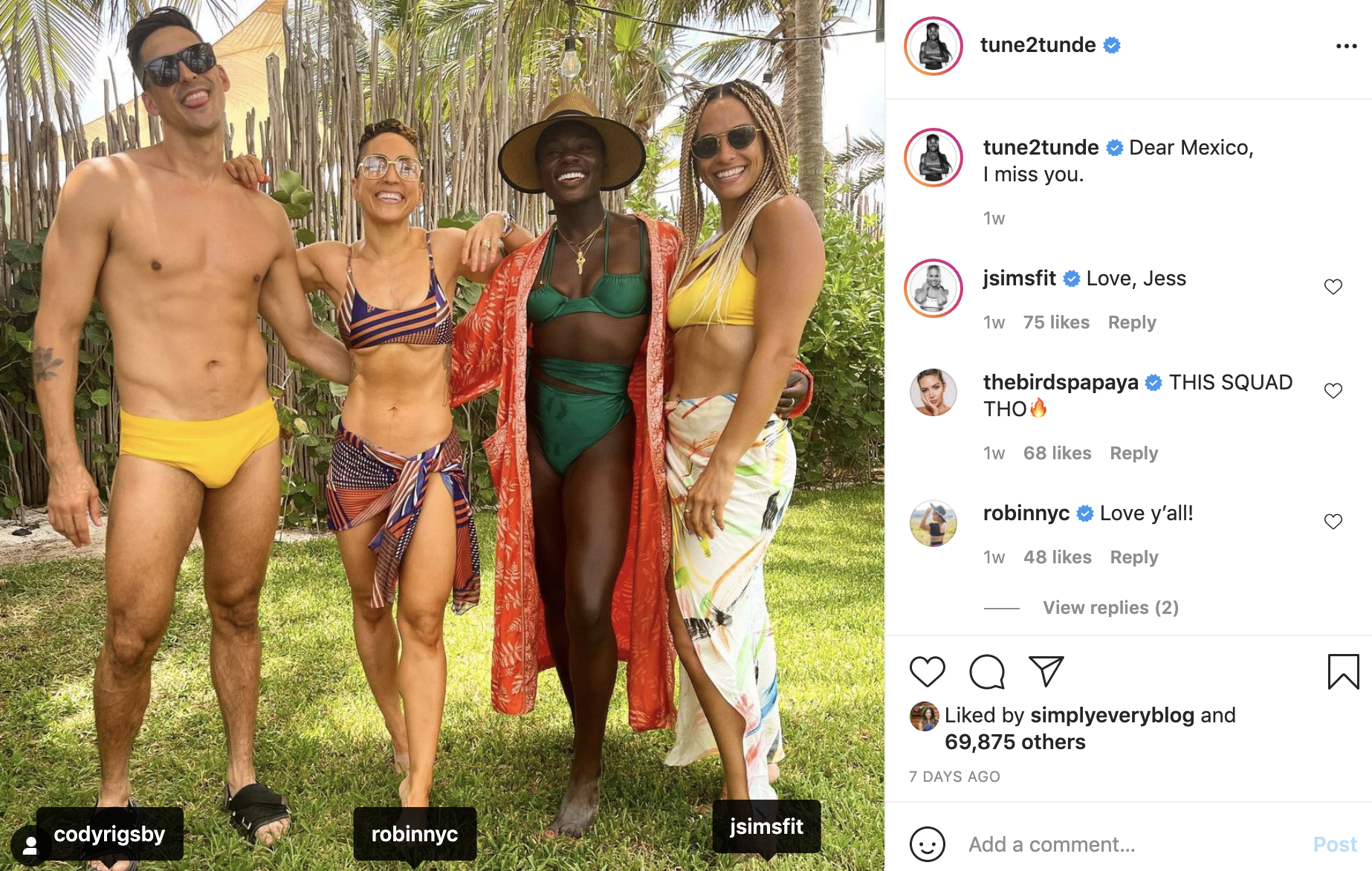 Peloton Beloved readers, it is time for me to announce that I (Tanya) am in a cult. But it's a good one, I think, or at least it is so far. I've been initiated into Peloton nation.
I don't own a bike, but my friend who lives nearby (hi, Lisa) lets me use hers as much as I want because I look after her cat from time to time. I'm hooked, literally (I'm attached to the bike) and figuratively. My new obsession could be due to the fact this is my first foray into a fitness craze, or perhaps because the company has figured out a way to hold my attention in a way that's not just about working out.
Many of us who are privileged enough to afford it invested in at-home workout programs during the pandemic. Even though Peloton was a laughingstock for much of 2019, by 2020, there was an absolute surge of people buying in as gyms closed.
For me, though, being a Peloton member is about more than pragmatism or convenience. I have become a full-blown convert. I've started to look forward to their classes, which is so unlike me.
Either something mystical and cultish is taking over my brain, or the company has created an experience more engaging and entertaining than any fitness company has before. In my opinion, it is the latter, and it has entirely to do with the instructors they've hired and the access we have to them on and off the bike.
Last week, Stephanie wrote about the spectacle and fun of being able to watch instructor Ally Love's wedding in a way that felt ~intimate~, even though over 770,000 followers looked on. As Stephanie wrote so insightfully, Ally crafted her brand thoughtfully and strategically leading up to her wedding.
Perhaps what was more interesting than seeing how her wedding turned out was seeing which of the other Peloton instructors attended. Viewers got to flirt with fun, voyeuristic questions like: Who's actually friends with whom? Who might secretly not get along? What type of relationships do the instructors have with each other off the app?
We will never know for certain, but that's beyond the point. This is exactly like the titillating appeal of gazing at celebrities, reality TV stars, and influencers!!!! It's like being in middle school and wondering which of your adult teachers actually liked each other and which ones didn't.
The way the company has enabled its instructors to be personalities first instead of regimented and soulless fitness gurus is genius. I find myself gravitating toward certain instructors not because I know or care if they have perfect form (I met a squat for the first time during quarantine), but because they are so magnetic. The internet is well aware of Cody Rigsby, whose monologues during his rides about life and pop culture have gone viral on multiple social media platforms, but he's not the only star. There are even entire social media feeds dedicated to special and funny one-liners from various instructors during their classes.
I personally love taking classes from Tunde Oyeneyin and Jess Sims, who deliver heartfelt mantras that fall somewhere between a therapy session and a sermon. They also offer personal anecdotes about their challenges and accomplishments while they're riding and instructing us how to do a spider plank. It's engrossing and makes me wonder how much of their real selves they're showing. (And does it matter? It's tantalizing nonetheless.)
The same way that the Bachelor franchise has become an almost foolproof stepping stone to becoming an influencer, Peloton has possibly become the first cultish fitness company to draw talent in for their personal branding before their fitness cred. This is not to say its instructors are not incredibly talented and don't have impressive credentials. But at Peloton, it seems to be more important for an instructor to be relatable, likable, and aspirational to their students than the most talented fitness trainer.
That parasocial relationship is what is holding together and rapidly growing the influencer industry, and I wouldn't be surprised if the company continues to seek out charisma over traditional credentials in its instructors.
It will be interesting to watch how Peloton grows as its roster of instructors inevitably changes. Peloton might continue to push its most-followed instructors to the front while unintentionally leaving others to fall to the sidelines. Will the company expand to include other kinds of personalities and body types? Will we see its most lucrative instructors pursue other opportunities, like in traditional entertainment? It feels sad and exciting to think about the possibilities.
And I hate so many things, including working out.
Until next time, Tanya Want more? Here are other stories we were following this week. So many people are invested in a prestigious duck art contest thanks to this TikTok creator. The annual Federal Duck Stamp Contest sees amazing artists painting their very best waterfowl.
Olivia Rodrigo fans are not happy after receiving her Sour album merch. Fans claimed that the items they received didn't look like what they had ordered, and some of them posted about it on TikTok to show just how different they believed the merch looked in person.
P.S. If you like this newsletter, help keep our reporting free for all. Support BuzzFeed News by becoming a member here. (Monthly memberships are available worldwide.) 📝 This letter was edited and brought to you by Tanya Chen, Stephanie McNeal, and BuzzFeed News. You can always reach us here. BuzzFeed, Inc. |


