Young Living influencer drama and Ally Love’s wedding bonanza

 MLM influencers have quietly accumulated power. Just look at how this top seller at Young Living broke from the company 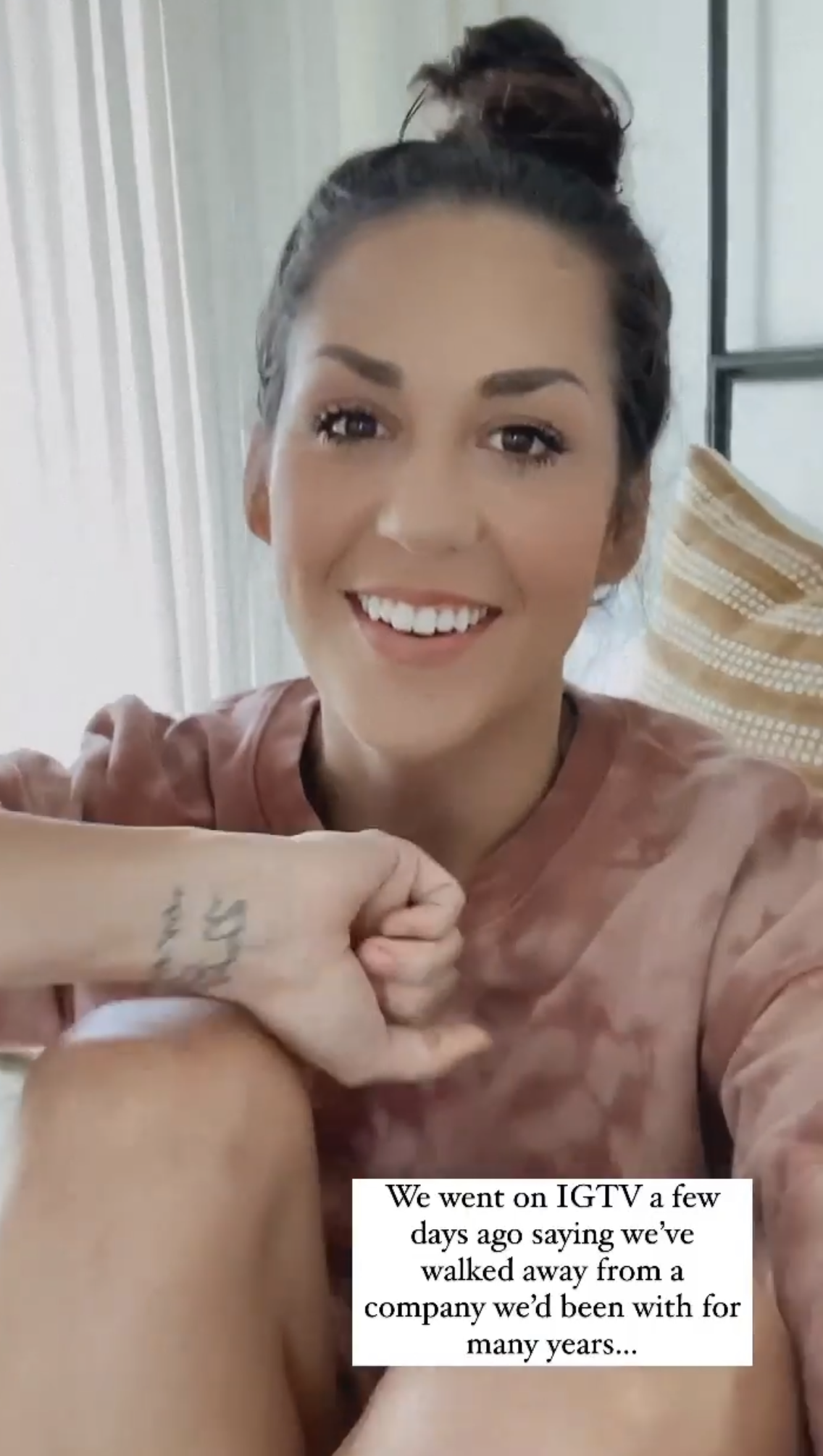 Instagram / @madisonviningblog Over the past several years, many people have written about how multilevel marketing companies, or MLMs, have been able to grow exponentially by recruiting underemployed millennial women through social media. (I have written about how Facebook supercharged LuLaRoe, an MLM clothing company.)
However, one aspect of this phenomenon isn't covered as much: the rise of the MLM influencer.
I've been thinking about this topic as I watched a juicy bit of drama unfold this week in the Young Living online community. Young Living, a company founded in 1993 by a rather "interesting" dude, has been one of the main benefactors of a recent boom in the popularity of essential oils.
Over the weekend, Madison Vining, who ran one of the top-selling teams in the company with her husband, Tyler, made a shocking announcement on social media. The couple said they had decided to leave Young Living for Modere, another MLM that has seen success hawking a line of collagen products, a buzzy trend in wellness.
In an IGTV video posted to Madison's more than 237,000 followers, the couple shared that, after around eight years with the company, they had resigned from Young Living. A few days later, Madison announced on her Instagram stories that they were moving to Modere.
Madison and Tyler had "Royal Crown Diamond" status in Young Living, which meant they were among the most successful consultants in the company. According to the company's 2019 statistics, Royal Crown Diamond sellers made an average of $1,645,692 annually, or roughly $137,000 a month. This revenue, of course, is mostly made up of sales generated by the Vinings' team, the Happy Oilers, who made the base of the, let's say, pyramid-shaped structure the couple sat on the top of.
By quitting Young Living, Madison and Tyler are walking away from it all, and they will need to rebuild their team from scratch. To many, the move made no sense. "My head hurts trying to understand. Walking away from over a million-dollar residual income a year & your team for another company?" wrote one commenter.
Another person claimed the Vinings had not even informed their teammates before making the announcement. "I'm happy for you and excited to see what comes next, I'm a bit bummed I didn't see this directly in the Happy Oilers," she wrote. Madison later said on Instagram that, because of the terms of her exit, she was not able to directly contact any of her team members before leaving.
Soon, rumors began to swirl that something shady was going on. People speculated that Modere had enticed the Vinings with the promise of a salaried position, which would be a shocking move for a MLM. Madison denied the rumors in a response to a comment on her Instagram video, saying, "I promise you haven't got a clue what you're talking about."
She added that they received no paycheck to leave and had left "$200k on the table." (I assume per month, since the lowest earner in their bracket makes around $600,000 annually, according to Young Living.) Madison also claimed she had not "sold" her team back to Young Living for any sort of profit.
"The rumor mill/drama factory is typically not the place to get ethical, factual information," she said.
I've reached out to Madison, Modere, and Young Living to ask about these rumors, but haven't heard back. This whole saga, though, has gotten me thinking about the MLM influencer and the leverage someone like Madison wields in the MLM structure.
Of course, the whole MLM business model has always only benefitted a select few superstars, but the internet has made this gulf even more apparent. Sure, before the internet an MLM used to be able to trot out its top performers and flaunt their lavish lifestyles to motivate their sellers at conferences or whatever, but, as with everything on social media, the comparison trap is now bigger than ever.
Madison has been such a success in Young Living, I believe, not just because of her skill at direct sales but because of her aptitude in social media influencing. She launched a career as a blogger and influencer alongside her Young Living business, and her dual professions have worked in tandem to enrich each other. Her Young Living business helped her get internet notoriety, which I think likely played a role in her Instagram growing from around 56,000 followers in September 2018 to now more than 200,000. That has led her to open additional income streams, like LTK and sponcon. But her Instagram has also helped her Young Living business; it's the best advertising imaginable for joining her team.
Madison has declared on her blog that "every brick, every board" of her enormous, custom-built home in Oklahoma "was made possible by our YL journey." She walked her followers through her journey creating "the house Happy [her team] built." Followers see how enviable Madison's life is every single day on her Instagram stories, full of videos from her beautiful home, broods of animals, happy and adorable kids, and all the luxuries her huge paycheck affords her. It doesn't take much convincing to sign up; here's someone living their best life every day who's reminding you that you could have this too, if you just gave it a shot.
Thus, Madison's exit actually kind of makes sense. Sure, the Vinings are leaving an easy paycheck on the table, but they don't necessarily need Young Living anymore. An MLM seller in the age of influencing can not only reach the top of the *cough* pyramid *cough*; they can create an entirely new career for themselves at the same time. Sure, the Vinings are going to Modere now, but their possibilities are endless. They could start their own MLM if they wanted, they could build a bigger team with a more favorable contract for themselves at Modere because of their star power online, or they could just be influencers. Or they could do all three.
MLMs have long parroted the often mocked phrase that their sellers "build their own business." But in this case, the Vinings actually have. Of course, very few of their downlines can ever hope to replicate their success. Peloton star Ally Love's Instagram wedding extravaganza is a master class in content creation 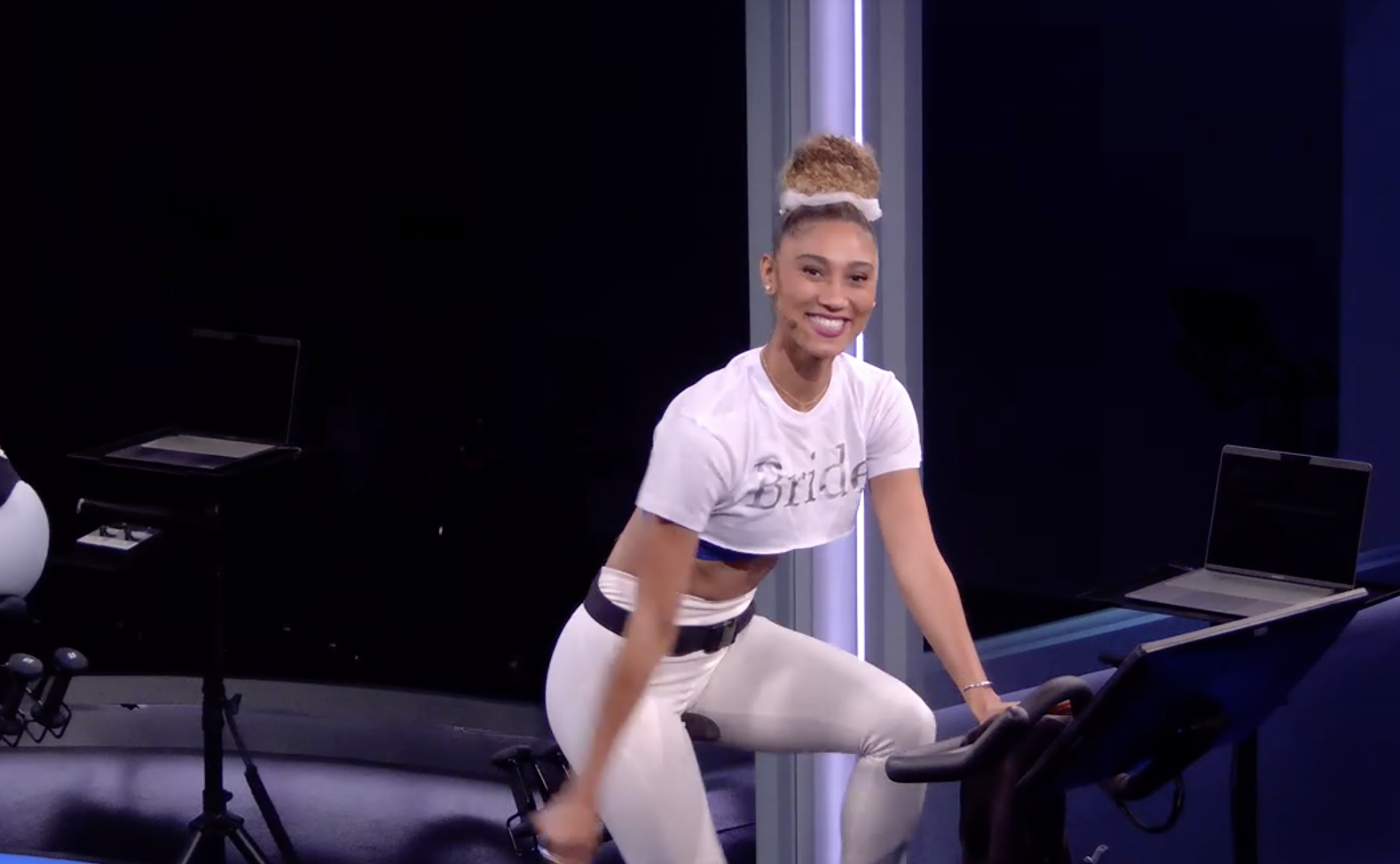 Peloton Ally Love is a Peloton instructor who has turned her platform as one of the workout company's most well-known faces into a truly impressive business and social media empire.
Not only does Ally have more than 750,000 Instagram followers on her personal account, but she also has more than 76,000 on her Instagram account for Love Squad, her fan community turned business venture. On the squad's website, you can buy branded merch (a limited-edition crop tee runs $68, but a tank is only $32) and sign up for webinars. Ally also has some high-profile side hustles, like serving as a host for the Brooklyn Nets and as a global ambassador for Adidas.
If you've ever wondered how Ally got so popular, she showed the world how this week. The secret? Ally is really, really, good at personal branding and content creation. She executed a truly epic Instagram event: her five-day wedding extravaganza in Mexico.
Ally crafted her social media strategy for her wedding flawlessly. On July 22, she hosted a "wedding celebration ride" on Peloton. She wore a "bride" T-shirt and rode to a playlist made up of songs submitted by her followers, to which they had either danced or walked down the aisle at their own weddings.
By making her Peloton riders feel as if they were part of the celebration of her big day, Ally subtly draws them into her inner circle, creating a parasocial relationship with her community that the best influencers have mastered (more than 75,000 people have taken the wedding Peloton class so far).
Even if you weren't a member of the #LoveSquad before, if you're anything like me and you took the ride, you'd probably be curious enough to follow Ally on Instagram before the big day(s). But right before her wedding week, Ally did another brilliant move: She went private on Instagram, so you HAD to follow her in order to watch. 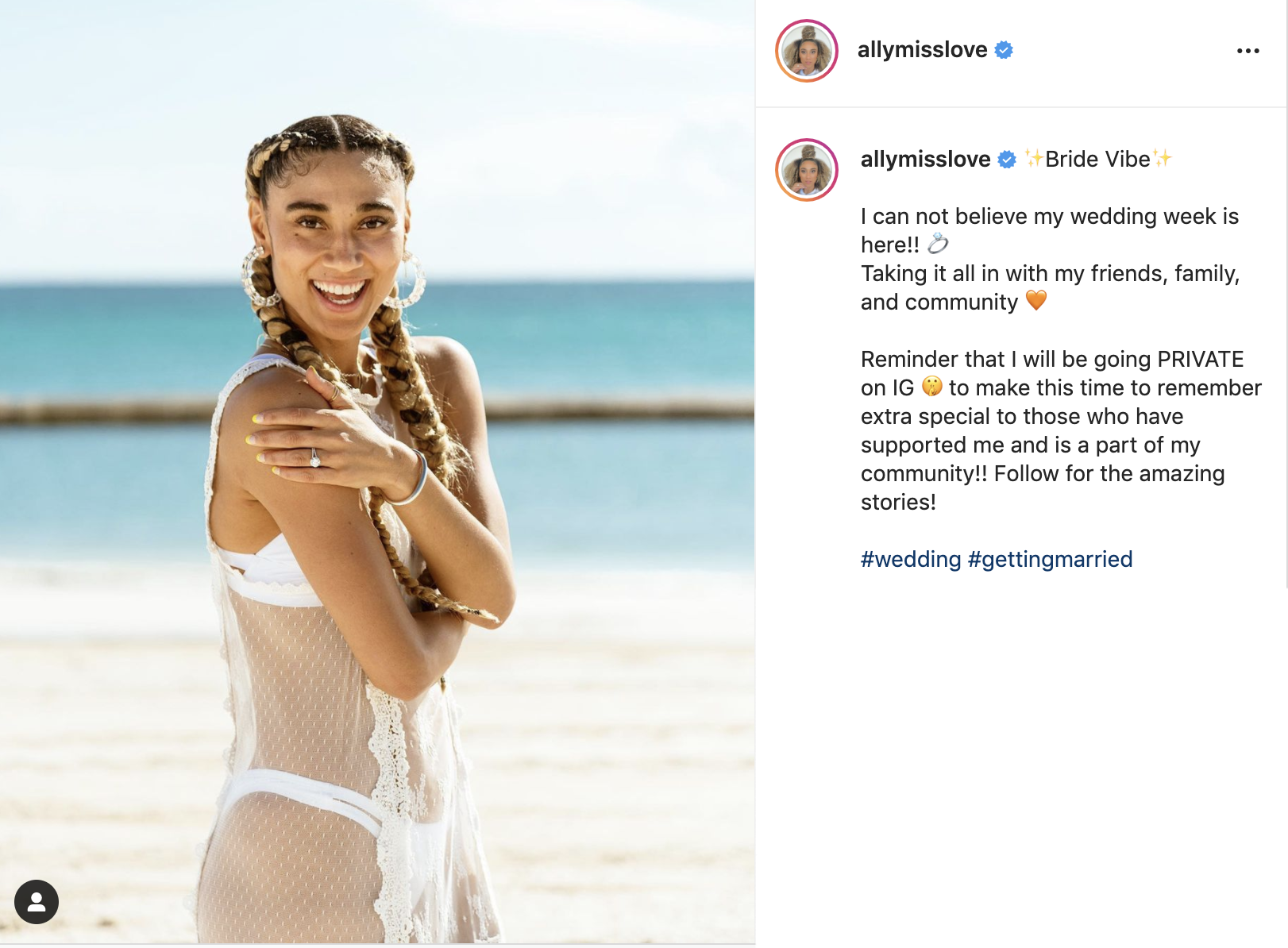 Instagram / Ally Love "Taking it all in with my friends, family, and community 🧡," Ally wrote. "Reminder that I will be going PRIVATE on IG 🤫 to make this time to remember extra special to those who have supported me and is a part of my community!!"
Some people may assume I am shading Ally by saying she went private as a business strategy, rather than to exclusively provide content to her community, as she claims. But I'm not at all, and I think her motivations were probably both. I also think influencers often get shamed for doing things that make business sense when there's nothing wrong with it. By providing her followers with an exclusive experience, Ally gets to reward them for their loyalty, and continue cultivating that parasocial relationship.
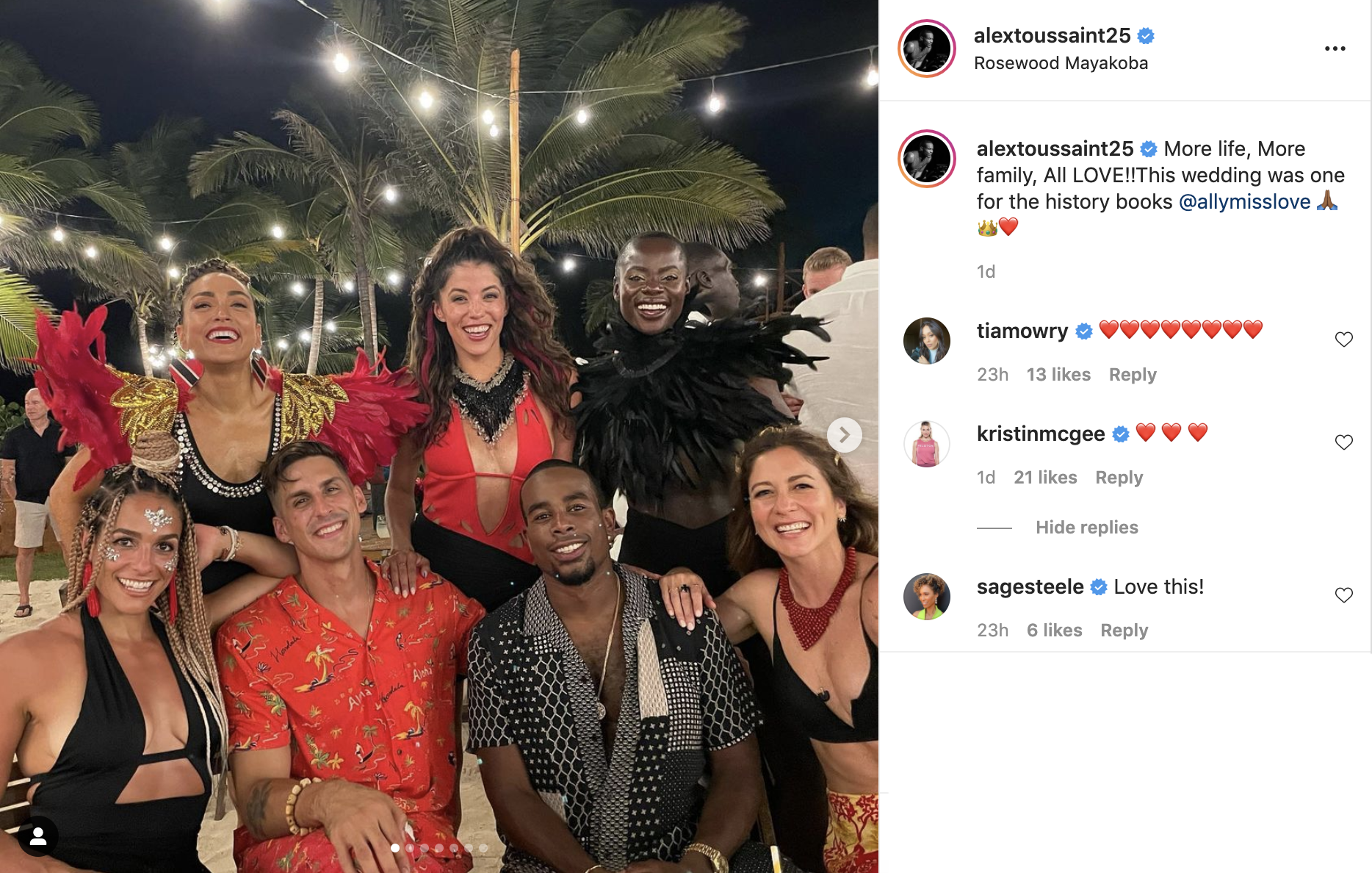
Finally, this week, Ally pulled her smartest move yet. She had all her Peloton coworkers who attended (all influencers and celebs in their own right) wait to post content from her wedding at the same time. After getting married, reportedly on July 31, Ally went back to a public account and began posting her wedding content on what appears to be on a schedule. For example, one night was Carnival-themed, and each instructor in attendance posted their pics from the night around the same time (some also included more pics from the other nights of the wedding as well).
Watching Peloton instructors all post about the same thing at the same time is kind of like watching the Avengers assemble. It made the entire viewing experience like a game. Each instructor had their own perspectives of the event, their pictures and videos, and, of course, their lewks.
 Instagram / Alex Toussaint
By crafting her content, and her friends' content, in this way, Ally turned her wedding week into an entire Instagram event. If you're a fan of the Peloton gang, you can spend an hour going down the rabbit hole of who wore what, who got invited, who didn't get invited (and is that shade in the comments?). When discussing the wedding with my husband, he said the rollout reminded him of another master class in social media content: Taylor Swift's star-studded 4th of July parties.
Some people may snark on caring about workout instructors or a stranger's wedding, but I think it's fun! It's taking something mundane in life, like working out on a spin bike and turning the experience into an entire character-driven event on multiple platforms. How many media companies would kill for that? Peloton's brand loyalty is unmatched, and tons of people are talking about it.
I'm sure others will say how awful it is that Ally turned a special life event into content, that she's too calculated, blah blah blah. To them I say, welcome to content creation. The industry has been around forever, and it is here to stay. Ally has mastered how to grow a community around herself and have a ton of money and success. It may not be for you, but you can't argue it isn't working for her.
Plus, Ally is doing a great job at one thing: keeping her actual relationship private. Her husband isn't even tagged in the posts, as far as I can tell, and he seems to live a normal life out of the spotlight. Fame, fortune, and keeping her personal life private? We stan a content queen.
-Stephanie McNeal Want more? Here are other stories we were following this week. Katie Notopoulos breaks down why she loves the @HauloverDaily TikTok account.
An ASL interpreter performing "WAP" has gone viral on TikTok.
The $5,000 quest for the perfect butt. P.S. If you like this newsletter, help keep our reporting free for all. Support BuzzFeed News by becoming a member here. (Monthly memberships are available worldwide.) 📝 This letter was edited and brought to you by Tanya Chen, Stephanie McNeal, and BuzzFeed News. You can always reach us here. BuzzFeed, Inc. |


