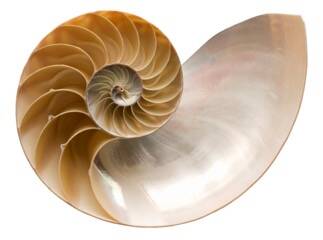
 The interior of a nautilus shell. Credit: Flaming Pumpkin/Getty Images | You know when you've just learned a new word or an interesting fact about something and then you keep coming across references to it? Such has been my experience with the sea creature the nautilus, which showed up first in a book I was reading and then in an article I was editing. And, it turns out, its appearance in both cases can be related to wellness. The nautilus is one of the stars of "The Sound of the Sea: Seashells and the Fate of the Oceans" by Cynthia Barnett, published earlier this summer. I am an inveterate seashell and sea glass collector -- the kind of person who walks the beach with her head down -- so I devoured the book, highlighting fascinating facts. Did you know, for example, that people who study the animals in seashells are called malacologists, and people who study the shells are called conchologists? Or that Shell Oil Company was founded by the sons of a Londoner who built an import-export business out of selling seashell-decorated boxes in the mid-1800s? In the chapter featuring the nautilus, the only cephalopod that has a shell, I learned that it is a survivor. The 500-million-year-old species existed before both the Great Dying (250 million years ago) and the mass extinction that killed the dinosaurs. Oliver Wendell Holmes Sr. was so impressed by the animal's ability to keep making progress (it builds a new section of shell, lives in it for a while, then builds another and closes off the earlier one with a wall) that he wrote a poem about it. Part of "The Chambered Nautilus" reads: Year after year beheld the silent toil That spread his lustrous coil; Still, as the spiral grew, He left the past year's dwelling for the new, Stole with soft step its shining archway through, Built up its idle door, Stretched in his last-found home, and knew the old no more. You don't get a much better metaphor for persistence and growth than that. But, wait, there's more. The nautilus offers not just a metaphor for wellness, it can be a tool for achieving wellness. In psychologist Jelena Kecmanovic's story today about seven surprising strategies for relieving stress, she includes looking at fractals. Fractals are infinitely repeating patterns at different scales, and many can be found in nature: snowflakes, tree branches, crystals. For some reason, we humans find gazing at fractals to be calming, perhaps because we evolved surrounded by them and thus can relax when presented with their familiar complexity. And what's one of the most beautiful examples of a fractal found in nature? A nautilus shell. There are many other interesting stress busters in Jelena's story: Suck on a lemon, change your posture, talk to yourself, chew gum, make yourself yawn and, perhaps most complicated, dunk your head under cold water. I think I'll stick to looking at fractals. Alas, I do not have a nautilus shell – I wish I did -- but perhaps another kind will work. It turns out that my very first highlight in "The Sound of the Sea" is a quote from Portuguese archaeologist João Zilhão, who, when asked why a Neanderthal child might have collected cockle shells found in a prehistoric sea cave responds: "There is something fundamental about shells' aesthetics that pleases the brain, that must be very powerful." Take care. | 




 Email
Email