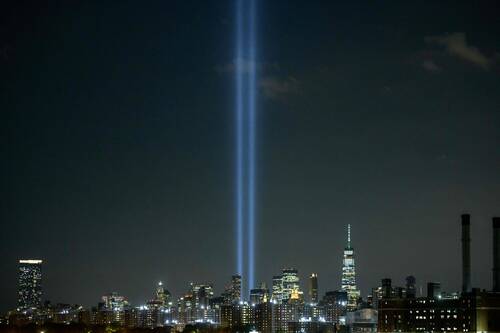
| When our older son was in maybe second grade, he was reading "Who is Derek Jeter" – a young reader biography. What's going on here? I remember him asking. I glanced over his shoulder and saw an illustration of smoke rising from the twin towers, and I froze. I guess it hadn't dawned on me that I'd have to explain that tragic day to my children, both of whom were born after it happened. "Then came more devastation: September 11, when terrorists flew planes into New York's World Trade Center. Thousands died," the page in that book read. That's a horrific, frightening concept for a young kid. But this would be a part of his history lessons and would come up in so many books he'd read. So we talked, briefly, about it. Straightforward, no more than he needed to know. I don't remember what I told him, but it was along the lines of this being a very sad thing, and that it was very rare. I was more prepared when his younger brother came along, and now that they're older, the conversations around this somber 20th anniversary are deeper. It's strange how that day is burned in my being, and yet to my children it is history, like the Vietnam War, the Holocaust, or the Cuban Missile Crisis are to me. They will never feel the impact those of us who were here did - I will never forget making my way toward The Post newsroom, as the city was panicking and people were trying to make their way toward home. The streets were blocked, people were yelling on the sidewalks that the Capitol had been hit. That planes were flying toward us. Will my children ever understand? Not in the way those of us who lived through it do. Not ever in the way those who lost loved ones do. But they will learn about it. So talking about 9/11 and the impact of that dreadful day is important. I was so grateful to have this piece this week, where psychologists, education leaders and others helped explain how we can tackle this subject with our kids. Like many of you, I can't believe it's been 20 years already. Wishing you all a peaceful, healthy weekend. Perspective ● By Meghan Leahy and Amy Joyce ● Read more » | | | | By Annabelle Timsit, Bryan Pietsch, Adela Suliman, Hannah Knowles and Dan Diamond ● Read more » | | | |
Parenting in a Pandemic These are challenging times for any parent to navigate. Let On Parenting help. Below you'll find a selection of expert advice and personal stories for all types of parents. To keep up with The Post's best advice for living through a lockdown, including recipes to make, shows to watch, the best socializing apps, resources for parents, guidance for managing anxiety and tips for canceled trips, bookmark Your Life at Home. And the latest on school reopenings can be found on The Post's Education page. For vaccinated parents with unvaccinated kids | Vaccinated adults may have more freedom. But for kids, 'the rules haven't changed.' For parents dealing with virtual school | Strategies to improve distance learning | Tips for creating a good learning environment at home | How parents can avoid anxiety around distance learning For parents dealing with in-person school | How to help children adjust to masks, according to experts and parents | As kids move from quarantine to school, separation anxiety may follow. Here's how to help. For parents working from home | 6 strategies for parents struggling with work-from-home interruptions For parents looking ahead to post-pandemic life | The pandemic changed everything about family
life. These are the parts parents want to keep. |





 Email
Email