If you're not super-rich, tax-hike proposals probably won't affect your retirement investing 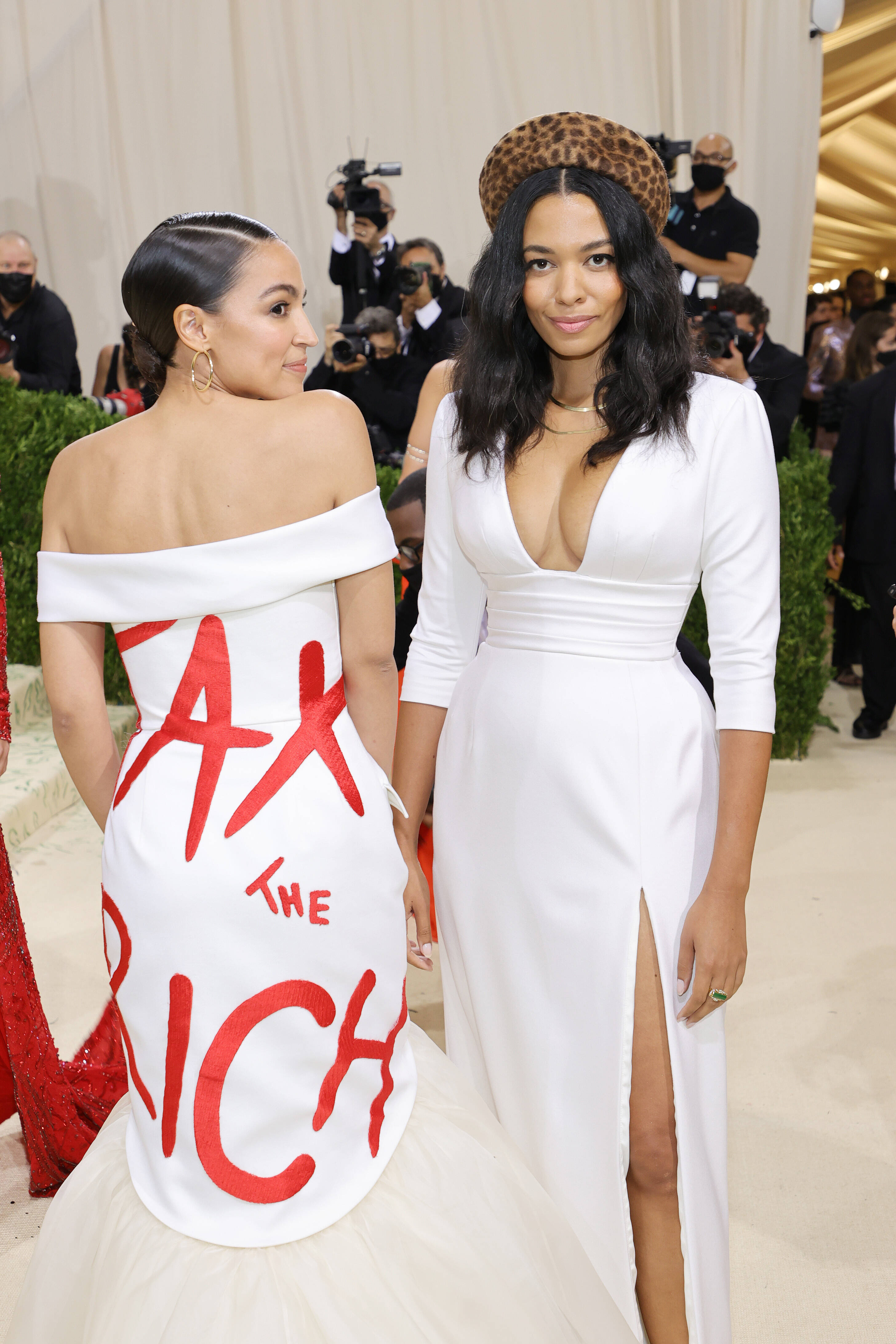 Rep. Alexandria Ocasio-Cortez (D-N.Y.), left, and fashion designer Aurora James at the Met Gala on Sept. 13 in New York. | Any mention of a tax hike and people's blood pressure rises. Tax revenue runs the government, and as a new budget cycle approaches there's a lot of discussion about who's not paying their fair share. Competing tax proposals from the White House and Congress include increases in individual and capital-gains tax rates — but just for the super-wealthy. It was 2017 when Congress enacted major tax legislation that gave a huge tax break to corporations but also expanded the standard deduction. Still, many felt the uber-rich weren't taxed enough. "Much of the income of wealthy households doesn't appear on their annual tax returns, and much of what does appear enjoys special tax breaks or discounted rates," a report this week by the Center on Budget and Policy Priorities points out. "… These changes would make the tax code more equitable by taxing income from wealth more like income from work." So much can change before any legislation is passed and signed into law. But for now, here are answers to questions you might have on how the proposals could affect your retirement planning. What individual tax hikes are being proposed? The Biden administration's proposed American Families Plan would increase the top marginal income-tax rate from 37 percent to 39.6 percent for those earning over $452,700 for single filers, $481,000 for head-of-household filers and $509,300 for joint filers, according to an analysis of the proposal from the Tax Foundation. The plan would tax long-term capital gains as ordinary income for taxpayers with an adjusted gross income of more than $1 million. This would result in a top marginal rate of 43.4 percent when including the new top marginal rate of 39.6 percent and the 3.8 percent Net Investment Income Tax, according to the Tax Foundation. The House Ways and Means Committee released a competing proposal this week that would also increase the top individual rate to 39.6 percent. This marginal rate would apply to single filers with taxable income over $400,000, heads of households over $425,000 and married couples over $450,000, according to the House plan. The top capital gains rate would increase from 20 percent to 25 percent. For most people, these changes shouldn't affect their retirement accounts, said Mark Hamrick, senior economic analyst at Bankrate. "The average American, meaning someone who is middle-income, probably doesn't have that much to be concerned about here," he said. "But what I would say is just continue to watch this space in the coming years." The need to raise tax revenue to address the federal deficit might change things, Hamrick said. "The math has not been adding up for quite some time." How will the House tax plan affect Roth IRAs? A Roth account is funded with after-tax dollars. Future withdrawals remain tax-free as long as you meet certain holding requirements. The current annual limit for a Roth is $6,000. If you're 50 or older, you can contribute an extra $1,000. The Roth 401(k) is increasingly being made available in employer workplace retirement plans. You still fund the Roth with after-tax dollars, but the annual contribution limit for a Roth 401(k) is the same as for a 401(k), which in 2021 is $19,500. People 50 and over can contribute an extra $6,500. There are income limits to contributing to a Roth. Your modified adjusted gross income must be under $140,000 for the tax year 2021 if you file as an individual. If you're married and file jointly, your MAGI must be under $208,000. But a backdoor loophole allows higher earners to convert their traditional IRAs or 401(k)s into a Roth. A ProPublica investigation found that Peter Thiel, one of PayPal's founders, had accumulated $5 billion in a Roth IRA. This revelation has led to a lot of discussion about limiting what rich folks can stash in a Roth. The House legislation would create new rules for taxpayers with very large IRAs and workplace retirement accounts. Contributions would be prohibited if the total value of an individual's IRA and workplace retirement account exceeded $10 million as of the end of the tax year. The limit on contributions would apply only to single taxpayers (or taxpayers married filing separately) with taxable income over $400,000, heads of households with taxable income over $425,000 and married taxpayers filing jointly with taxable income over $450,000. Additionally, if an individual's combined traditional IRA, Roth IRA and workplace account balances exceed $10 million at the end of a taxable year, a required minimum distribution, or RMD, would be required for the following year. "They're looking at putting gates around retirement accounts to prevent them from being supersized," said Eric Bronnenkant, head of tax for the online financial adviser Betterment. "For the average person, I'm not too worried that they are going to bump up on these limits." With possible tax increases coming, should I fund a Roth IRA? It's possible that there will be a huge influx of money going into Roth IRAs because of fear of the possibility that tax rates will be higher in the future. For younger investors or folks with lower incomes, a Roth account makes sense because they're likely to be in a relatively lower tax bracket and the tax-free growth with years of compounding can outweigh the benefit of current-year tax deductions for contributions to a traditional 401(k). If you're in a high tax bracket at present but expect to be in a lower one when you retire, it might make more sense to get an upfront tax break now by contributing to a regular IRA or 401(k) rather than a Roth account. Whatever you decide, the important thing is to save as much as you can for retirement, urged Hamrick. "People would be wise to try to optimize their tax savings," he said. "I hope that people would look at the options that include Roth and all the other good savings vehicles that are out there."
Reader Question of the Week
If you have a personal finance or retirement question, send it to colorofmoney@washpost.com. In the subject line, put "Question of the Week." Please note that questions may be edited for clarity. Q: I am currently on Social Security Disability (SSDI). My full retirement age is at 67 years and 10 months. I am now 63. At my full retirement age, do the SSDI payments switch over? A: When you reach your full retirement age your SSDI payments automatically convert to retirement benefits, according to the Social Security Administration. Here's an article from AARP with additional information about this issue: Will my Social Security disability benefits change when I reach retirement age? Also read: Social Security Q&A: After Taking Disability, Can I Suspend at 66? In Retirement News Part of planning for retirement and then living on the money you've saved or invested is keeping up with the issues that you need to know. In this section, I feature blogs, news stories, new research, surveys and government policy changes that could affect your retirement. If you see a news story or issue you think would help folks, let me know and I'll check it out and share it with newsletter subscribers. This week brought a lesson in the perils of investing without doing research. On Monday, a phony news release led to a brief surge in the price of litecoin, one of many cryptocurrencies akin to bitcoin. The release falsely reported that Walmart was going to start accepting litecoin. The bogus announcement drove up the price of litecoin by more than 30 percent at one point. "Walmart has no relationship with Litecoin," the retailer said in a statement on its website. This incident is a good reminder to investors to be careful, especially about cryptocurrencies. Bloomberg Opinion columnist Brooke Sutherland pointed out that "digital currencies aren't yet a practical method of payment for toilet paper, cereal or other household items that you might purchase at Walmart. But they can be a useful tool for criminals." Read: What's Stopping the Next Walmart Litecoin Pump-and-Dump Scheme? You might also want to read the following articles: Cryptocurrency advocates find Treasury's Yellen to be a tough sell As cryptocurrency goes wild, fear grows about who might get hurt White House reviews 'gaps' in cryptocurrency rules as bitcoin swings wildly Retirement Rants and Raves What are your thoughts about saving for retirement? If you're retired, how is it going? What advice would you have for others about retirement? This is your space to rant or rave about anything related to retirement. Send your comments to colorofmoney@washpost.com. Please include your name, city, and state. In the subject line put "Retirement Rants and Raves." Responses may be edited for clarity. Still looking for 401(k) or TSP millionaires There are a growing number of workers who have reached the millionaire's club — at least before taxes. Despite the economic upheaval of the pandemic, 401(k) balances hit record levels in the second quarter of 2021 and are creating a record number of millionaires, according to Fidelity Investments. If you've joined this club, I would like to hear from you for a future project. I'm hoping to show workers starting out how it's possible to become a millionaire in their workplace retirement plan. Share your story by sending an email to colorofmoney@washpost.com. In the subject line put "IRA, 401(k) or TSP millionaire." If you're responded already, thank you, and I'll be contacting you soon. | 



 Email
Email 

