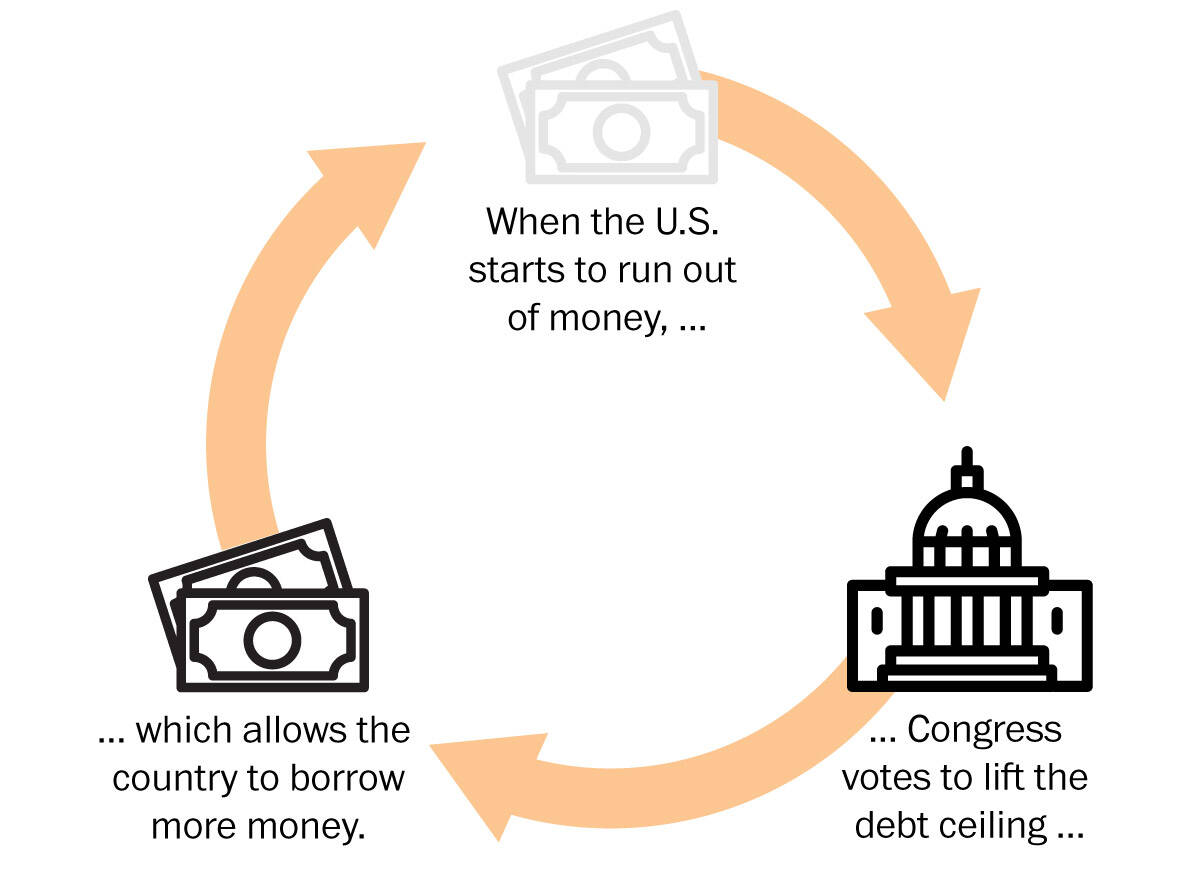
| Could the U.S. soon be plunged into a recession and face financial calamity by defaulting on its loans for the first time ever? It's at least a possibility, as a deadline to raise the debt limit comes up next month, and Republicans in Congress say they won't provide the votes to help raise it. (Democrats control majorities in Congress, but not enough votes to get through a Republican filibuster. At least one Republican senator, Ted Cruz, said he will filibuster raising the debt limit.) For those of us who are kinda sorta familiar with the debt ceiling, here's a refresher. The debt ceiling, in one sentence: It is a restriction that Congress puts on the federal government for how much money it can borrow to pay its bills. Why does Congress need to raise the debt ceiling? Congress wrote a law in 1917 that says the Treasury Department must come to lawmakers and ask Congress to raise it. The federal government spends more than it takes in, so the government has to borrow money fairly often to do that. Why are we talking about it now? Treasury Secretary Janet Yellen says the government will run out of all ability to pay its bills sometime in October (although the exact date isn't yet known). After that, a bill will come due that the U.S. can't pay, and that could mean the U.S. defaults on its loan for the first time ever. A default would be ugly; it could cause an immediate recession, financial markets to fall off the cliff, and an estimated 6 million lost jobs, reports The Post's Jeff Stein. What's the deal with Republicans' brinkmanship? Senate Minority Leader Mitch McConnell (R-Ky.) said Republicans won't provide votes to raise the debt ceiling. "They have the House, the Senate and the presidency. It's their obligation to govern," he told The Post's Mike DeBonis. "You think I'm bluffing?" he's said more recently. McConnell's argument is that because Democrats control all the levers of power in Washington and want to spend trillions of dollars in a spending bill filled with Democratic priorities, it's on them to figure out a way to raise the debt ceiling. There are two important fact-checks to McConnell's argument. 1. Raising the debt ceiling has almost always been done on a bipartisan basis. "There's never been a debt limit that had any trouble passing for want of Democratic votes," said Georgetown Law Professor David Super. "The people who are most attuned to the harms of the debt limit are the business community, and Democrats are always afraid of being seen as the anti-business party, so playing games with the debt limit feeds into that image." 2. Raising the debt ceiling today pays for yesterday's bills. Specifically, spending authorized when Republicans were in power. Add police reform to the list of things Congress can't get done  Sen. Cory Booker (D-N.J.) said he's frustrated that bipartisan police reform negotiations fell through. (Drew Angerer/Getty Images) | One of the few Democratic priorities not in their big spending bill is police reform. It's something Republicans have been open to working on too — former president Donald Trump signed a bipartisan criminal justice bill into law loosening sentencing guidelines. Spurred by the George Floyd killing last summer, a bipartisan group of lawmakers has been working for months to find agreement on legislation that could get a majority of votes in Congress. They failed, they announced Wednesday. Sen. Cory Booker (D-N.J.) said Republicans were nervous about making even incremental changes. Republicans were more vague on what went wrong; Sen. Tim Scott (R-S.C.) said Democrats want to "defund the police" — a policy proposal championed by some progressives on the far left, but not by mainstream Democrats and the White House. So now, everyone is looking at the White House to take executive action to change how police are monitored and trained. And the White House has said it's open to it. This is a recurring trend on everything from immigration to health care to policing: Congress tries to act, fails, and whoever is president takes much more limited executive action that gets tied up in courts by the other party. | 




 Email
Email