| Welcome to The Daily 202 newsletter! Tell your friends to sign up here. On this day in 1776, the Continental Congress formally embraces the name "United States of America," replacing "United Colonies" as the country's name. The War on Poverty, the War on Drugs, the War on Terrorism, the War on Crime. They all share a trait that has bedeviled successive presidents: It's hard to say when, how, and under what circumstances — if ever — the United States can declare victory. No president wants to get caught in a fleeting "Mission Accomplished" moment that looks in retrospect like a premature, overly exuberant triumph. President Biden faces a similar conundrum nearly eight months after taking office with promises to smother the resurgent pandemic and revive the economy, launching an effort he and senior aides have regularly compared to a "wartime" mobilization. But while he has foretold a return to something like normal life, it's unclear what that means. It's unlikely the virus could be stamped out entirely, like smallpox. Americans could instead be in for annual strains, like the flu, with yearly boosters as the remedy. Biden will detail the next steps in the fight in a speech at 5 p.m. Eastern. Gallup polling early last month found just 48 percent of Americans say he has laid out a "clear plan" of action against the virus, even as his approval rating has slipped. 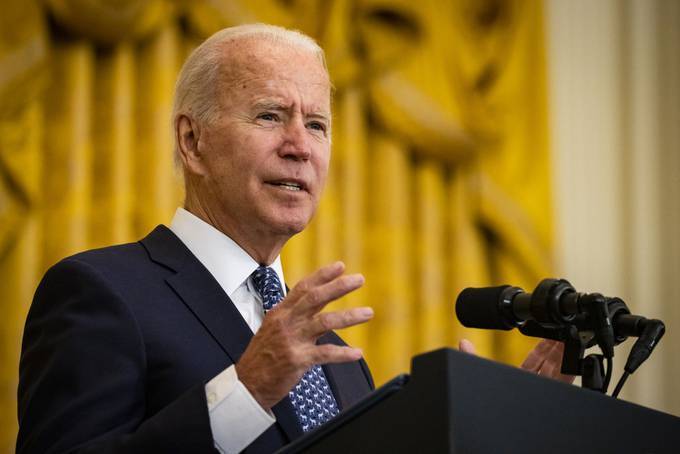 President Biden will detail the next steps in the fight against the coronavirus in a speech at 5 p.m. (Samuel Corum/Bloomberg) | The president is expected to sign an order today requiring all federal employees get vaccinated, without any option for testing as an alternative, according to a person familiar with his plans. He is also expected to propose steps to keep schools open, boost testing, require mask-wearing in some settings and improve care for those who have had the virus, the White House said. My colleague Dan Diamond reported Biden could also soon call for a global vaccination summit around the late-September U.N. General Assembly. He is not expected to set a target date for victory over the pandemic, a politically risky promise that would require recalcitrant GOP governors to cooperate with his calls for aggressive vaccination and mask-wearing. ("Even if we devote every resource we have," Biden said March 11, "beating this virus and getting back to normal depends on national unity.") With the 20th anniversary of the 9/11 attacks looming this weekend, it's worth looking back at a curious stretch in the 2004 campaign when both President George W. Bush and his Democratic rival, former Sen. John Kerry (D-Mass.), got into trouble for offering nuanced answers to the question of how the war on terrorism would be won. Bush, known for blunt talk like demanding Osama bin Laden "dead or alive," gave an uncharacteristically — and politically risky — subtle answer when asked in August whether the United States could win the war on terrorism. "I don't think you can win it," he told Matt Lauer of NBC News. "But I think you can create conditions so that those who use terror as a tool are less acceptable in parts of the world." Come October of that same year, it was Kerry's turn in the barrel after he told the New York Times that victory in the war on terrorism meant a return to when "terrorists are not the focus of our lives, but they're a nuisance." "As a former law-enforcement person, I know we're never going to end prostitution. We're never going to end illegal gambling," Kerry said. "But we're going to reduce it, organized crime, to a level where it isn't on the rise. It isn't threatening people's lives every day, and fundamentally, it's something that you continue to fight, but it's not threatening the fabric of your life." Bush and Kerry quickly retreated, but the undeclared War on Nuance won't end with a treaty signed on a battleship. (This is a joke that borrows an image the 43rd president frequently invoked when talking about the war on terrorism.) It's a challenge of policy — can you truly defeat a tactic like terrorism, or social ills the system perpetuates, like poverty or crime? And it's a challenge of political rhetoric, of fanning American hopes without raising them only to dash them later. That's the balancing act Biden faces now, not quite eight months into his presidency, as the virulent delta variant of the coronavirus has piled up cases, filled hospital beds and swollen the U.S. death toll to more than 650,000. "We know that increasing vaccinations will stop the spread of the pandemic, will get the pandemic under control, will return people to normal life," White House press secretary Jen Psaki told reporters yesterday. "We are still at war with the virus." Biden himself has promised the country can get back to normal — or something close to it — if Americans will only get vaccinated and wear masks. "We all want our lives to get back to normal, and fully vaccinated workplaces will make that happen more quickly and more successfully," the president said July 29 in the East Room of the White House. Americans who've had their shot(s) are "able to return to a closer-to-normal life," he said June 3 in the South Court Auditorium of the Eisenhower Executive Office Building adjacent to the presidential mansion. "Fully vaccinated people are safely [shedding] their masks and greeting one another with a smile. Grandparents are hugging their grandkids again. Small-business owners are reopening storefronts and restaurants," he said. "Let's finish the work of beating this virus and getting everything back to normal," he said May 13. Vaccinated Americans can "start returning to a closer-to-normal life," Biden said May 12. "Closer to normal" was also his formulation on April 27 and April 21. But perhaps the best distillation of Biden's approach came in a March 11 prime-time speech, in which he cautiously held out the possibility of a normal-ish July 4 celebration. "If we do our part, if we do this together, by July Fourth, there's a good chance you, your family and friends can gather in your backyard and have a barbecue and celebrate Independence Day," Biden said. But, he said, "a lot can happen. Conditions can change. The scientists have made clear that things may get worse again as new variants of the virus spread." He added: "I don't want to over-promise anything here." | 


 Email
Email