A Tumblr teen turned controversial influencer quits it all

 One of the most hated influencers on the internet is logging off 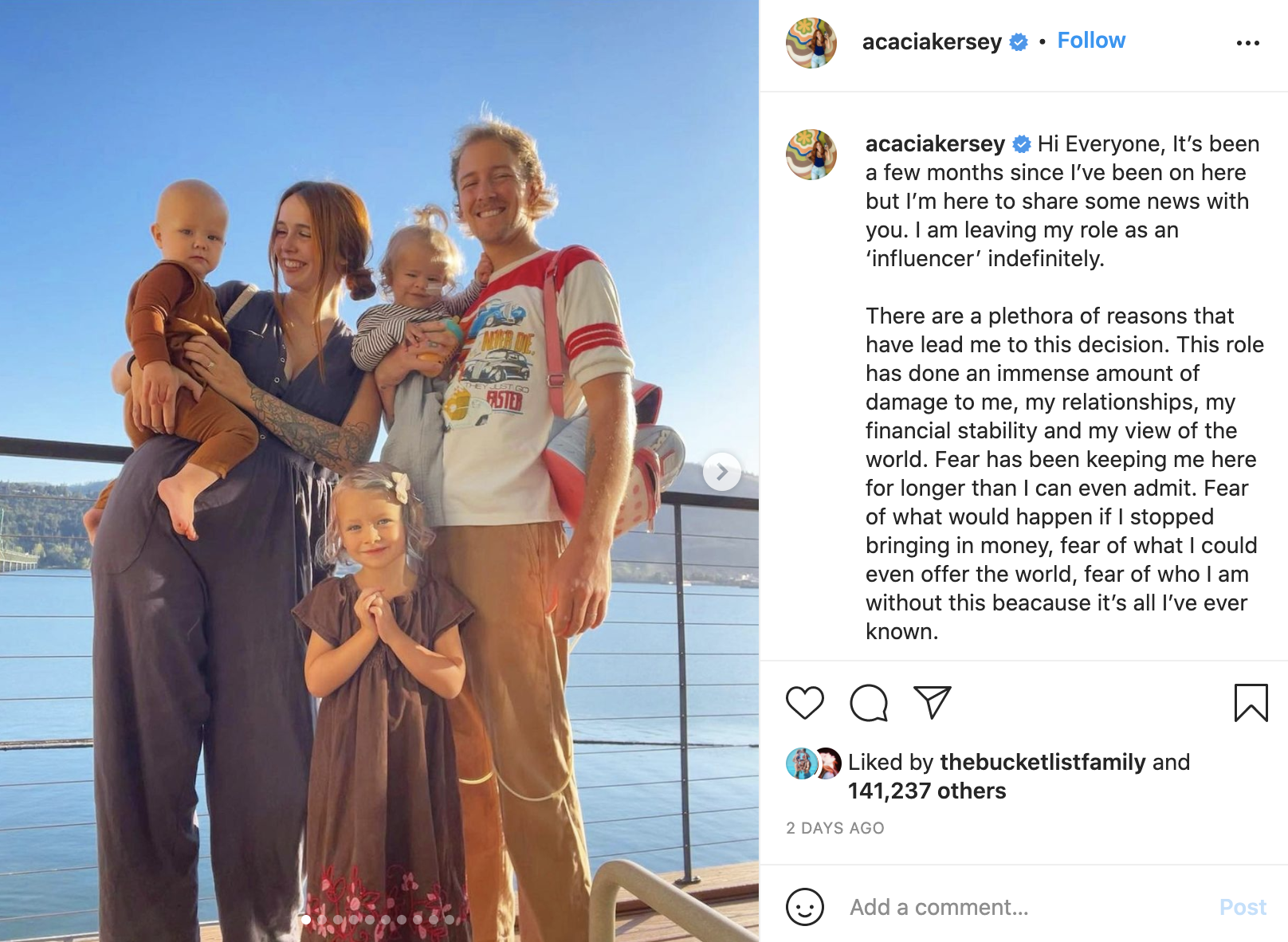 Instagram / @acaciakersey For more than a decade, Acacia Kersey has been one of the most controversial figures on YouTube, Tumblr, and Instagram. This week, she decided she had had enough.
Acacia, 23, announced in an Instagram post that she will quit influencing and step away from social media indefinitely. She is done monetizing her life, she said, and after months of debate, has decided it is "time to move on." The negatives of being an influencer finally outweighed the positives.
"This role has done an immense amount of damage to me, my relationships, my financial stability and my view of the world," she wrote.
This decision is huge for Acacia because, as she notes, she has only ever lived her life online. Acacia's family is familiar with fame. Her older brother Peyton Clark appeared on the Disney Channel. When she was young, Acacia aspired to become a singer and actor. She appeared in a few bands with middling success and had a few small acting roles over the years.
Acacia started a Tumblr account when she was in seventh grade and soon became famous on the platform. According to contemporaneous Tumblr posts, Acacia's popularity came from creating relationships with famous boys on Tumblr, getting involved in drama on the platform, and posting photos of herself with varying levels of sex appeal.
A lot of criticism of her seems to be rooted in sexism, drama, and general bad vibes. (To read about it, you can google various write-ups about Acacia on Tumblr, but I won't link out to any because they are kind of yikes.) TL;DR: Acacia became the girl on Tumblr who everyone loved to hate. An entry on Urban Dictionary, for example, described her as "an ex tumblr girl infamous for getting into relationships incredibly quickly (often with guys a lot older than herself), faking self-harm and abusing pets."  Tumblr / Acacia Kersey Acacia soon leveraged her Tumblr fame to other areas, and amassed more than 800,000 subscribers on YouTube and 2 million followers on Instagram. As she got older, her content changed. She started dating Jairus Kersey, a singer in the rock band Alive Like Me, in 2015, and documented their romance on a new, shared YouTube channel. The couple moved in together right before Acacia turned 18, had their first child, Brinley, in 2017, and their second, Rosemary, aka Rosie, in 2018, shortly after they got married. They had a third child, Cali, in 2020.
Acacia's life changed a lot during her time living publicly, but her haters never wavered. They moved on from calling her a slutty and messy teen to criticizing her as a bad mom. Twitter accounts dedicated to hating her blasted the toys she gave Brinley, what she fed her, and more.
After Rosie's birth, the critics got more biting. Rosie has special needs, which were undiagnosed for the first year or so of her life and led to wild speculation online. People accused Acacia of hating Rosie, neglecting her, and failing to acknowledge or treat her condition. Acacia's eventual public revelation that Rosie had been diagnosed with a rare genetic condition called Alagille syndrome did little to quell the criticism.
As I'm sure her haters are screaming right now, Acacia has had many public missteps. In 2020, she apologized for racist tweets and Tumblr posts she had written that had resurfaced. She has gotten hate for rehoming pets. Most recently, another creator accused Acacia of ripping off a series of presets from her. I'm sure people who hate Acacia could rattle off a litany of things she has done wrong over the years if we asked.
But if you attempt to understand why these events led to such a fervent hatred for Acacia online, you will likely still be scratching your head. The truth is, it doesn't make a ton of sense. For many, Acacia has become, to use the parlance of internet snark forums, a bitch eating crackers. The term means that you hate someone so much, everything they do annoys you. (Look at that bitch eating crackers like she owns the place!)
To her detractors, hating Acacia is a lifestyle, not a phase. They derive pleasure from watching her life and then finding ways to hate every single thing about it. She's not the only internet figure who gets this kind of treatment. Countless influencers and creators have maintained their fame not in spite of a huge army of haters but perhaps because of them. For some reason, groups on the internet tend to enjoy finding a woman to hate and follow her with the same fervent devotion as a fan would. It's a phenomenon as old as the internet itself.
Acacia, though, is turning off the free show that is her life. After going mostly radio-silent since July, she returned to announce her retirement this week. Acacia said she decided that she is done sharing her life and her family's lives for the pleasure of fans and haters on the internet. As she explains, it was a difficult decision for her to make. She has been able to make money and support her family off her influencer income for years, and it is super hard to give up a steady, lucrative career, no matter how harmful it becomes for a person. But Acacia decided that the money was no longer worth the price she was paying.
The most poignant part of Acacia's announcement is her revelation that she knows her career is harming her but she has no idea how to live without it. Her life is analogous to that of a child star, whose time in the spotlight is all they have ever known. Acacia said that the fear of who she is without the internet is debilitating.
"Fear has been keeping me here for longer than I can even admit," she wrote. "Fear of what would happen if I stopped bringing in money, fear of what I could even offer the world, fear of who I am without this because it's all I've ever known."
She sounds hopeful, though. She and Jairus are searching for a place to live in Oregon, somewhere "practical & safe," she wrote. Jairus will work full-time to support their family, and she plans to be a stay-at-home mom and start a creative side project. Maybe she will come back to the internet someday, but not for profit. "I will not rely on social media for my family's survival," she wrote.
Of course, the haters came for her retirement post as well, calling her "pathetic" and a "coward" and making fun of Jairus for losing his sugar mama. But at this point, does it matter, really? Acacia is gone. Her family lives offline, and now she really doesn't have to care what anyone else thinks.
—Stephanie McNeal A TikToker has some comprehensive theories about Mormonism and Instagram influencers 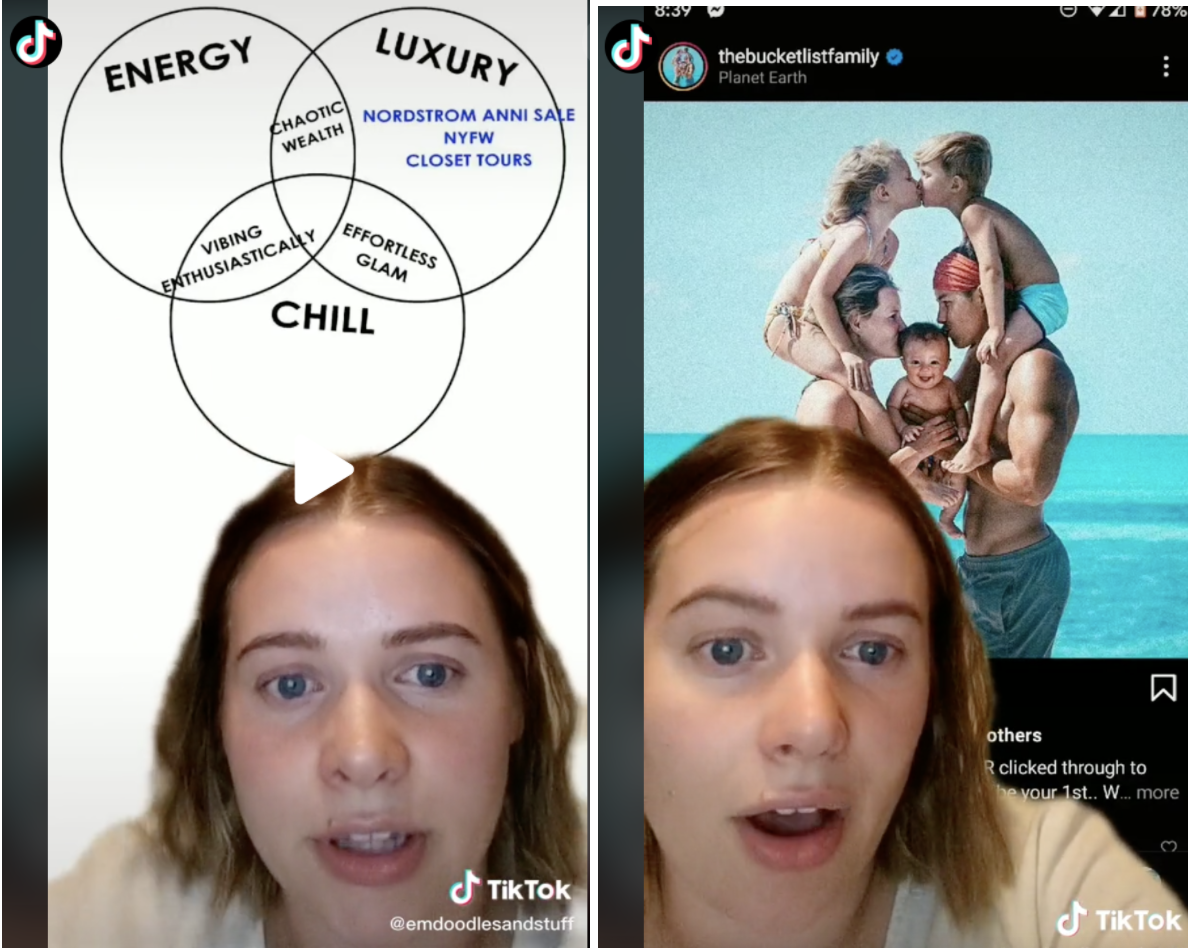 TikTok / @emdoodlesandstuff Never have I ever seen someone package a dense thesis on piety and influencing into a nearly three-minute clip quite like Emily Kim did in this TikTok.
Earlier this week, Kim posted a video/epic social media essay in response to one of her followers, who was shocked to learn so many influencers are Mormon. Kim told me she's followed a group of lifestyle bloggers turned Instagram influencers for years, so she's well aware of their religious backgrounds. Their posts have made her deeply reflective on how Mormonism informs their line of work (but more on that later).
"THEY'RE MORMON????" a commenter wrote on a previous TikTok Kim made about how certain influencers name their babies. So she decided to make a whole new TikTok in response to this person's bewilderment. "Yes, they are, and so is every influencer you've loved in the past decade," she says in the video.
"Finally, a chance to share an elaborate diagram," she says, and she delivers. Displaying a Venn diagram behind her, Kim says she categorizes Instagram influencers into one of three categories: "One, luxury: These are the OG fashion bloggers who are still doing it and raking in the dollars," she says. She cites traditional influencing techniques, like closet tours and Nordstrom Anniversary Sale promos, as well as swipe-ups. Examples of these kinds of influencers include the Skalla sisters.
Kim categorizes the next cluster of influencers as "chill" — or very curated and outdoorsy women who post "Instagrams full of refreshingly artistic film photography with a focus on imperfections and letting the moment be real." An example is the ever-so-effortless @amberfillerup (who undoubtedly puts a lot of effort into her work).
And the last category is "energy," which Kim says scares her the most (lol) because these influencers have no limit to the amount of Instagram reels or stories or "clickbaity videos with titles like 6 Life Hacks To Taking Eight Kids With Broken Legs To Disney World" they can produce. (Double lol.) In this category, she points to influencers like @jordanpage and Shannon Bird.
Like all good researchers, Kim also breaks down how these categories intersect. Between luxury and chill are "effortless glam" influencers; the overlap between energy and luxury makes for influencers who post their wealth chaotically and often; and energy and chill produces people or family accounts that are "vibing enthusiastically," like The Bucket List Family.
"And they're all Mormon, whether by their own declaration or context clues," Kim concludes in her TikTok. She adds the disclaimer that there is a whole spectrum of devotion — whether it casually informs people's values or they strictly live by the religion's decrees — but that she's "fascinated by this group because they're all connected by Mormonism."
Many fashion and lifestyle influencers on Instagram are Mormon by their own declaration, but of course it's unclear if every single person Kim mentions is still practicing today. However, because many of them have spoken about their faith at some point, it's interesting to consider how that religious background has shaped the industry as we know it (at least the segment dominated by young, pretty white women).
"There are so many theories to explain why Mormonism dominates the world of influencers, and I bet there's a grain of truth from most," Kim says. "Young, white Mormon women are more likely to get married and have kids younger than the national average, and that's connected to the long history of the church's guidance to prioritize having a family above everything else." She then alludes to an LDS children's songbook with lyrics like, "While I am in my early years, I'll prepare most carefully / So I can marry in God's temple for eternity."
Kim explains that since the religion prioritizes women marrying and starting families young, blogging has become a natural outlet for people to share their domestic lives, all with a coat of glamour. And it allows them to generate income without having to compromise their duties at home. The way Mormon women have used the internet to manage these basic needs has come to define a huge portion of the influencer culture we consume and criticize today.
"College-educated women are putting aside other aspirations in favor of being a stay-at-home mom, and I think it's a natural inclination in that role to seek an outlet that lets them feel creative, organized, in control, and social," Kim says. "Blogging started doing that a decade ago, and it has evolved into the influencer culture within Mormonism we see today."
Of course, the consequence of elevating one brand of women on social media is it creates an illusion of a perfect life and an improbable standard for the rest of us to meet. But, as Kim points out, it's extremely addicting to see how influencers maintain the image of being a perfect wife, mother, and Mormonwomanboss.
"Watching a 20-year-old Mormon newlywed travel the globe while expecting their first baby brings out feelings [like] curiosity, confusion, envy, admiration, scorn, or aspiration," Kim says. "No matter which feeling, [followers are] probably coming back to see more."
Kim's TikTok and theories are so compelling to me. I've written about organized religion, particularly Christianity, and its latent ties to social media work before. But it's also important to remember there's more to a person than their religious background. We can learn a lot about why people may make the choices they do, or contradict their values, or contribute to an industry in both positive and harmful ways, without reducing them to stereotypes. That's always what I fear when Stephanie and I write about influencers: that we may unintentionally be giving people more fodder for hating on them or the business. Influencers should be critiqued, but I hope this kind of analysis on why they've gotten into the industry further humanizes them.
"Like the quote in Ted Lasso, 'All people are different people,' you really can't assume you know someone's beliefs because you can stick them in a category," Kim articulates. "It's important to pay attention to nuance. For example, Harry Potter fans may cherish the deep-rooted message of friendship and also disown J.K. Rowling for her [anti] transgender comments. Mormon influencers may resonate with the doctrine of life after death and also renounce church leaders who hurt the LGBTQ+ community."
Oh, and one sub-category of influencer Kim didn't include in her TikTok is the "progressive Mormon," the opposite of the conservative evangelical woman.
"Progressive Mormons would include accounts like DesignMom by Gabrielle Blair, the writer Meg Conley, and influencer Rosie Card," Emily said.
Until next time, Tanya Want more? Here are other stories we were following this week. How TikTok's most viral indie star is challenging the music industry: From making songs on a ukulele in her parents' guest bedroom to performing at Lollapalooza, 21-year-old singer Mxmtoon told writer Steffi Cao why this era of viral fame has the opportunity to reshape the entertainment world.
P.S. If you like this newsletter, help keep our reporting free for all. Support BuzzFeed News by becoming a member here. (Monthly memberships are available worldwide.) 📝 This letter was edited and brought to you by Tanya Chen, Stephanie McNeal, and BuzzFeed News. You can always reach us here. BuzzFeed, Inc. |


