Does the link sticker punishment fit the crime?

 What is going on with Instagram taking away the link sticker for some creators? Earlier this week, influencer Erika Altes got a notification on her Instagram account @whiskeyandlace that stunned her.
"Losing access to the link sticker," it read. "Starting October 25, you will no longer have access to the link sticker because you have shared content that violates our community guidelines."
Erika was instantly terrified. Without link stickers — the platform's replacement for the "swipe up" feature it just retired — her income from Instagram is in jeopardy. Using them in stories makes it much easier to share affiliate links, where influencers get a commission off each sale made through their link, as well as links to ads they do with brands. Instead, Erika would only be able to share a clickable link through her bio, which results in a much lower click-through rate.
Erika is not alone. Many creators are complaining they have gotten the same message this week. While Instagram insisted the move is meant to punish creators who have repeatedly and flagrantly violated its community guidelines, many influencers who got the notice have told me they have only ever been flagged once or a few times, and often for content that was not obviously harmful but was said in jest or was nuanced. Creators can appeal when their content is flagged, but there is not yet a way for them to contest the link sticker ban.
The first group to raise the alarm about the ban was creators in adult entertainment and other fringe industries, such as provocative art, who often have to battle with Instagram to keep their accounts alive. As Vice wrote earlier this week, these creators see it as "just the latest move from a company that discriminates against sex workers."
An Instagram spokesperson told me that the ban was enacted on creators who "repeatedly or severely violated" its community guidelines as a way to "limit the spread of harmful content." So, creators are ostensibly being banned for either going against the guidelines many times or doing something so egregious that it warrants an immediate ban.
However, many influencers insist that isn't how it's actually being used.
Erika, for example, says she has been flagged for two posts. In one case, she says she got dinged for hate speech after saying "boys are so gross" on a photo of her brother. In another, she says she got reprimanded for attempting to "incite violence" for saying she wanted to burn her house down after finding a dead mouse in her Yeti cooler.
Some creators say they only had one violation. Ailsa Gonzalez of @_happygocurly_ says she got the notification due to one photo she'd posted of kids waist up in a bath that was removed for "nudity or sexual activity." Jess Bonds, of @pacificnorthjess_, also had one violation, for a video of herself playfully slapping a friend's boob that was taken down for "bullying/harassment."
When I asked about these examples and others, the spokesperson said Instagram is looking into the claims.
"We're investigating an issue where people may have mistakenly been notified that they will be restricted, and we're working on resolving this as soon as possible," they said.
This whole thing is rather confusing. While it's admirable that Instagram is taking measures to ensure people actually play by the rules, I wonder if it's being executed in a way that's fair.
It feels unnecessarily punitive to punish someone for a photo of a child in a bathtub, for example, when that kind of content is all over Instagram. Furthermore, a bathtub photo (or a photo of a toddler in a diaper, which Bethanie Garcia of @thegarciadiaries has been flagged for) is not necessarily explicit, and a determination of that kind requires a nuanced examination of each photo. Other examples, if the influencers are right, appear to be part of an attempt to cut down on genuine hate speech that's catching harmless examples in its dragnet.
To enforce this specific punishment, which greatly affects the income of creators, without warning and without an ability to appeal, also doesn't seem to make a lot of sense to me.
For many Instagram creators, even those who aren't being impacted, this issue is one more example of a policy that makes them feel underappreciated by the platform they feel they helped create.
"I've had followers DM me and comment on my stuff with the most vile, hateful things, and this is what I am potentially getting my livelihood taken away for," Erika said. "Punishment doesn't fit if you ask me."
—Stephanie McNeal Young people, especially young women, are reporting concerning medical and behavioral changes due to social media, and I hope we're paying attention 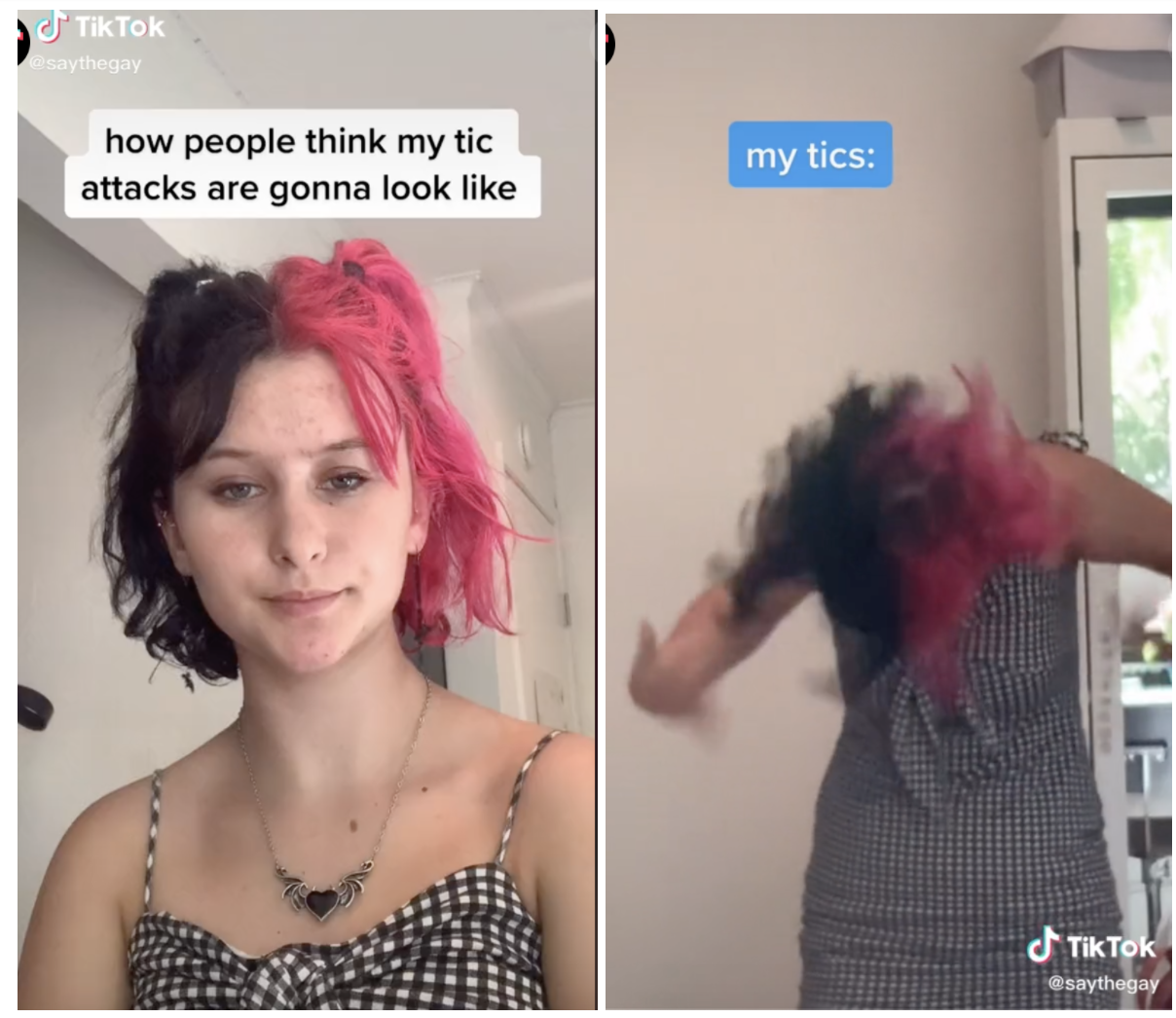 TikTok / @saythegay I was really struck this week by this article from the Wall Street Journal, where writer Julie Jargon connects a rise in cases of teens reporting new physical and verbal tics to TikTok videos they've consumed.
According to Jargon's reporting and previous research, this development involves mostly young women and is heavily influenced by how often they watched TikToks from influencers who said they had Tourette syndrome. The movements are sociogenic, meaning they are developed socially, but have profound and real neurological effects. Patients had physical jerks, such as neck twitches, or were compulsively and involuntarily repeating a word like "beans."
Doctors who were cited in the article noted that many of the teen girls with these tics were also diagnosed with depression and anxiety. The thesis, it seems, is that the pandemic created a cascade of new challenges and coping mechanisms: The more young people were consuming these videos at home, the more the TikTok algorithm fed them to their feeds, and the more the videos were affecting their own psyches and behaviors.
Because we consume so much social media content, and there is scarce research done on its short- and long-term effects, perhaps I shouldn't have been as shocked to hear about this report as I was. But I am fiercely sobered by it. It's easier to neglect the sinister consequences of social media than to stare squarely into its eyes, like this WSJ report did. BREAKING: Turns out the poorly regulated, 24-hour content mill of being Extremely Online is really threatening to our mental health!
But it was also concerning to observe how the public received this story. Since it involved mostly young women and their social media use, I worried that people would mock or dismiss their ailments. Nothing brings dissenters online like reading about how young women are suffering because of the holding power of tech companies exploiting and profiting off their dependencies.
The response was mixed: Many people were as struck as I was by the report, and plenty predictably minimized it to Twitter punchlines and began casting a lot of doubt.
I reached out to Dr. Caroline Olvera, a neurologist and movement disorders fellow at Rush University Medical Center in Chicago cited in the WSJ piece. She's one of the few medical professionals actively studying this case and other sociogenic changes due to social media.
Olvera gave me a lot more context to her own research and why the new cases are being diagnosed as "functional neurological disorder," as opposed to classic Tourette syndrome. I won't be able to parlay all of that in this newsletter (it's profound, and very dense, and you can read more about that here), but the thing I want to emphasize is just how legitimizing her research is for these TikTok-induced tics. They may be atypical compared to how we've conceptualized or diagnosed disorders before, but the behavioral patterns and obstacles they present are very, very real.
"Historically, and currently, I believe that women's medical complaints are sometimes minimized compared to men," Olvera told me. "For example, the term 'mass sociogenic/psychogenic illness' was previously called 'mass hysteria,' referring to the uterus, and thus the underlying assumption may be that this is a phenomenon only affecting women who have gone 'crazy' or 'hysterical.'"
She also pointed out other examples of women's complaints being minimized, such as how long it's taken society to offer and normalize pain medication for childbirth.
"With more and more women becoming doctors, I think the perspectives are changing to take women and their complaints more seriously," said Olvera. "We have certainly come a long way, but there is still a long way to go — as with society in general."
She believes social media is the catalyst, if not the root, for worsening mental health issues. And it'd be wise if we took these young women, and other people reporting concerning behavioral changes, seriously. Olvera noticed she developed mild tics herself —"a lot of eye blinking" — after spending weeks watching similar TikToks for her field research.
"Social media use has previously been tied to worsening depression, anxiety, and eating disorders in those who may be more susceptible to these disorders," she said. "In general, tics are very suggestible, so watching them in videos may provoke them to worsen."
Olvera noted, however, that social media also has "the ability to act as almost a global support group for those with the same illness." The visibility of Tourette syndrome on TikTok is ultimately great for those who are diagnosed, but she advises undiagnosed users to turn to medical professionals for counsel instead.
I imagine that noticing these kinds of changes in our bodies, and in our daily habits, is a very jarring experience, especially when there aren't a lot of concrete answers. It's easy to doubt ourselves or even dismiss stimuli like social media as being a cause. There are already a lot of prejudices against women, especially young women, especially young women of color, who raise their health concerns. Even more so if they don't neatly fit into traditional conceptualizations of medical conditions. So it'd be wise and responsible if we paid attention now, instead of paying the price of these conditions worsening in the future.
"While my patients have been using Google for quite some time to research their illnesses, it may be that now patients are going to social media to gather information on their medical illness," said Overa. "As a medical profession, we are at the very beginning of understanding how social media may positively or negatively impact our patients and what type of information patients are obtaining online."
Until next time, Tanya Want more? Here are other stories we were following this week. Meet Aunt Karen, the TikToker dedicated to putting racists on blast. Her real name is Denise Bradley, and she fights against racism by identifying people caught using racial slurs or engaging in discriminatory behavior.
Letterboards: Why? Writer Kathryn Jezer-Morton examines how letterboards on mom blogs became so popular and ubiquitous with influencers and why they now seem to be falling out of popularity. P.S. If you like this newsletter, help keep our reporting free for all. Support BuzzFeed News by becoming a member here. (Monthly memberships are available worldwide.) 📝 This letter was edited and brought to you by Tanya Chen, Stephanie McNeal, and BuzzFeed News. You can always reach us here. BuzzFeed, Inc. |


