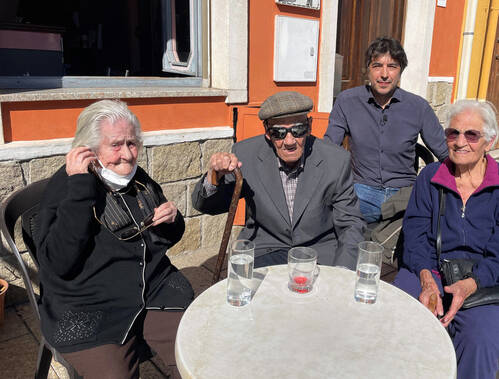
| A few weeks ago, I read a New York Times Magazine story, "How long can we live?" with interest, because I had just assigned a similar story. The Times story included some fascinating details about Jeanne Calment, who, having died at 122, is believed to have been the world's longest-living person. Calment seemed to have a nice life -- for most of it, anyway. She lived in the city of Arles, in the south of France, where she married a merchant and had one child. According to reporter Ferris Jabr, "She never needed to work, instead filling her days with leisurely pursuits: bicycling, painting, roller skating and hunting. She enjoyed a glass of port, a cigarette and some chocolate nearly every day. In town, she was known for her optimism, good humor and wit." Calment outlived her husband, child and grandchild, and resided in a nursing home for the last 12 years of her life. In her final years, "the once-athletic Jeanne Calment was essentially immobile, confined to her bed and wheelchair," Jabr writes. "Her hearing continued to decline, she was virtually blind, and she had trouble speaking. At times, it was not clear that she was fully aware of her surroundings. By some accounts, those in charge of Calment's care failed to shield her from undue commotion and questionable interactions as journalists, tourists and spectators bustled in and out of her room." Somewhat troubling. So, when I was editing freelance writer Matt Fuchs's story, "Want to add healthy years to your life? Here's what new longevity research says" and came across the term "healthspan," I was excited. Yes! I thought. We shouldn't be focused on increasing lifespan; we should focus on improving healthspan. Curious about where the term healthspan came from, I looked it up online and found lots of references in medical articles and journals (it seems to have caught on during the 2010s). There was also some debate about what it means. In a 2018 article, Matt Kaeberlein, a professor in the Department of Pathology at the University of Washington School of Medicine in Seattle, who is also quoted in Matt's story, wrote that "one common definition is that healthspan is the period of life spent in good health, free from the chronic diseases and disabilities of aging." On the other hand, in a 2017 blog post, Tim Peterson, assistant professor in the Department of Medicine at Washington University in St. Louis, noted that healthspan might be described as to being free from "serious disease." He defined serious disease as a leading cause of death, such as heart disease or Type 2 diabetes. But, I thought, what about all the awful diseases that aren't leading causes of death? Surely, they affect healthspan, too. You can see the problem. Not only is healthspan a difficult term to define, it's also difficult to quantify. "There are no accepted or validated metrics for measuring healthspan," Kaeberlein wrote. He argued that the term should not appear in scientific literature, unless it's used conceptually. But as a concept, Kaeberlein noted, healthspan is a helpful term. In a passage that reflected my concerns about Jeanne Calment, he wrote about healthspan: "It is a concept that is easy to understand and is more palatable to a general audience than increasing lifespan. Indeed, while some would debate the ethics of research aimed at increasing lifespan, there is broad agreement that expanding the period of life spent in good health is a worthwhile research endeavor, with significant economic and social benefits." So, while healthspan may disappear from scientific publications until researchers develop a metric for it, I think we laypeople should hang on to it. After all, for most of us, as the phrase attributed to anthropologist Ashley Montagu goes, "The idea is to die young as late as possible." Take care. |





 Email
Email