| Whether Democrats should weaken or get rid of the filibuster in the Senate is a tantalizing idea for some in their party — so tantalizing that it now seems to come up once every few weeks. President Biden is now open to getting rid of Republicans' ability to filibuster measures to raise the debt ceiling. That would allow Democrats to suspend the ceiling with just Democratic votes and avoid a default. Biden's posture is notable because the president has been a skeptic of broader changes to filibuster rules. The latest on the debt-ceiling fight, by the way: Republicans have offered Democrats the choice of raising the debt ceiling into December, to give Democrats time to figure out how to raise it on their own without taking down the filibuster. But if they want to dent the filibuster, Democrats would have to win over Sen. Joe Manchin (D-W.Va.), who summoned reporters outside his office Wednesday and pointedly said his position — to keep the filibuster intact — hasn't changed.  Sen. Joe Manchin III (D-W. Va.) talks to reporters Wednesday about his opposition to changing the filibuster. (Amanda Voisard/for The Washington Post) | Still, it may just be a matter of time before Democrats (or Republicans) start seriously whacking the filibuster Even as they say they hate to do it, senators have been minimizing the filibuster for nearly a decade. They do it full well knowing that whatever hole one side makes in it, the other party might soon punch a larger one. The deterioration of the filibuster so far has gone like this: In 2013, Senate Democrats were really frustrated with a Republican blockade on President Barack Obama's political appointments. So they eliminated the filibuster for most political appointments, with the exception of Supreme Court justices. Four years later, Senate Republicans were trying to seat President Donald Trump's first Supreme Court appointment, but Democrats were filibustering Neil Gorsuch. So Republicans eliminated the filibuster for Supreme Court nominees, too. Today, the filibuster can only used for legislation. But the more it gets used, the more it feels like its days are doomed. All it takes is 50 or 51 senators to be frustrated enough to make a big change. And Senate Democrats are close to that, at least on the debt ceiling. A quote in the news, explained "You can't legislate like FDR when you got a 50-50 Senate, and that's their basic problem." That's a Republican senator, John Cornyn, talking to The Washington Post's Mike DeBonis about Democratic senators' struggles to pass a sweeping expansion of the federal government safety net. It's rare to have a tied Senate. Cornyn's point is that Democrats just don't have enough votes to make the kind of major changes to American society (universal prekindergarten, free community college tuition, expanded Medicare, reprieve for dreamers, retrofitting buildings to withstand climate change) that they want to. That's why you see one or two Democrats (Manchin, Sen. Kyrsten Sinema (Ariz.)), able to drastically change the price tag or elements in it. Manchin in particular has said he doesn't want to create new programs, which could spell doom for the bill's really big ideas like universal pre-K or paid family leave, reports The Post's Paul Kane. "He'll get one or two thumbs up, a lot of thumbs down, a lot of mehs." 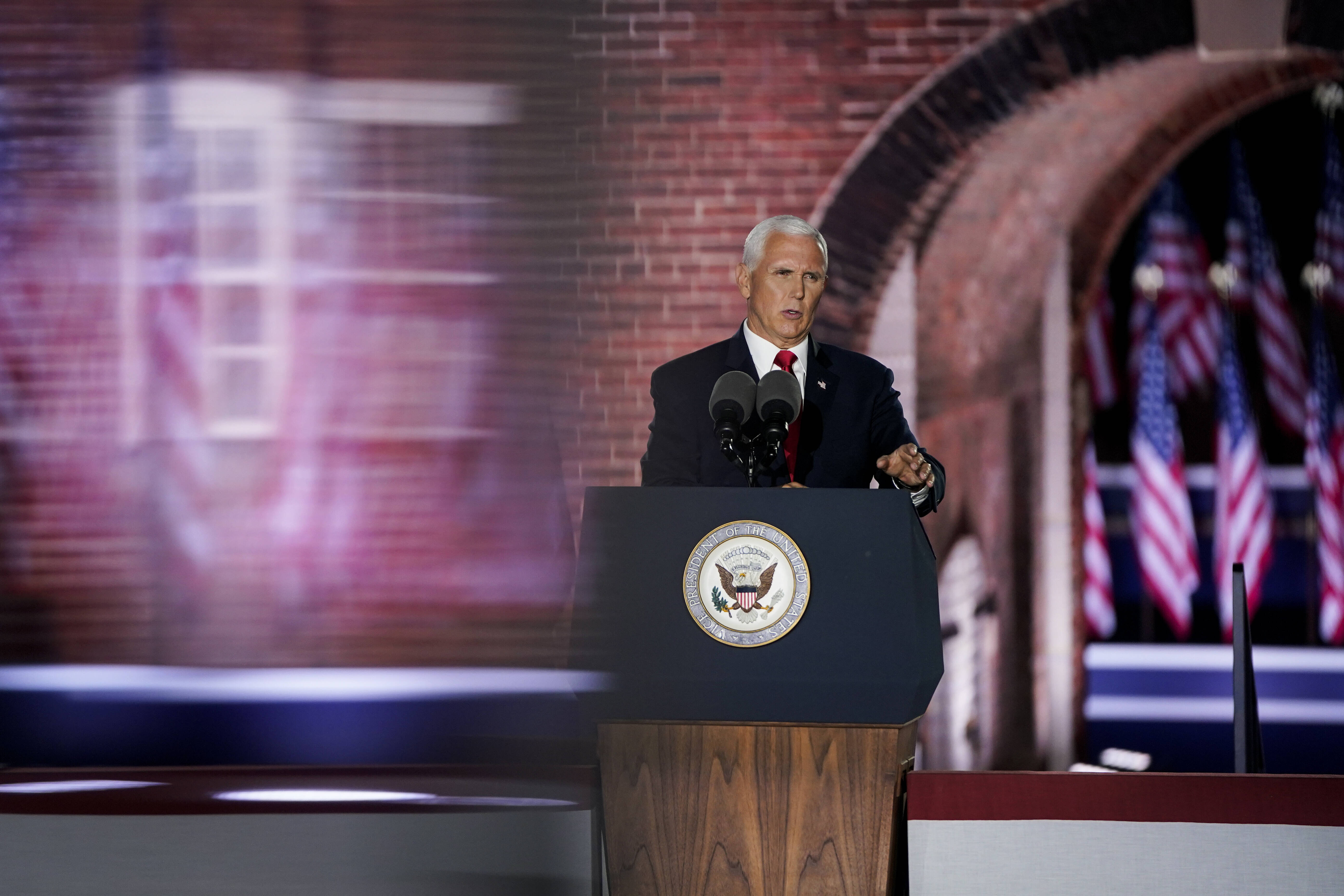 Vice President Mike Pence speaks in 2020 at the Republican National Convention. (Jabin Botsford/The Washington Post) | Let's look at one more quote in the news. That's a former Republican strategist talking about the reaction to Mike Pence running for president in 2024 when Trump voters in focus groups in Ohio and Georgia were asked about the former vice president. Pence sure seems like he's running, report The Post's Ashley Parker and Josh Dawsey. (Hence how he tried this week to give the benefit of the doubt to Jan. 6 insurrectionists tearing through the Capitol in search of him). But there are already doubts about how excited the base is for Pence, even when he did all but override an election to stay on Donald Trump's good side. Why Trump is probably irked about being off a list of richest Americans For the first time in about 25 years, Donald Trump is off the Forbes 400 richest list. Forbes says Trump's estimated $2.5 billion has stayed the same from last year, "but as the rich get richer, stasis won't cut it," writes The Post's Marc Fisher. Fisher writes about how Trump has been obsessed with making the list ever since he inherited millions from his father, even calling in as a fake PR persona to champion his wealth. Eventually Forbes gave up trying to pin down how rich Trump was, Fisher writes: "In 1999, Trump was #145 on the list, with a net worth of $1.6 billion, but with this explanation: 'We love Donald. He returns our calls. He usually pays for lunch. He even estimates his own net worth ($4.5 billion). But no matter how hard we try, we just can't prove it.'" | 




 Email
Email