| Steve Bannon was a dominant figure at the beginning of the Trump administration who became a big player at the end, specifically around the Jan. 6 insurrection. That's why a special House committee investigating the insurrection wants to talk to him so badly. And since he's refusing to, the full House of Representatives voted today to hold Bannon in contempt of Congress. Let's back up to understand why he is so critical to the investigation. Who is Bannon? He used to run a right-wing website, Breitbart. He joined and engineered Donald Trump's 2016 campaign, and then Trump brought him on as White House chief strategist. But Bannon's embrace of nationalistic ideas was too toxic even for some in the White House after Trump championed self-proclaimed white nationalist protesters in Charlottesville. Bannon got pushed out.  Steve Bannon. | Bannon's role in the Jan. 6 insurrection: Is unknown. But he remained in Trump's orbit. And as Trump was fighting his election loss, Bannon personally had conversations with Trump in the weeks leading up to Jan. 6. And he held a meeting with Trump allies in Washington on Jan. 5, report The Post's Felicia Sonmez and Jacqueline Alemany. That same day, he said on his podcast that "all hell is going to break loose tomorrow." What the committee wants from him: They subpoenaed him, among other Trump allies and aides, to provide documents and testimony. Other Trump allies have been cooperating, but Bannon has tried to claim executive privilege — even though he didn't work in the White House at the time — to avoid talking. Some committee members think that Bannon is the key to understanding whether Trump was personally involved in putting the insurrection together. How the committee will try to get him to talk: By pressing every pressure point they can on him. They are taking steps to fine him or even put him in jail for not cooperating. It's technically illegal to ignore a subpoena from Congress. So the House voted today to hold Bannon in contempt of Congress, pass that contempt charge on to the Justice Department and encourage them to charge Bannon with a crime. What happens next on voting rights? Democrats are running out of time to pass legislation in Congress that would push back on a Republican-led effort to limit who can vote, how they can vote, and who tallies election results in key states. Republicans in swing states are also drawing new congressional lines that will help them take back the majority in the House and possibly keep it for years to come. Senate Republicans blocked a voting-rights bill this week. So, Democrats have two options, both of which they're pursuing: - Convince Sen. Joe Manchin III (D-W.Va.) to vote to end the filibuster, at least for voting-related legislation, so Democrats can pass a bill over Republican objections. There's no word on whether he's considering it, reports The Post's Mike DeBonis.
- Try to convince Republicans to vote for narrower legislation. Such as a bill to restore a civil-rights-era law that requires states with a history of discriminatory voting practices to have their changes approved by the federal government. Democrats plan to bring this bill, the John Lewis Voting Rights Advancement Act, to a vote soon.
There's a third option, of course: To just drop this and say they tried. But Democrats — President Biden included — are getting an enormous amount of pressure from advocates, especially in communities of color, to find a way to put more protections around their voting rights. "Failure is not an option," Senate Majority Leader Charles E. Schumer (D-N.Y.) regularly says on this. 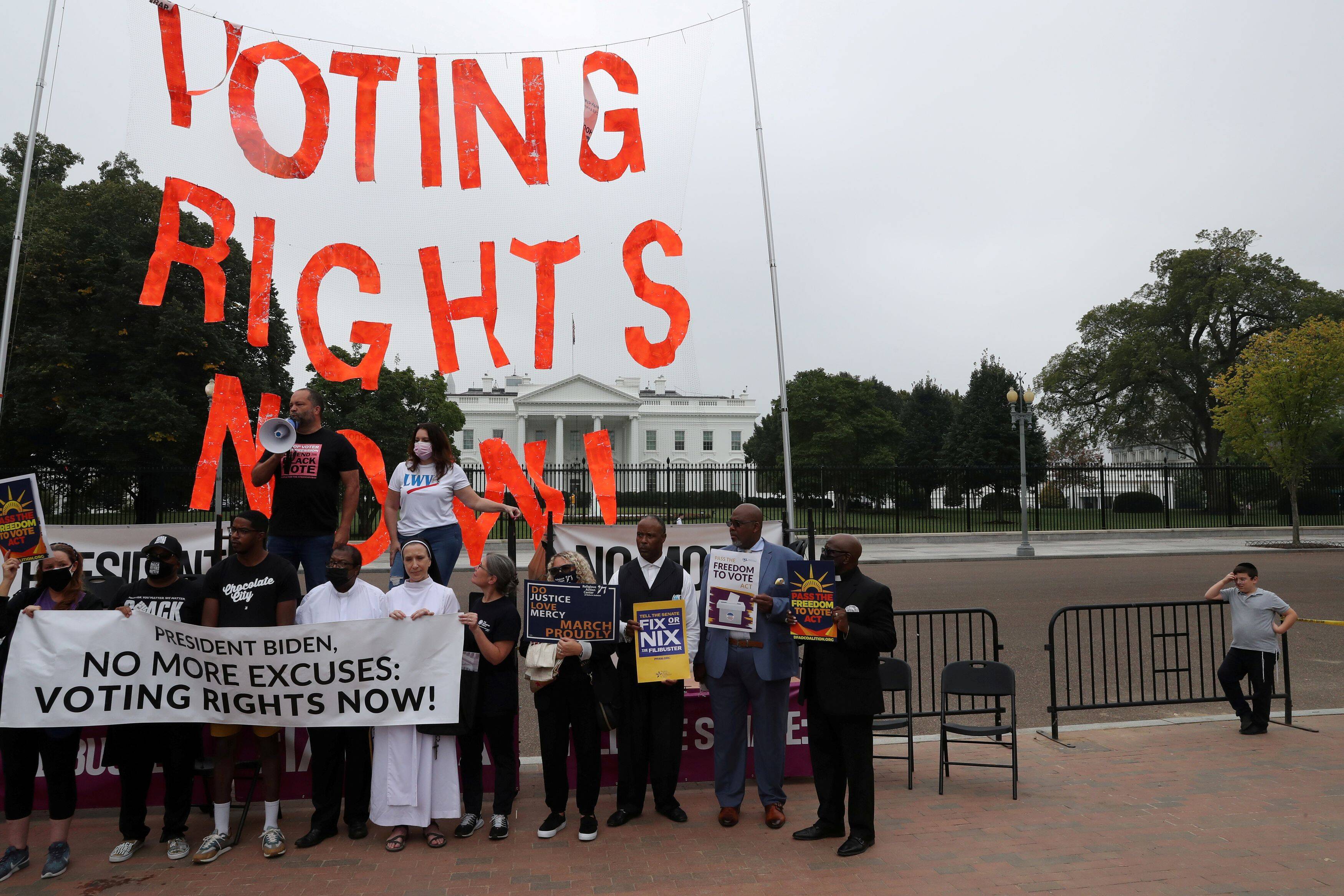 People protest for a voting-rights bill outside the White House earlier this month. (Leah Millis/Reuters) | What Democrats have to leave on the cutting-room floor: paid family leave edition We know that the Democrats' big social-safety-net bill is going to be much less, maybe by as much as half, than many in the party originally wanted to spend. What to cut is an impossible decision for lawmakers who see this as perhaps their only chance in years to pass the expansive legislation liberals have only been able to dream of. That headache is underscored best by the debate on paid family leave. It's a huge selling point for the bill, one that Biden uses regularly. But to save money and get votes from moderates, Democrats are considering cutting a proposal to mandate 12 weeks of leave for a new parent or someone caring for an ill family member to four weeks, reports The Post's Tony Romm. Here's that debate, encapsulated in two quotes. "All we've asked for is 12 weeks. If it's good enough for us, then it's good enough for the American people." — Rep. Rosa L. DeLauro (D-Conn.), talking about how lawmakers get 12 weeks off. "To someone who doesn't have a day of paid leave, four weeks could still be meaningful to them." — a paid family leave activist, Dawn Huckelbridge. | 




 Email
Email 


