When a TikTok prompts real policy changes

 What Happens When An Influencer Wants to Retire? These Found Someone To Replace Them In April, Kimberly Smith announced to followers of her blog, Penny Pincher Fashion, that after a decade of blogging, she had decided to retire.
In a post, Kimberly wrote that she had burned out of the industry once it shifted from traditional blogging to influencing primarily via social media. The industry is very different from the one she joined in 2011, and she said "the more that this industry has changed, the more I have found myself wanting out."
However, in September, Kimberly returned to the blog with a surprise announcement. Instead of slowly fading her blog out, she had decided to let it live, with a new owner at the helm.
"Two months ago, I met Veronica and I knew she was the perfect person to take over the business," Kimberly wrote. "I am thrilled to introduce her to you today as the new owner & author of PPF! She is going to breathe new life into the blog and pick up right where I left off."
Kimberly had passed on her website, her Instagram, and its contents to Veronica, whose last name she did not reveal. Soon after, Veronica introduced herself to the Penny Pincher Fashion audience, writing, "my goal is to continue providing budget friendly fashion finds, outfit inspiration, and beauty ideas to you." Veronica has kept the core focus of Kimberly's blog, affordable clothing and budget finds, while putting her own face and spin on it. 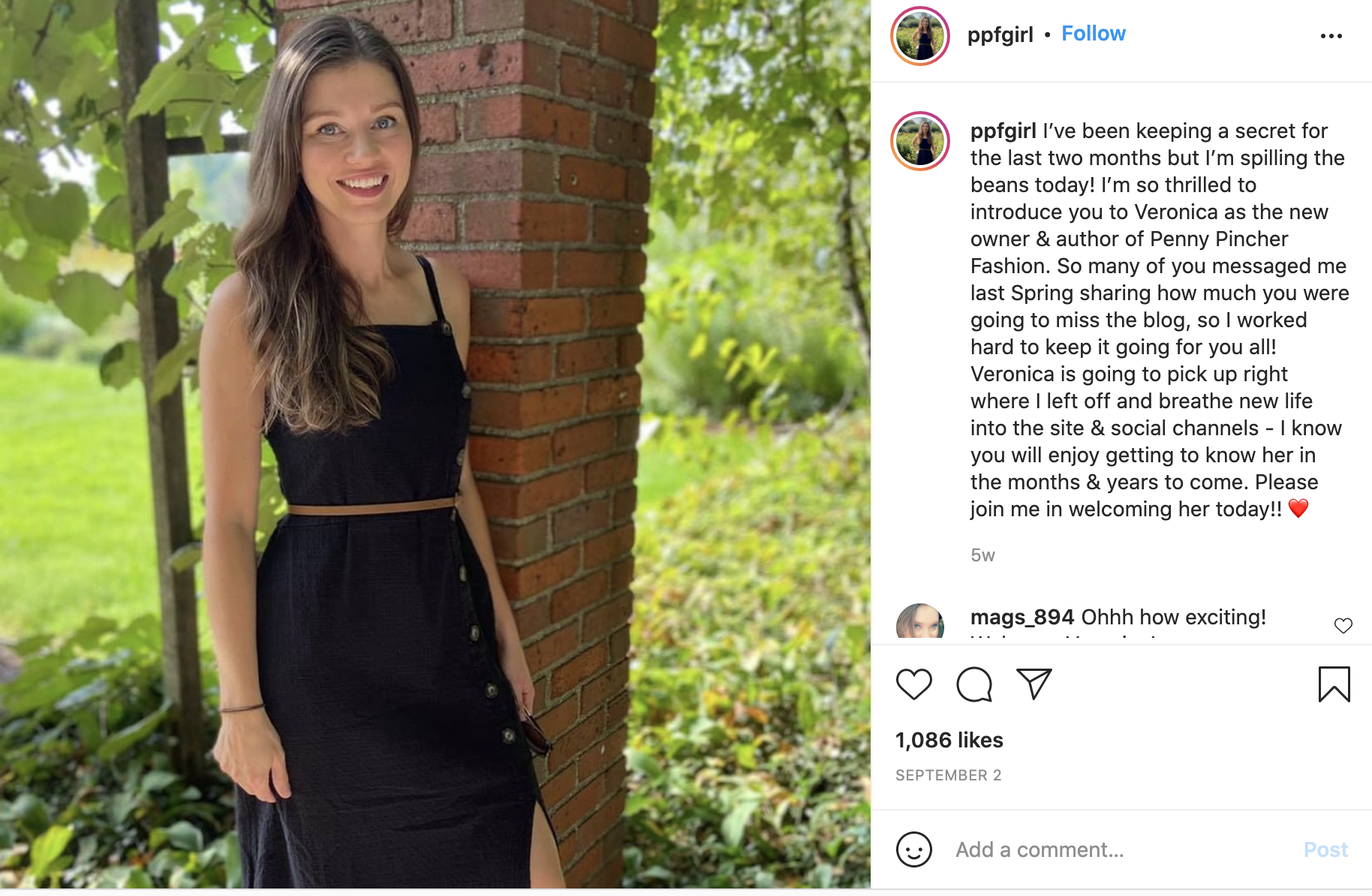 Instagram / @ppfgirl Over the past decade, blogs and Instagram accounts have morphed from passion projects into small side hustles to bonafide small businesses, run by thousands of people all over the world. I have often wondered if we would start to see some people, clearly burned out by the frenetic pace of influencing, begin to retire, and if so, what would happen to their incredibly valuable businesses.
It turns out, just like any other small business, like a doctor's office or a boutique, influencer businesses can be bought and sold. Influencers can also choose to just give away their business to a newcomer eager to try out the influencing game for themselves (it's unclear if Veronica paid to take over Kimberly's accounts or what her social presence was before this).
This is becoming more and more common, as many influencers are choosing to step away or retire for various reasons. Taking over an established account is a much more enticing option than starting from scratch, as it can be extremely hard to build a new brand from the ground up in an increasingly competitive and crowded marketplace.
For many influencers, passing on their account can also be a way to ensure that their hard work lives on without them having to maintain it. That's what happened with an account called @ReadLikeARockstar, which provides anti-racism resources and education for teachers, educators, and other advocates.
The account was founded by Naomi Simone O'Brien, an elementary school teacher, and she had amassed more than 100,000 followers by early 2021. One of her fans was Deonna Smith, an assistant principal and former teacher in the Los Angeles area, who had begun posting about racial justice on her personal account in 2020.
Deonna told me that she first began posting on her private account to show people what the Black Lives Matter protests in Los Angeles were really like on the ground. Over time, she began sharing more and more resources for anti-racist education and began hosting Instagram lives on the topic. She grew acquainted with Naomi through Instagram, and the two appeared on a panel together. While Deonna's posts would sometimes go viral, she never cracked more than 800 followers.
Naomi decided that Deonna would be the perfect person to take Read Like a Rockstar into its next chapter. In spring 2021, Deonna said, Naomi reached out to her and asked if she would be interested in taking over @ReadLikeARockstar. She explained that she was burned out from running her Instagram account and wanted to focus on other ventures. Deonna said she did not pay for the account and got it "no strings attached."
Deonna decided that the account would be a perfect way to launch her activism into even greater heights. On June 1, they officially switched over the account. "Here's to new beginnings," Deonna wrote.
"Really it was meant to be because she was praying for a way out and I was ready for the next step in my journey as an advocate, thought leader and consultant," she continued. "So here I am. Ready to learn and grow with you."
Despite being excited for the opportunity, Deonna was nervous followers would reject her. However, she said, the response has been "overwhelmingly positive."
"Her audience has been into it, like they've been down, which is crazy," she said. She also didn't lose followers, as Social Blade data shows the follower count on the page has remained remarkably steady since her takeover.
Deonna has kept the spirit of the page while putting her own flair on it. She changed the name to her own, @deonnasmith, saying she wanted to allow Naomi to keep the "read like a rockstar" moniker. (Naomi now has a smaller following on a new account, @readlikearockstarteaching.)
The main change, she said, is that she and Naomi are different women, with different life experiences, so they present information in different ways. Also, she said, Naomi focused more on resources for teachers to use in the classroom, while she is more geared towards "coaching teachers...to become better as a whole" at anti-racism and recognizing inequities in the systems and institutions.
So what's it like going from a normal person to having the attention of more than 100,000 people overnight? As crazy as you'd expect, Deonna said. She has had to navigate learning all sides of the business, from brand deals to dealing with a ton of DMs, on top of running the account and her day job (oh yeah, and she's also a doctoral candidate). However, she knows all the hard work will be worth it. She hopes to grow her consulting business and continue her activism through the account.
"At the end of the day, it's challenging, but I do not regret it for a second because I'd be crazy not to take this opportunity to really do something to put my money where my mouth is," she said. "This is what I care about."
Deonna's story is fascinating and a harbinger of things to come in the industry. People are slowly starting to recognize that being an influencer is akin to being an entrepreneur and that an established Instagram account, blog, and other online establishment is an asset with value.
As the influencer economy grows more mature and complex, I wouldn't be surprised if we see more and more of these deals.
— Stephanie McNeal A viral TikTok can be the first step of real policy changes — but it is only a first step 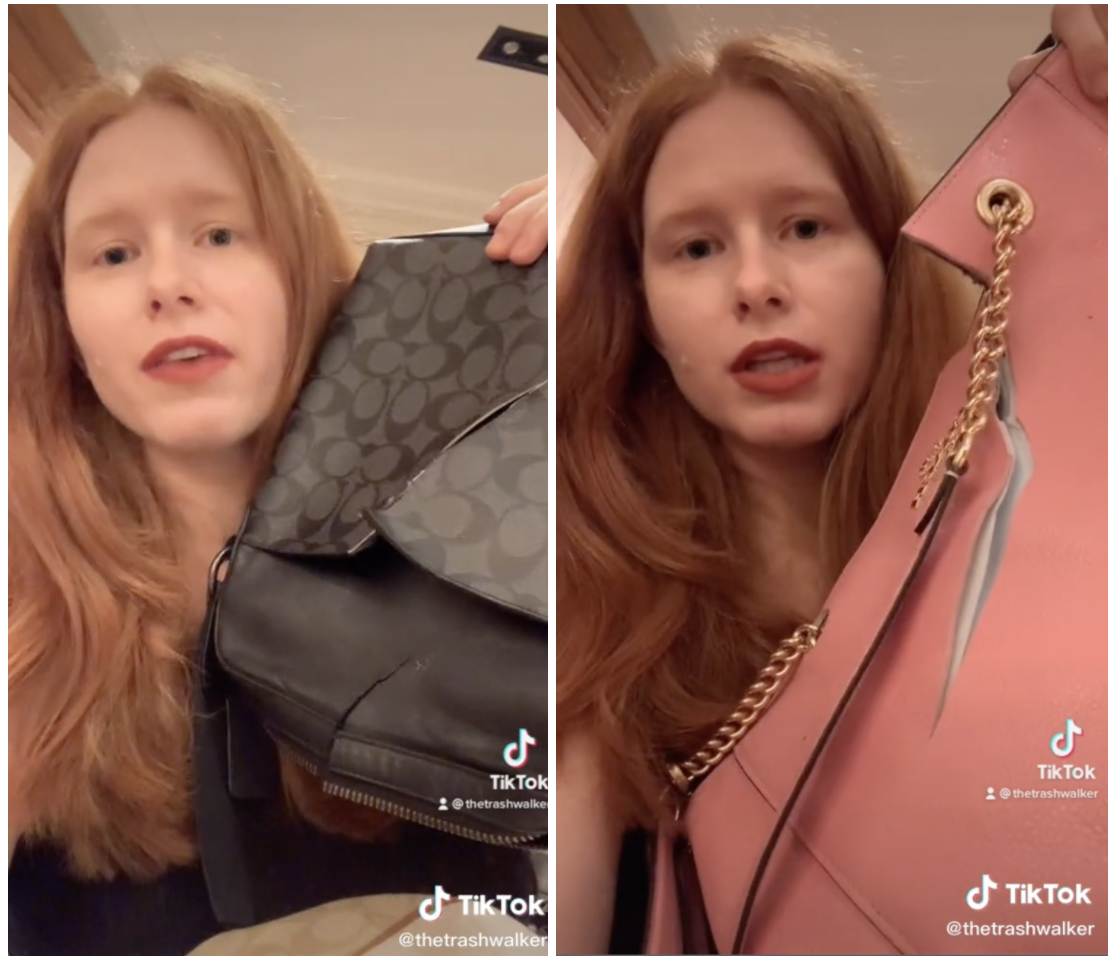 TikTok / @thetrashwalker Anna Sacks had been running educational programs on how to reduce waste in New York City, working closely with various environmental coalitions. But the 30-year-old is now channeling that advocacy work on her social media. Over the weekend, she posted a TikTok that not only broke through the public consciousness but also inspired an actual (however incremental) policy change.
Sacks filmed an "unboxing" video where she showed off a haul of Coach purses and other goods that were slashed. She claimed in her video that these were pieces of unwanted merchandise that the company couldn't get rid of, and thereby were slashed by Coach employees so they could be marked as damaged goods for a tax write-off. Sacks then pointed to the hypocrisy of the company proclaiming to care about sustainability. Coach even touts a repairs program that Sacks said in her TikTok she'll be taking advantage of by dropping off bags the company apparently destroyed itself. The video gained so much attention and fervent responses from TikTok users that Coach was forced to respond. The company pledged to stop destroying "unsalable" products.
This might sound like a fitting response from a large corporation, but there are subtleties to this language. Coach announced this week that it has "now ceased destroying in-store returns of damaged, defective, worn and otherwise unsalable goods." When I talked to Sacks, she pointed out that there are a host of other reasons companies like Coach can continue to justify damaging their inventory — "If stitching is not up to standard, if a bag in a store is scratched, if it's a style that might not sell" she listed as just a few examples.
I reached out to Coach representatives to ask them to clarify what exactly constitutes "unsalable" goods and if they'll be ceasing this practice for other circumstances too. I've not yet heard back from the company.
Sacks told me she's surprised, but overall pleased, that her TikTok inspired a "tipping point" for change. She also credits the herds of engaged people sharing the post widely and tagging Coach.
"I actually made a similar video last year that didn't blow up; it didn't make waves or cause any changes. It showed images of Coach destroying merchandise contrasting with what it said on its website and reports," she said. "It was a stronger video [this time around] having the actual merchandise in hand."
She also said that the TikTok may have struck at a time when a lot more people are "grasp[ing] the severity" of climate change by experiencing the effects first hand.
"Maybe in the past year we've seen more of the physical effects of the climate crisis. We experienced Hurricane Ida in New York City, the flooding, heat waves, flood … All these climate events that people have to admit are unprecedented. These are exceptional."
On Tuesday, Coach released a very June 2020 statement on Instagram. "We are committed to sustainability," its slideshow post began. 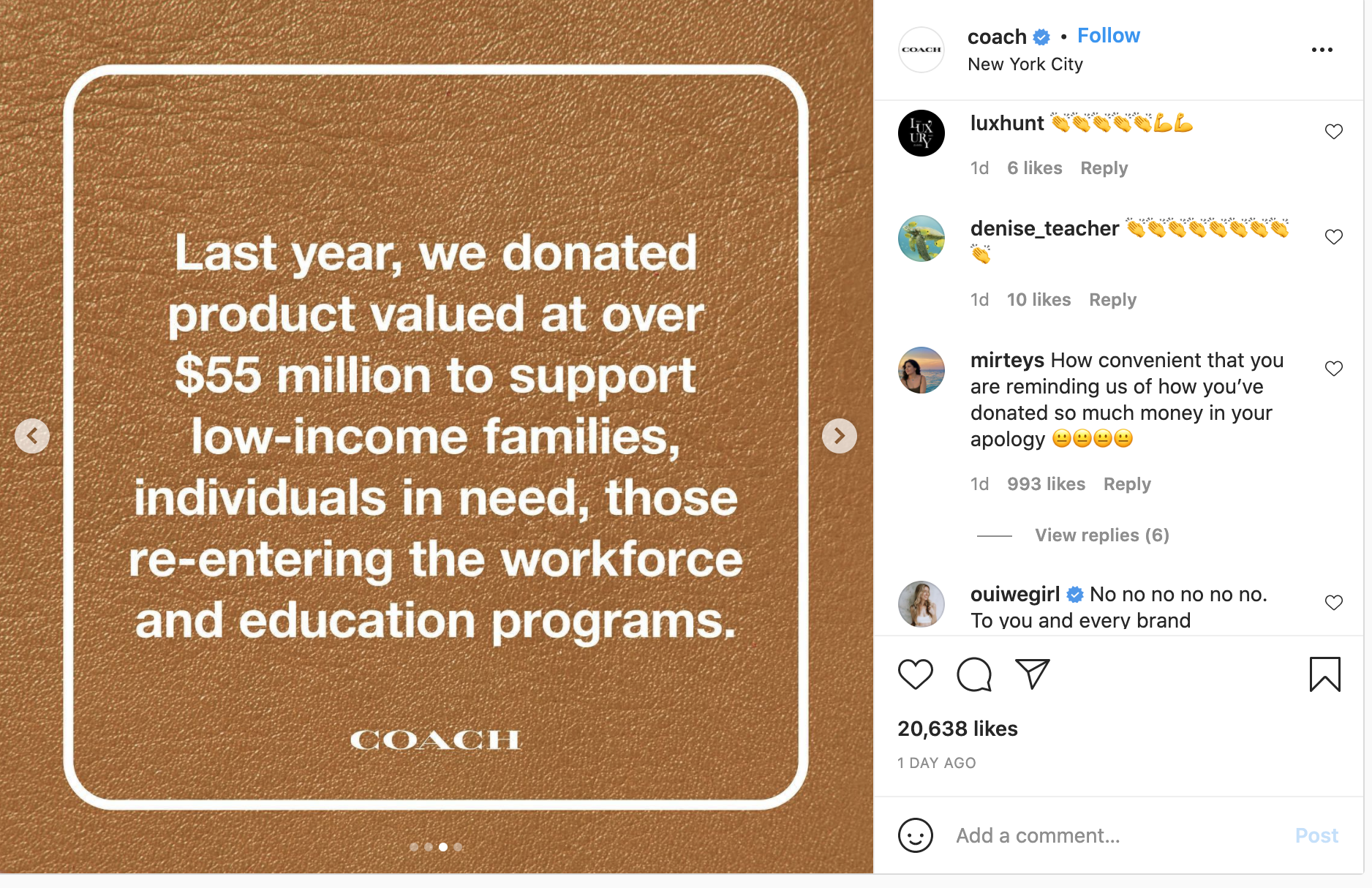 Instagram / @coach The company reiterated its commitment to "destroying in-store returns of damaged goods" and other "unsalable goods" (again, TBD what that entails) before reminding us that it's also "donated product valued at over $55 million to support low-income families, individuals in need."
The TikTok, its galvanizing energy, and Coach's response are all momentum forward for something ostensibly good. We've seen time and time again how weaponizing social media to speak up and to organize around social causes can be effective. So I give a lot of kudos to Sacks for thinking creatively about how to approach an issue she's all-too familiar with in a way that activates people online to care. Coach was pressured to respond and minimally corrected its contradictory practices because of all the bad publicity surrounding them.
But, as Sacks mentioned, companies in the hot seat of social media backlash respond strategically. It's hard to trust that these changes will...sustain.
"What Coach will do is lay low for a bit," Sacks said. "And then continue as if nothing has happened. It's because of the severity of people's reactions, and people wanting to hold them accountable, that they were forced to issue a statement on one aspect of their policy."
(As much as Coach is taking the heat for this, Sacks wants to remind us that many, many big fashion brands have similarly controversial policies for their outstanding inventories. You can scroll through her @thetrashwalker TikTok account for a myriad other examples of companies throwing out huge quantities of their products as waste.)
Social media can be a subversive tool for campaigning for social causes — but it's only a starting point.
"It can't just be social media; it has to be social media paired with emails and calling," Sacks advised. "Politicians don't log comments and shares. It might catch their attention, but they don't log it the way they log the number of calls and emails. Maybe that will change for politicians, but you need to do both."
Sacks is right; social media "activism" is a tenuous way to engage because it's debatable how active it really can be. It's great for putting pressure on big brands when they care most about their image, but right now it starts and stops there. It's exciting to me to imagine lawmakers one day being able to quantify social media engagement the way they do logging petitions, calls, and emails. For now, social media is a springboard and a call-to-action for more traditional models of advocacy. When you watch a TikTok or scroll through an educational Instagram slideshow and are compelled to act, it's as important to then follow through.
And, I'd add, TikTok itself can help with pushing these videos to the top of people's FYP, instead of, well, perhaps conspiracy videos. I reached out to TikTok about this idea.
Sacks is going to continue posting TikToks as she works with local coalitions in NYC like Save Our Compost and Donate Don't Dump. They won't all be hits, but she said she's definitely felt reinvigorated by how successful her last TikTok was. She also hopes people who work for these fashion companies can use social media to be more transparent about what's going on internally.
"One day it could be powerful to see more people who work for these corporations sharing behind-the-scenes of what's required to do their jobs," she said. "People message me footage, it's powerful to see, but it's also very risky."
I don't think I need to reiterate to subscribers of this newsletter how both empowering and precarious social media is for sounding an alarm on a company that projects an image or standard it can't live up to.
When that alarm is ringing, I hope we're paying attention.
Until next time, Tanya Want more? Here are other stories we were following this week. The Messy Truth About Teen Girls and Instagram. Jessica Grose at the New York Times asks herself, and researchers on the subject, "How do we know for sure that social media is worse for teen girls than traditional media was for previous generations?"
Couch Guy and the nightmare of going viral. Rebecca Jennings at Vox breaks down how a moment between a young couple that was shared online truly became a nightmarish paradigm. P.S. If you like this newsletter, help keep our reporting free for all. Support BuzzFeed News by becoming a member here. (Monthly memberships are available worldwide.) 📝 This letter was edited and brought to you by Tanya Chen, Stephanie McNeal, and BuzzFeed News. You can always reach us here. BuzzFeed, Inc. |


