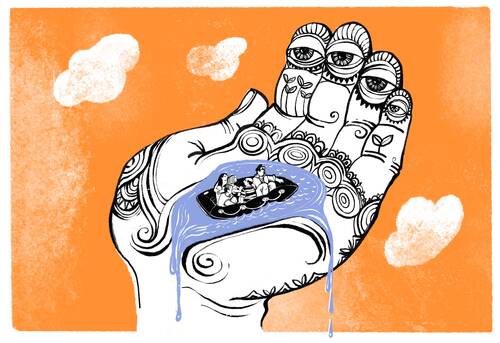
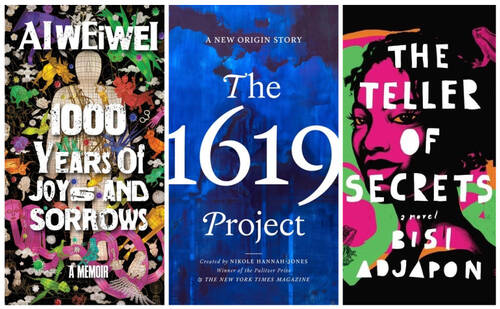
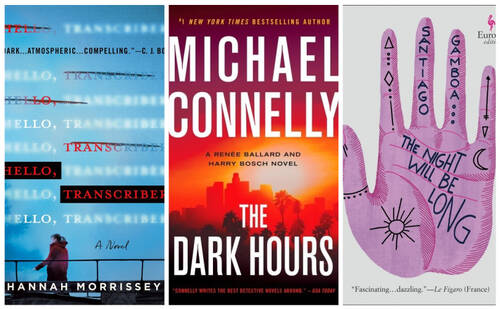
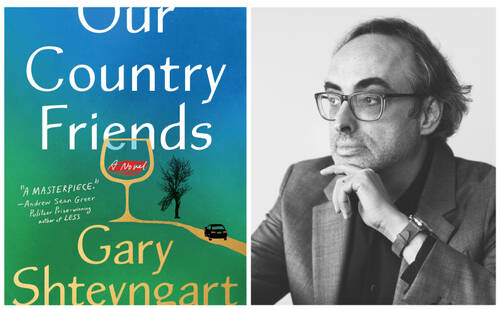
 This week, the U.S. Justice Department scrambled Penguin Random House's plans to acquire Simon & Schuster. | Not so fast, penguin. A year ago, Penguin Random House, the largest publisher in the United States, announced plans to buy Simon & Schuster from ViacomCBS for about $2 billion. The deal would have reduced the so-called Big Five publishers to the Really Big One & the Three Others. At the time, there were objections (like mine), but even among avid readers, publishers remain surprisingly invisible. No one ever asks a bookstore clerk, "Where are your Scribner titles?" (No offense, Scribner.) For most of us, imprints are not like favorite sneaker designers or auto manufacturers, which means the financial machinations of publishing companies can feel irrelevant. On Tuesday, the Justice Department declared that those machinations are not irrelevant: It filed suit to stop PRH from buying S&S (news). Attorney General Merrick Garland announced, "If the world's largest book publisher is permitted to acquire one of its biggest rivals, it will have unprecedented control over this important industry. American authors and consumers will pay the price of this anticompetitive merger." When the deal was first announced, my concern stemmed from how the merger might affect what people read, but the government's complaint focuses on how it might affect what authors earn. Because PRH and S&S compete for talent, their merger could create a monopsony — a single large buyer — resulting in lower payments to writers. PRH executives insist that the company's various divisions and imprints are encouraged to bid against each other for manuscripts, despite the added cost. And they promise that a merger with S&S wouldn't change that arrangement. But the government claims the company's promise to continue competing with itself "defies economic sense, can be evaded or violated without detection, and is unenforceable." In a joint statement, the two publishing houses characterized their imperiled merger as "a pro-consumer, pro-author, and pro-book seller transaction, which will allow increased investment." As much as I respect these good people, I don't believe that's entirely true. It cannot be a good thing for one corporation to exercise such unrivaled control over America's literary culture. And PRH's claim that even after swallowing S&S it would still be contending with "a range of mid-size and smaller publishers all capable of competing for future titles from established and emerging authors" feels disingenuous. A brief statement from Mary Rasenberger, CEO of the Authors Guild, hints at the real issue — and it's a doozy. She said the government's opposition to the merger "raises the bigger question that goes beyond traditional publishers to the consolidation of distribution channels and Amazon's monopsony of book retail. We look forward to working with the Biden Administration on antitrust reform that gets to the root of the problems in the industry, whereas the proposed merger was just a symptom." What's she talking about? With the Kindle, Amazon dominates the e-book market; with Audible, it dominates the audiobook market (story). What's more, Amazon is responsible for about half of all new book sales. If the Justice Department takes on this behemoth, the fight with Penguin Random House will seem quaint by comparison. But if it doesn't, the government is just fiddling around the edges of the problem with publishing. (Amazon founder Jeff Bezos owns The Washington Post.) 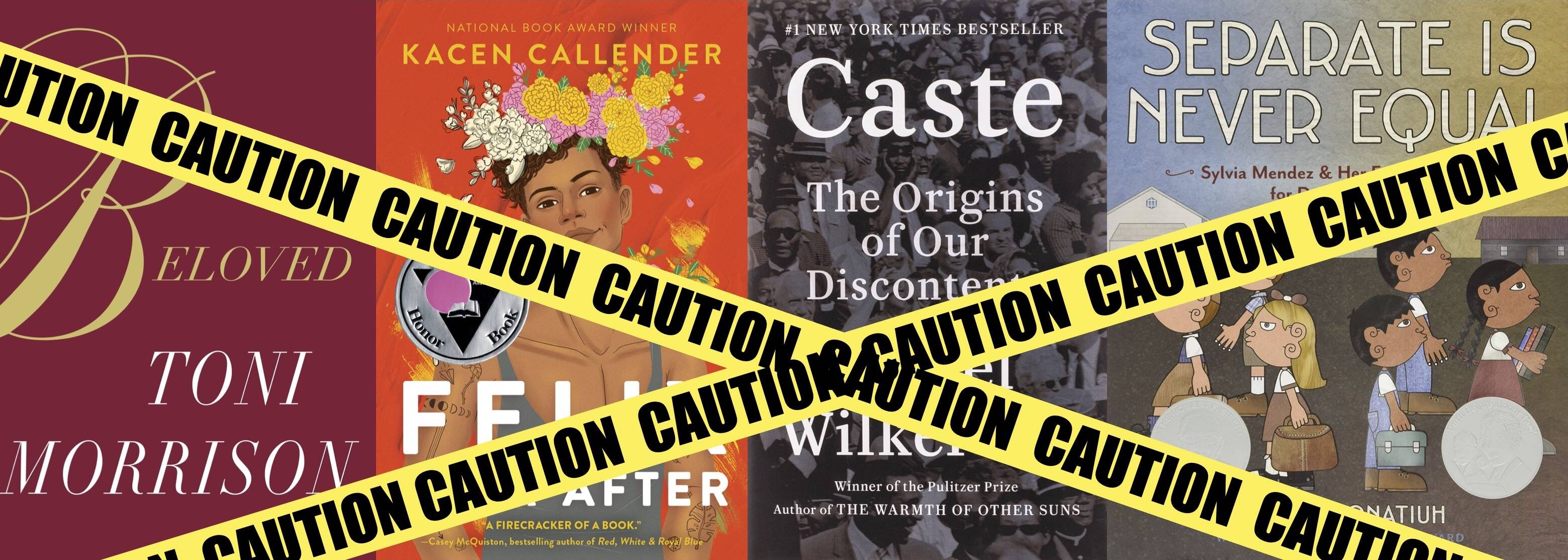 GOP politicians have discovered that flaming parental panic about school books can bring out the votes. (Vintage; Balzer + Bray; Random House; Harry N. Abrams) | A year of manufactured hysteria over critical race theory paid off for the GOP this week. Republican Glenn Youngkin was elected governor of Virginia on Tuesday (analysis). Throughout the campaign Youngkin promised to ban critical race theory in schools, even though critical race theory is not taught in Virginia schools. It's as if Youngkin won by pledging to serve only gluten-free apples in the cafeteria. Most importantly, Youngkin perfected the tricky Beloved Maneuver. Weeks before the election, he produced an ad featuring a White woman who was horrified to discover that her son, a high school senior, had been assigned a book full "of the most explicit material you can imagine." Unmentioned in the ad is the fact that she's talking about Toni Morrison's "Beloved," the greatest novel ever written about American slavery (story). Such homeopathic racism — diluting all mention of Blackness so that just trace elements of the root anxiety remain — will continue to help Republicans win elections and bleach reading lists in history and English classes. The reduction of a classic like "Beloved" to its dirty parts continues a long calumnious tradition of linking people of color with "objectionable" sexuality. Last week, Texas State Rep. Matt Krause (R-Fort Worth) sent the Texas Education Agency a list of more than 800 titles about minorities, sexuality, civil rights and sexual health. This list — a voluminous fever dream from a man dismayed that anyone might question the supremacy of straight White men — includes Ta-Nehisi Coates's memoir, "Between the World and Me"; Kacen Callender's YA novel about a transgender teen, "Felix Ever After"; Isabel Wilkerson's history "Caste"; David Levithan's YA novel "Two Boys Kissing"; and Duncan Tonatiuh's children's book "Separate Is Never Equal: Sylvia Mendez and Her Family's Fight for Desegregation." Krause demanded to know how many copies of each book the schools hold and how much money they spent on them. And in a breathtaking expression of his fragility, he told the districts to "identify any other books" that contain content that "might make students feel discomfort, guilt, anguish, or any other form of psychological distress because of their race or sex." (Try to imagine a great book that doesn't do that. . . .) On Monday, Gov. Greg Abbott turned up the heat and sent a letter to the Texas Association of School Boards claiming that parents are "rightfully angry" about books in public school libraries that contain "clearly pornographic images and substance that have no place in the Texas public education system." Unfortunately, when it comes to books, politicians' attention is like mold: Once it gets a foothold, it's very destructive and almost impossible to get rid of. People who care about literature need to be ready when the torch-bearing villagers arrive to cleanse the school library with the white fire of their righteousness.  Illustration by Lily Lambie-Kiernan for The Washington Post | If you've ever felt stumped when standing in a bookstore amid 80,000 titles, you know what psychologist Barry Schwartz famously called "the paradox of choice." Of course, a vibrant newspaper book section can provide reliable recommendations (hint, hint). And this week, Book World posted its annual holiday gift guide (something for everyone). But there are times when you crave more specific advice. The nonprofit journal n+1 has just launched Bookmatch. It's a cerebral/quirky book recommendation algorithm — like, say, if your librarian were Dr. Who. In exchange for a donation of any size, n+1 presents a web questionnaire to determine your literary tastes. I was expecting something along the lines of "Thrillers or Romance?" But instead, the quiz consists of more than two dozen multiple-choice questions such as this: The longed-for compliment you've never received is - You're a riddle, wrapped in a mystery, inside an enigma
- You're a world-historical genius
- I love you, alive girl
- Nice stems
As I worked my way through the questions, I sometimes had to stop and look up words. (Remind me again — what's "ekphrasis"?) At the end, Bookmatch instantly produces a list of 10 recommended titles drawn from a database of about 150. My list included one I'd already read (Philip Roth's "Goodbye, Columbus"), a couple I know (Iris Murdoch's "The Bell" and Leonard Marcus's "Margaret Wise Brown"), and several that intrigue me (Lauren Berlant's "Cruel Optimism," Emmanuel Iduma's "A Stranger's Pose" and Elisa Shua Dusapin's "Winter in Sokcho"). For large donations ($250 and up), n+1 will even send you one or more of your recommended books. Sometimes, all it takes to jolt you from a reading slump is being asked, "Which 20th-century spatial phenomenon are you?" (Take the Bookmatch quiz). 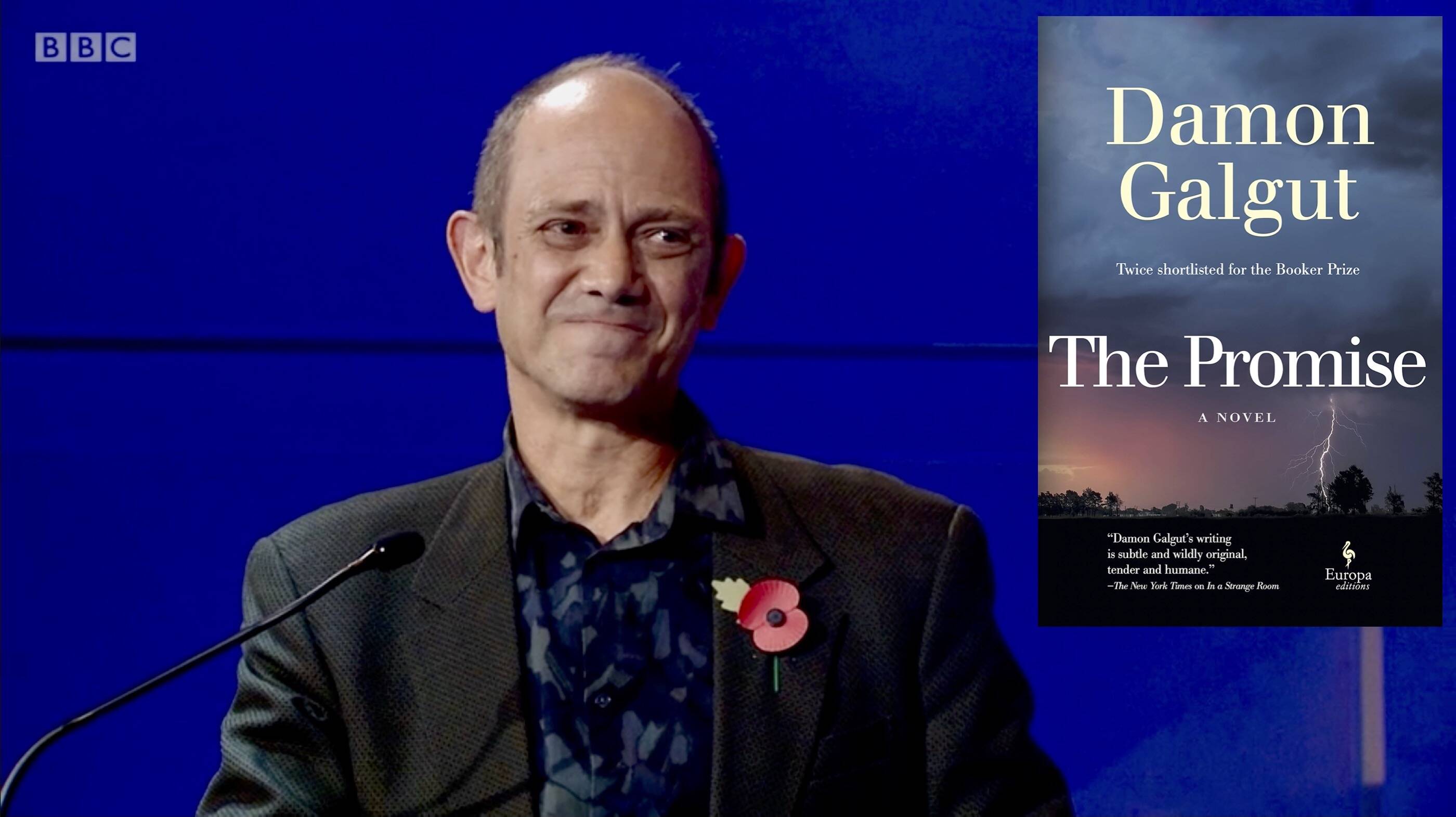 Damon Galgut wins the Booker Prize in London on Nov. 3, 2021 (BBC screenshot); Europa Editions | As the oddsmakers predicted, Damon Galgut's "The Promise" won the Booker Prize in London on Wednesday. The South African writer had been shortlisted twice before for the U.K.'s most prestigious literary prize — in 2003 for "The Good Doctor" and in 2010 for "In a Strange Room," which I found intolerably dreary (review). Now, of course, I feel like a fool for missing what sounds like a new masterpiece. "The Promise" is about the members of a White family and the Black maid whom they betray during South Africa's transition from apartheid. Maya Jasanoff, chair of the 2021 judges, said, "Galgut's searching examination of family, place and the dysfunctions that connect them reminded us of William Faulkner. His deft inhabiting of different characters' consciousnesses evokes Virginia Woolf. All this he does with a sensibility, artistry, and scope that are entirely his own." At Wednesday's ceremony, which was sharply curtailed by the covid pandemic, Galgut said, "This has been a great year for African writing, and I would like to accept this on behalf of all the stories told and untold, the writers heard and unheard from the remarkable continent that I'm part of. Please keep listening to us. There's a lot more to come." The Booker Prize is worth about $68,000 and typically drives a dramatic boost in sales. Despite rave reviews, "The Promise" had sold fewer than 9,000 copies in England before the Booker news; now it's No. 9 in literary fiction on Amazon. In the United States, Galgut is published by the independent publisher Europa Editions, which offers a hardback edition of "The Promise" and is planning a paperback edition for March. Other literary awards and honors this week: - The School District of Philadelphia is the inaugural winner of the Robinson Literacy Champion Award from Scholastic and the Council of the Great City Schools. The award, named after the late Scholastic chairman Richard Robinson, honors a school district for advancing reading. The library of Philly's General George G. Meade School (K-8th grade) will receive more than 6,000 books and other instructional resources from Scholastic.
- Nobel laureate Kazuo Ishiguro will receive a lifetime achievement award from the Center for Fiction in New York. Ishiguro's most recent book is the best-selling novel "Klara and the Sun" (review). The lifetime achievement honor — along with several other prizes — will be presented at a ceremony on Dec. 7 to celebrate the 200th anniversary of the Center for Fiction (ticket information).
- The National Book Critics Circle is launching a new award for the year's best book in translation. The prize is named in honor of Gregg Barrios, a Latino writer and longtime NBCC board member who died earlier this year at 80. I knew him when I served on the board. In addition to being an insightful critic, he was a gentle, insistent advocate for greater inclusiveness and diversity. The inaugural Gregg Barrios Book in Translation Prize will be conferred in March 2022.
- Correction: Last week, in an item about the Kirkus Prizes, I wrote that this year's judges were Rumaan Alam, Elsbeth Lindner, Ikwo Ntekim and Laurie Muchnick. In fact, they were the judges only for the Fiction Prize. The Nonfiction Prize and the Young Readers' Literature Prize each had different juries (details). Remarkably, this is my first mistake.
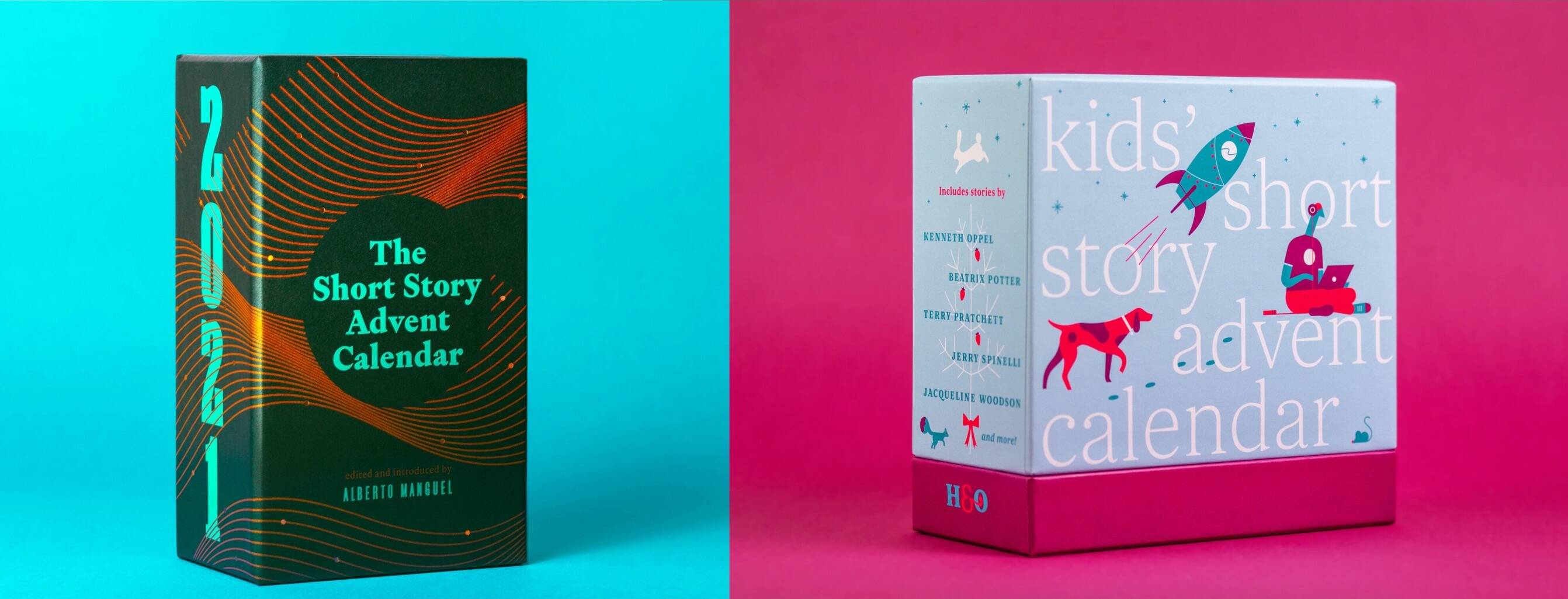 Hingston & Olsen | The classiest literary gift for the holidays may be the Short Story Advent Calendar. It's an elegant box of 25 individually sealed stories from the boutique Canadian publisher Hingston & Olsen. This year's collection — one story to open and surprise you each day — is curated by Alberto Manguel, whom both Michael Dirda and Jonathan Yardley have praised in our pages. Manguel has chosen classic and contemporary authors from 25 countries, such as Aleksandar Hemon (Bosnia), José Saramago (Portugal), Muriel Spark (Scotland) and Leo Tolstoy (Russia). Note: Despite the "advent" framing device, these are non-religious works of literary fiction, so come all ye faithless, too. And this year for the first time, Hingston & Olsen is offering a Short Story Advent Calendar for Kids (ages 9 and up). The collection includes 25 stories by such writers as Beatrix Potter, Terry Pratchett, Kenneth Oppel, Jerry Spinelli and Jacqueline Woodson. If your New Year's resolution is to read more good fiction, this could be a great head start (more information). 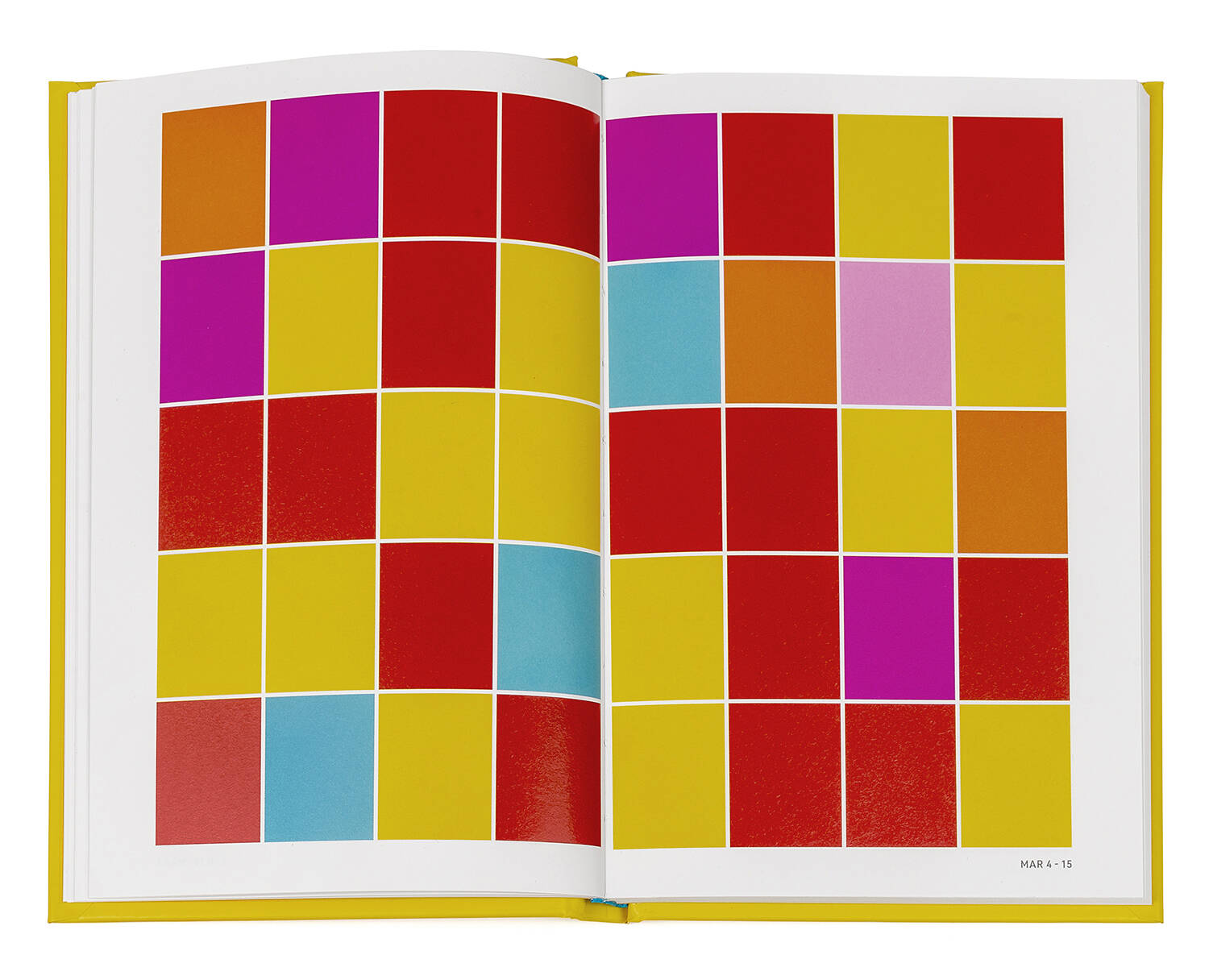 Excerpt from "'It Is What It Is': All the Cards Issued to Donald Trump, January 2017-January 2021," by Richard Kraft (Siglio, 2021) | How will you observe Guy Fawkes Night? On this day in 1605, barrels of gunpowder were discovered beneath the House of Lords. Conspirators — Guy Fawkes among them — were caught plotting to blow up Parliament and kill King James I. This is our first Guy Fawkes Day since Jan. 6 when Donald Trump plotted to overturn the presidential election and incited a mob to storm the Capitol chanting, "Hang Mike Pence." Americans might take a moment to consider the way history is written and heroism and villainy are assigned. Four hundred years from now, how will Trump's efforts to blow up our democracy be remembered? The Post recently published a massive study of what happened before, during and after that deadly attack (start here). But Trump and his allies have spent the last year working equally hard to distort, minimize and erase the historical record. Trump is suing the National Archives to keep Congress from investigating his actions. Rep. Andrew Clyde (R-Ga.) said TV footage of the rioters looked like "a normal tourist visit" (gobsmacking). And these concerted acts of revisionism are paying off: At least seven Jan. 6 "tourists" won elections on Tuesday (yes, for real). One of the strangest efforts to document Trump's reign comes from a British born artist named Richard Kraft, who received a Guggenheim fellowship earlier this year. The day Trump was inaugurated, Kraft started pretending he was the referee of a political soccer match: Every time Trump committed a foul, Kraft issued him a colored penalty card and wrote a brief description. Now Kraft has published those penalty cards — some 10,000 of them — in five volumes called "It Is What It Is," released in a boxed set by Siglio Press (details). An appendix in each volume briefly describes the day's actions or merely quotes what Trump said. All of this is already well-documented by multiple journalists, of course, but there's something weirdly haunting about Kraft's record with its manic determination and regularity. Flipping through these thousands of colored cards, like an elemental cartoon, is both baffling and horrific. "From about any vantage point, this piece is an exercise in futility," Kraft said about his project, "and that futility made the effort all the more worthwhile. . . . Whenever I wanted a day of respite, I fortified my resolve not to succumb, not to allow the unabating pace of Trump's lies, attacks, ineptitudes, errors of judgement, craven self-dealing — in short, the grotesque nature of his presidency — to wear me down. My belief in the transformative, alchemical power of art served as a survival mechanism." Happy Guy Fawkes Day. 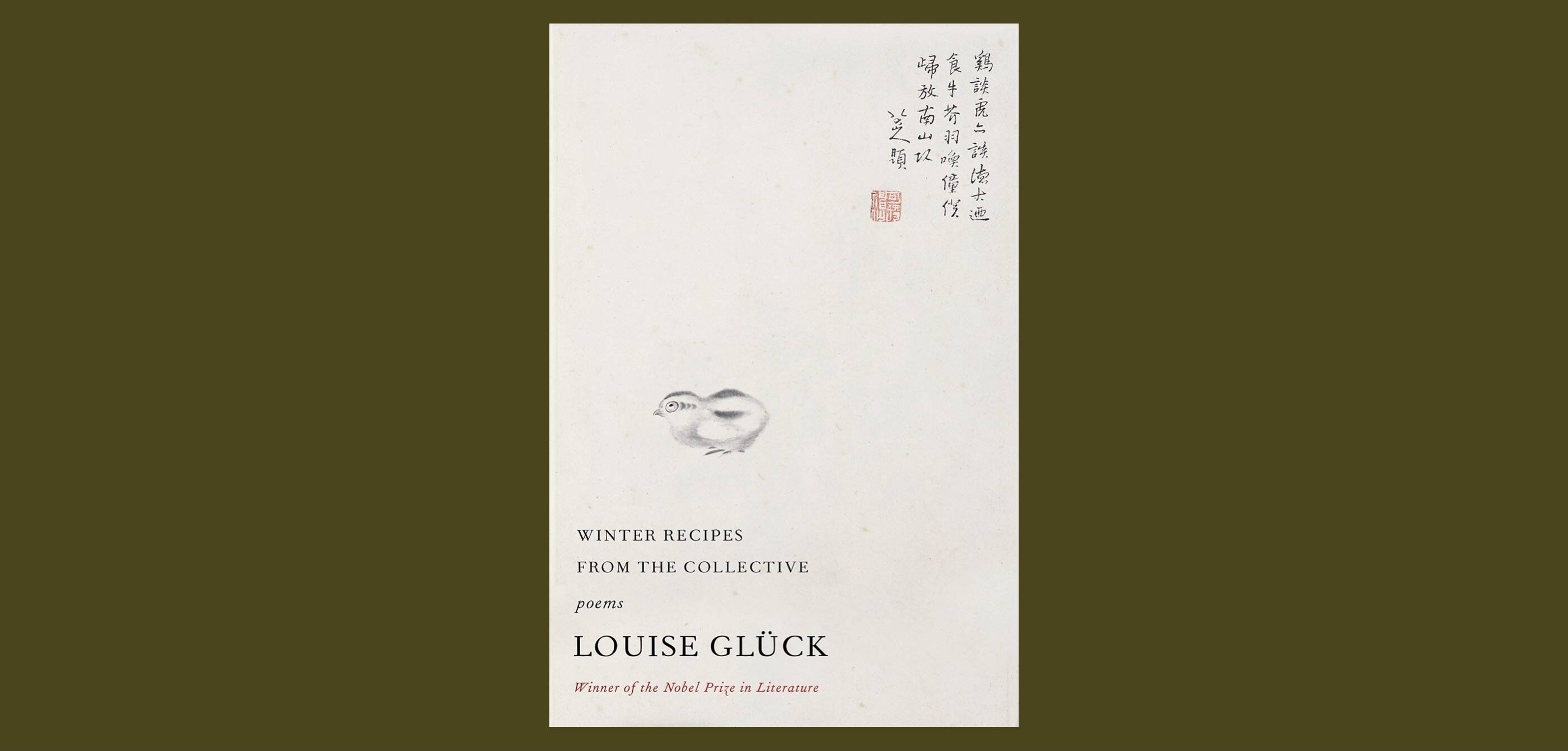 Farrar Straus Giroux | Louise Glück has just published "Winter Recipes from the Collective," her first book since winning the Nobel Prize in Literature last year (story). Our reviewer, Troy Jollimore, calls Glück's latest collection "elegiac, brooding and death-obsessed, haunted by intimations of mortality, by ghosts facing backward with regret and forward with trepidation" (review). It's a small book, sparsely designed and almost proudly concise — no need to unscrew the doors themselves from their jambs. "How heavy my mind is," Glück writes, "filled with the past." But every one of these wise, reflective poems defies resignation. She reassures us, "The fire is still alive." Presidents' Day Lots of good-natured sunshine everywhere
making the snow glitter—quite
lifelike, I thought, nice
to see that again; my hands
were almost warm. Some
principle is at work, I thought:
commendable, taking an interest
in human life, but to be safe
I threw some snow over my shoulder,
since I had no salt. And sure enough
the clouds came back, and sure enough
the sky grew dark and menacing,
all as before, except
the losses were piling up—
And yet, moments ago
the sun was shining. How joyful my head was,
basking in it, getting to feel it first
while the limbs waited. Like a deserted hive.
Joyful—now there's a word
we haven't used in a while. "Presidents' Day" was originally published in the Oct. 14, 2019, issue of the New Yorker. Excerpted from "Winter Recipes from the Collective," by Louise Glück. Published by Farrar, Straus and Giroux. Copyright © 2021 by Louise Glück. All rights reserved. 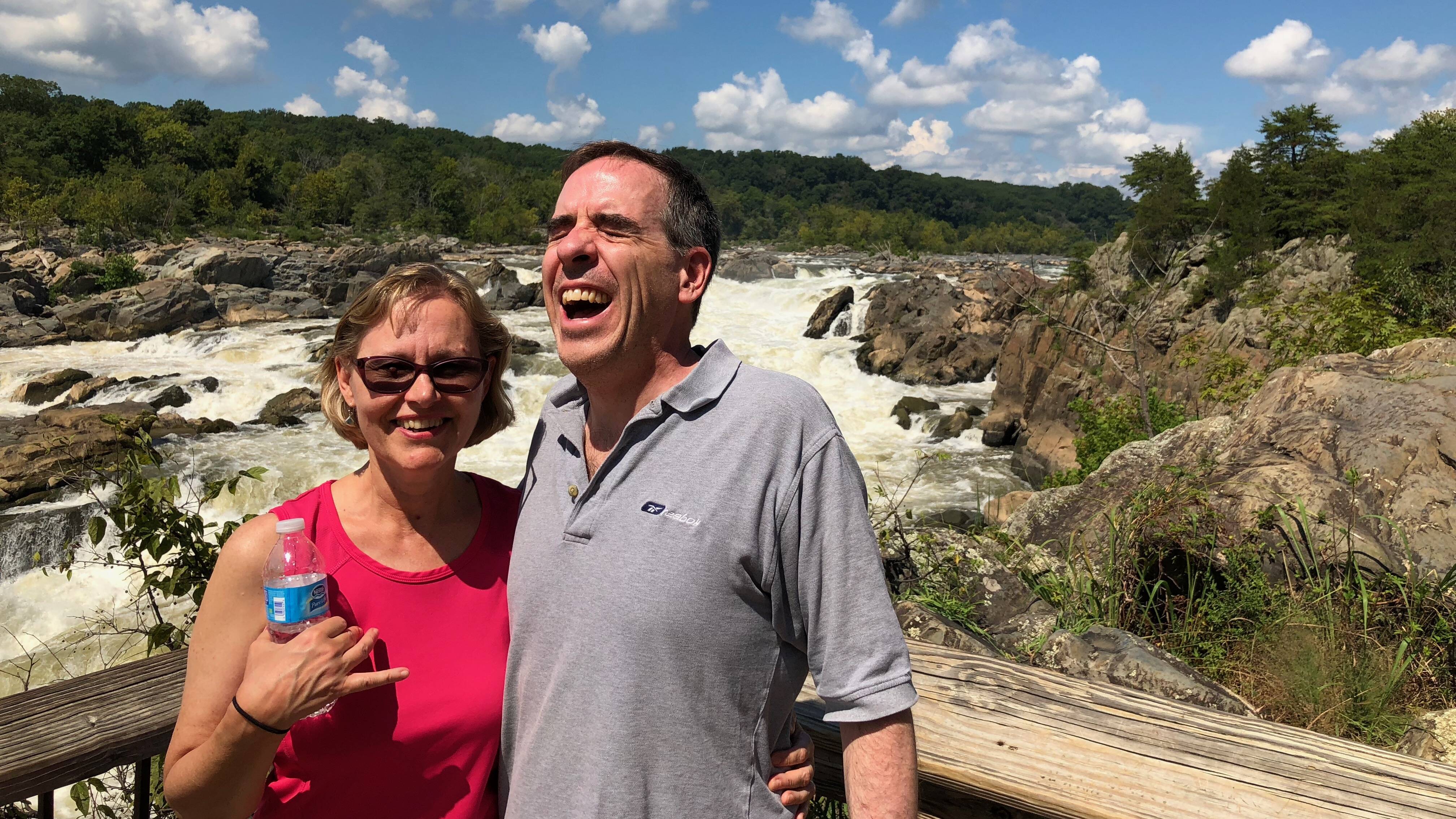 Dawn and Ron Charles at the Great Falls of the Potomac on Sept. 3, 2018. The sun was so bright we couldn't see what was coming. (Ron Charles/The Washington Post) | Grades are due this morning at school, so I haven't seen Ms. Charles for eight days. I have, however, received a stern warning that there will be no work permitted tomorrow — no writing, no reading, not even email. I can feel the pressure building already to plan something sufficient unto the day. I was thinking maybe a little hike to see the Great Falls of the Potomac, or, if it's not too cold, we might drive out of the city to pick apples. (Hey, kids — they've got broccoli, too!) When we were first married and living in Southern Illinois, my wife and I went to a farm on the Mississippi River and picked so many Jonathans and Honeycrisps that afterwards we bought a Foley food mill and cooked up gallons of pink apple sauce. Back in those days, somehow it seemed easier not to work all the time. Meanwhile, send any questions or comments about our book coverage to ron.charles@washpost.com. You can read last week's issue here. And if you know friends who might enjoy this newsletter, please forward it to them and remind them it's free! To subscribe, click here.
Interested in advertising in our bookish newsletter? Contact Michael King at michael.king@washpost.com. |





 Email
Email