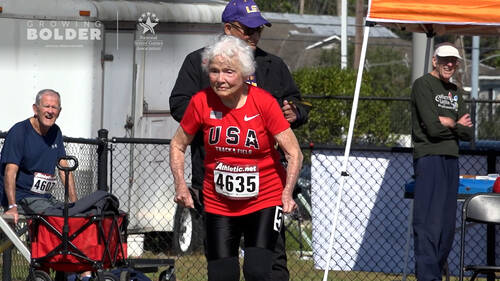
| My favorite story of the past week was about Julia Hawkins, the oldest woman to run the 100 meters in a competition. She is 105. For those who don't remember how long 100 meters is, it's about 1 and 1/10th football fields. Ms. Hawkins completed it in 1 minute 3 seconds. It was a record because she was the only runner. Her closest competitor in age is a 103-year-old. Freelance writer Matt Fuchs wrote an inspiring story about Ms. Hawkins full of details both practical (she runs inside ever since she tripped over a magnolia cone) and delightful (some of the former students who came to watch her race were in their 90s). In interviewing Ms. Hawkins about how she stays mentally and physically fit, Matt learned that she exercises and eats well (the only vices she could think of were iced coffee and hot tea, both of which are fine in moderation); had a long, loving marriage; and lunched with friends until the pandemic. She didn't watch television but read books instead, and she keeps her mind sharp by listening to them now that she can't see well enough to read. She gardens, which exposes her to sunlight and greenery and keeps her moving. (Many of these habits, by the way, reflect the advice in Matt's earlier article, "Want to add healthy years to your life? Here's what new longevity research says.") Ms. Hawkins is facing the inevitable with equanimity ("The last great wonder of life is what happens afterwards, and I'm anxious to find out.") but is content to hang around for a while ("I'm staying alive to be an inspiration for a few people."). It was the kind of story that makes me feel so good reading it that I didn't want the feeling to end, so I looked at the comments, too. Many readers wrote in appreciation of Ms. Hawkins, while others gave their own thoughts about ways to live to a healthy old age, suggested that good genes likely play a role in longevity, offered philosophical thoughts about death or pointed out that extreme old age is not always kind to people. As one reader said, in part, "Each of us is an experiment of one." This quote stood out because it struck me as such a good way to think not just about longevity, but about wellness in general: We are all unique; there can be no universal practice or advice, and certainly there are no guarantees. It seems like a good line to paste to one's mirror and be reminded of every day. I searched online to learn where this bit of wisdom came from and learned about the late George Sheehan, a cardiologist, marathoner and author of books about running and life lessons who was known as "Mark Twain in sneakers." The quote comes from an essay (and I think appeared in his book "Personal Best"; here is an excerpt that includes it: We do share a host of attributes with others: drives and desires, instincts and longings. Under precisely controlled conditions our overall responses to certain stimuli can be statistically predicted. But we are not statistics. Under precisely controlled conditions, we will, individually, do as we damn please, and fortunately, that is precisely what we should do. We must have a healthy distrust and a healthy cynicism for the experts, and for authority in general. Each of us is an experiment of one. Each is an expert in the self, a witness of a personal truth, our own best authority. My advice to these advisors would be. "Do not tell me what to do, tell me what you do. Do not tell me what is good for me, tell me what is good for you. If, at the same time you reveal the you in me, if you become a mirror to my inner self, then you have made a listener and a friend. Isn't that last part beautiful? You can read more about Sheehan in this 1990 Washington Post article by Margaret Mason, and then, along with the story about Ms. Hawkins, you will have received a double dose of inspiration in a week. Take care and have a Happy Thanksgiving! | 




 Email
Email