| Democrats and Republicans are both excited about one thing Congress is working on this week: passing the rest of President Biden's social/economic agenda. Both sides feel like they can use this to their political advantage in the midterms. Here's how each side is working to message this to gain the upper hand — and some of the roadblocks they might face. Democrats: We're trying to make every aspect of your life better 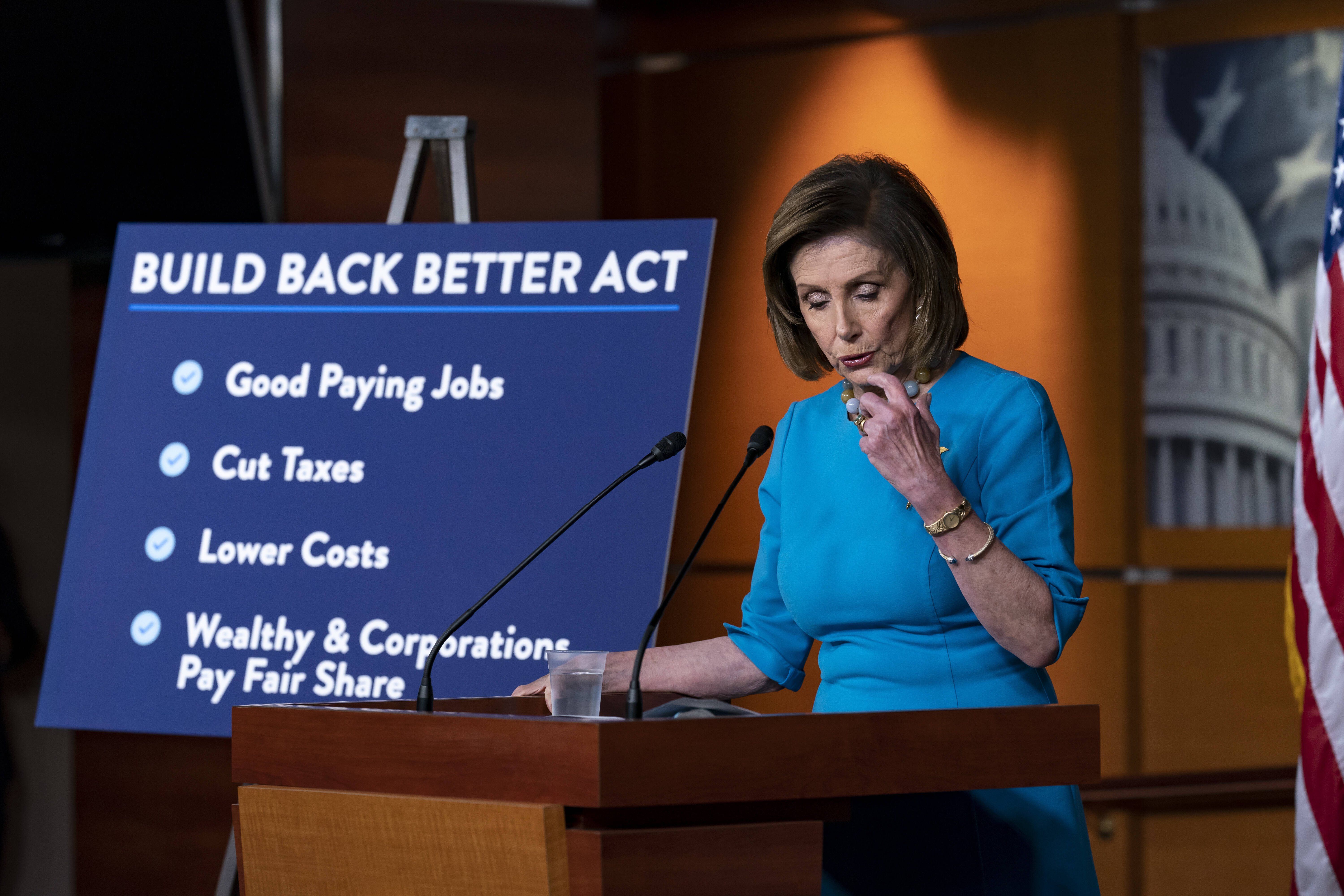 Speaker of the House Nancy Pelosi (D-Calif.) addresses reporters Thursday. (AP Photo/J. Scott Applewhite) | This is simultaneously the simplest and trickiest political message heading into the 2022 elections. It's simple because Democrats can hold up things like universal prekindergarten or money to fix the potholes in your road and they can say, "I did that." "I'm making sure New Hampshire water is safe to drink, upgrading pipes that are 100 years old and helping eliminate PFAS chemicals from the waterways," Biden said in New Hampshire on Monday. But where they run into trouble is how massive this all is. If Democrats are promising voters' lives will be transformed, then voters' lives need to improve noticeably. And that could be difficult to demonstrate, given there might not be enough infrastructure investments to go around, or prices for some Medicare prescription drugs under Democrats' plan won't go down until 2023, after the election. Even already existing policies can be hard for Democrats to talk about in a concrete way. For the past few months, most American families have received up to $300 per child in their checking account to help cover the costs of children. And yet Biden doesn't seem to be getting a ton of credit for that. Republicans: Democrats are the reason your prices are going up This messaging is much simpler and much more narrow. Republicans are tying across-the-board inflation to Democrats' plans to expand government by spending trillions over the next decade (though by paying for a good chunk of it with higher taxes on the rich and corporations). "For many of my constituents, this is a choice in some cases between putting food on the table and staying warm." Senate Minority Leader Mitch McConnell (R-Ky.) said Thursday. "This could not be a more challenging problem confronting America." The problem is, as we talked about in a previous newsletter, Democrats can try to message this right back at Republicans, pointing out that Republicans also authorized trillions of spending during the pandemic. And what if inflation slows before the midterms? Before prices started spiking for a variety of reasons, Republicans had struggled to land an attack on the Democrats' agenda. For now, Democrats are on the defensive 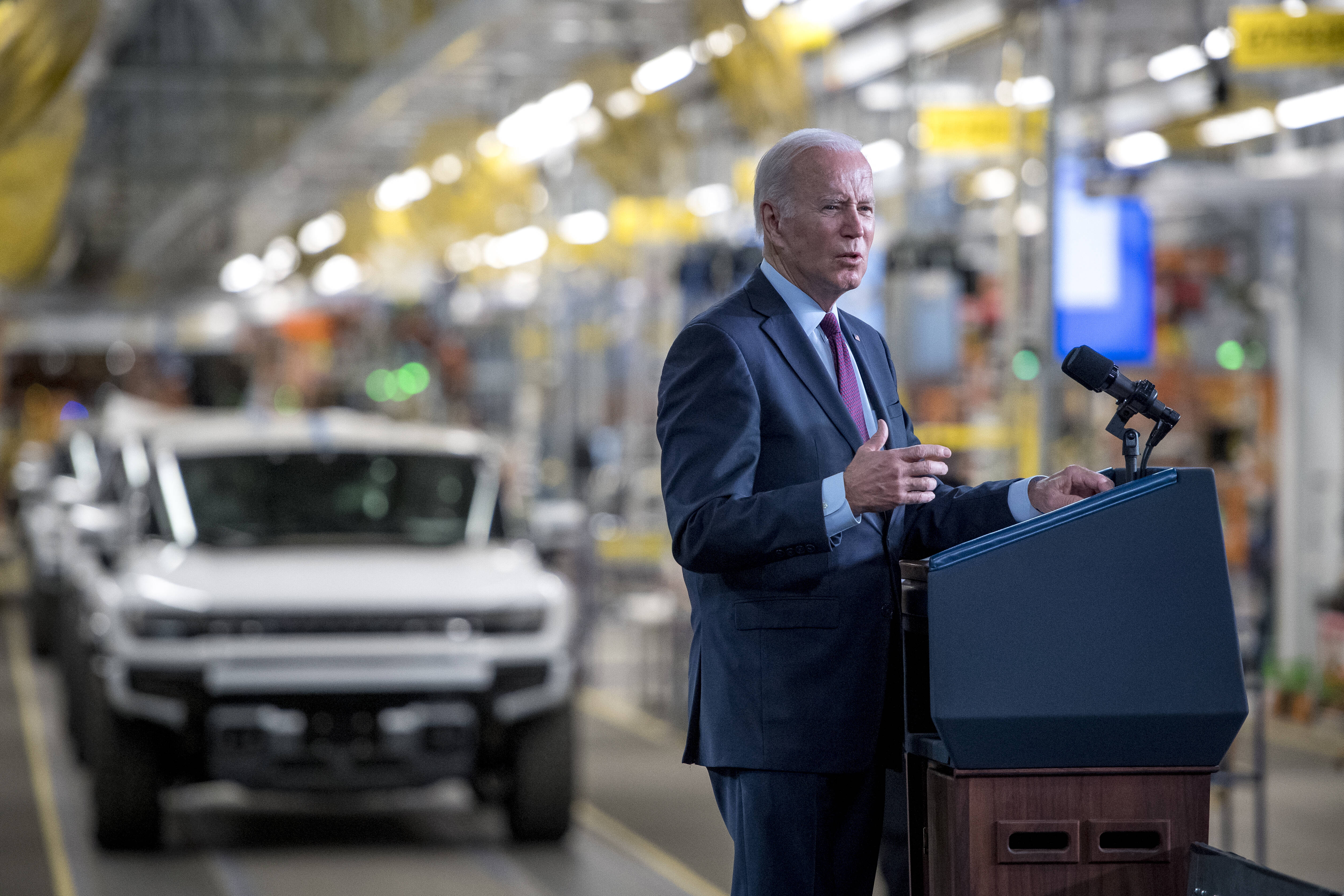 Biden stands in front of an electric Humvee at the General Motors Factory in Detroit. (Nic Antaya/Getty Images) | When Biden went to Detroit on Wednesday to tour an electric vehicle assembly plant, he didn't lead with how he is helping transform the automotive industry to be more environmentally friendly. That came later. First, he defended his policies from Republican attacks based on inflation. "Two of the leading rating agencies on Wall Street confirmed today — not a liberal think tank, two Wall Street outfits — said that the economic proposals we put forward for the nation … will not add to inflationary pressures in the economy," he said. Biden's vigorous defense is how you know that Republicans' more narrow, targeted messaging is sinking in with the broader public, perhaps more so than Democrats' broad promises. Can Trump win in 2024? This is a frequent reader question I get. The answer is: I don't know. No one does. But if he runs — and it seems like he wants to — Trump has a shot at becoming president, again, for at least a couple of reasons: - He would automatically be the GOP front-runner. If Trump gets in, almost all other Republican hopefuls — and there are a lot — probably bow out.
- Polls now say he has a shot. It's early, and hypothetical matchups can only tell us so much. But a respected poll in Iowa found that Trump would beat Biden by 11 points in a hypothetical matchup. A national poll asked who voters would elect today, and found Biden and Trump tied at 40 percent.
But: There might not be much appetite for Trump to run in the first place. A new Marquette University poll found that 71 percent of Americans said they didn't want him to run again. A Quinnipiac University poll from October found 58 percent don't want him to run. As another reader put it, rather succinctly, I think: "The pandemic economy is very unsettled right now, but are Americans really ready to usher back in the craziness of the Trump era?" We might get the chance to find out. | 




 Email
Email 


