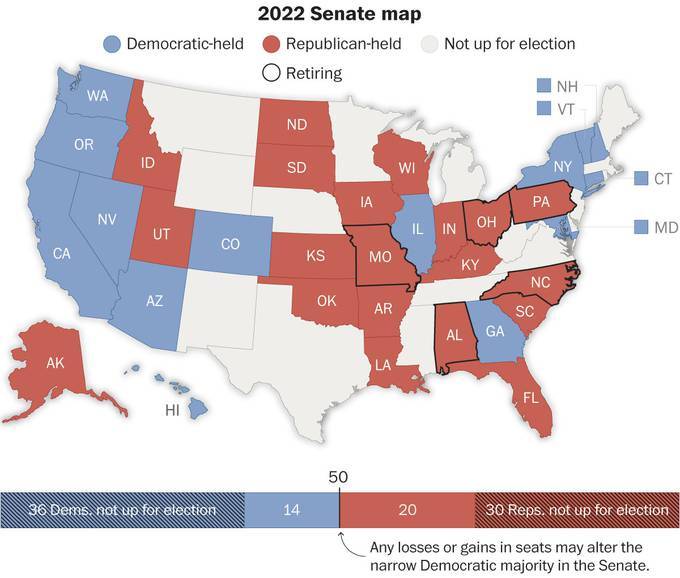
| After over-performing in Virginia and New Jersey last week (and their big win in Virginia's governor's race), Republicans are feeling pretty confident about taking back the majorities in Congress in next November's midterm elections. We can see why. A year out from the midterms, President Biden is unpopular, Americans are spooked by this strange pandemic economy, and Republicans think Democrats' legislative agenda is politically unpalatable. Here's a look at what needs to happen for Republicans to take back the Senate and the House next year. The battle for the Senate Where it stands: The chamber is split in a rare 50-50 tie between parties, but Democrats technically have the majority because Vice President Harris (D) casts the tiebreaking vote. What Republicans need for the majority: Just to net one seat. That's it. Then the Senate would stand at 51 to 49, with Republicans having a one-vote majority. Where Republicans have a chance to pick up seats: They're eyeing at least three purple states where Democrats are running for reelection: Arizona, Georgia and Nevada. The good news for Democrats is that these are states Biden won in 2020, albeit not by much. The bad news for Democrats is that Biden won Virginia by a larger margin than he did any of these states — and last week, Virginia Democrats lost all three statewide races and their state House majority. Candidates matter, too, and it's a mixed bag for Republicans. In Georgia, Trump endorsed former NFL player Herschel Walker despite allegations of domestic violence against him — one of several Republican Senate candidates with ugly pasts. The estranged wife of Pennsylvania GOP candidate Sean Parnell accused him of strangling her. (He denies this.) New Hampshire was on Republicans' priority list to knock off a Senate Democrat, but Republicans may need to reassess that after GOP Gov. Chris Sununu announced today he is not going to run against Sen. Maggie Hassan (D). Still, a year out, Republicans feel confident they can make a legitimate run at the Senate majority. It's not all bad for Senate Democrats: They have a chance to pick up seats, too, and mitigate any losses. Republicans are retiring next year in such competitive states as North Carolina and Pennsylvania. That could significantly help Democrats, since it's easier to win an open Senate seat than to kick out a sitting senator. The House of Representatives Where it stands: Republicans are even more confident about the battle for the House. Democrats have the majority in the 435-person chamber, but just by eight seats. What Republicans need to win for the majority: They need to net a total of just five seats to take back the majority. Where Republicans have a chance to pick up seats: All over the country. Republicans ecstatically pointed out after the Virginia elections that 50 House Democrats sit in seats from California to Maine that are more Republican-leaning than the state of Virginia as a whole. Plus, Republicans control the map-drawing process for congressional districts in key battleground states, including North Carolina and Georgia. So they could conceivably just draw themselves a few seats closer to the majority. It's not all bad for Democrats: They hope they can gain back some popularity by passing legislation that affect the lives of millions of Americans. They just passed a major investment in U.S. roads and bridges and broadband. And they are trying to pass an expansion of the federal safety net and regulations to lower carbon emissions to fight climate change. But will this come soon enough to make a difference in voters' lives? And can Democrats successfully message that? When is Trump going to get indicted? One of the most popular reader questions I get is about the former president's legal vulnerabilities. Let's walk through them. Donald Trump — and/or his business — is facing at least two criminal probes, one civil probe and roughly half a dozen lawsuits. The hottest one seems to be surrounding his company. In April, the Trump Organization and its longtime chief financial officer were indicted on charges related to defrauding the government in taxes. Last week, a new grand jury just convened in the case, meaning more indictments could come. There's also a criminal probe in Georgia about whether Trump improperly tried to overturn that state's 2020 election results. And he's fighting defamation lawsuits from two women who say he sexually assaulted them. Those are just the ones we know about and that I can fit in this newsletter. So, is Trump going to get indicted? That's a tougher question to answer. I called up The Washington Post's Shayna Jacobs, who is covering a head-spinning amount of probes related to Trump, and asked her that question. Here's what she said: "While readers and spectators may be frustrated at the lack of finality in these matters, it appears both criminal investigations involving Trump remain active. But it remains unclear how likely it is he would be indicted in either case." She added that many of these cases are taking a while: "There have been a number of delays that have contributed to the length of time the probes in New York has taken, including a protracted battle over whether investigators would obtain Trump's personal and business tax returns and related records from his accounting firm." (Prosecutors in Manhattan got those earlier this year.) And then there's the Jan. 6 committee investigation Which is really ramping up. This week alone, the special, bipartisan committee in Congress subpoenaed 16 people to better understand what Trump was doing the day of the insurrection at the U.S. Capitol. Some of these people are aides you've probably never heard of. Others are big names, including former press secretary Kayleigh McEnany and adviser Stephen Miller. Many of them were by his side on Jan. 6 as he watched the Capitol being attacked on TV. It's possible — although maybe not probable — that Trump himself gets subpoenaed. | 




 Email
Email