| Let's start today with a tweet. It's the White House press secretary, Jen Psaki, writing on Sunday that Vice President Harris (@VP) is a valued partner to President Biden (@POTUS). Why would she need to assert that? Because the political world is starting to question where Harris is. When Biden picked her as his running mate, Harris was big news. A year in, the first female vice president is not nearly as front and center. CNN reported that some in Harris's orbit feel as though Biden is not using her to her full potential. The Post's Cleve R. Wootson Jr. and Sean Sullivan reported that Harris supporters are frustrated that Biden has handed her some big, intractable problems, such as addressing the root causes of illegal immigration. 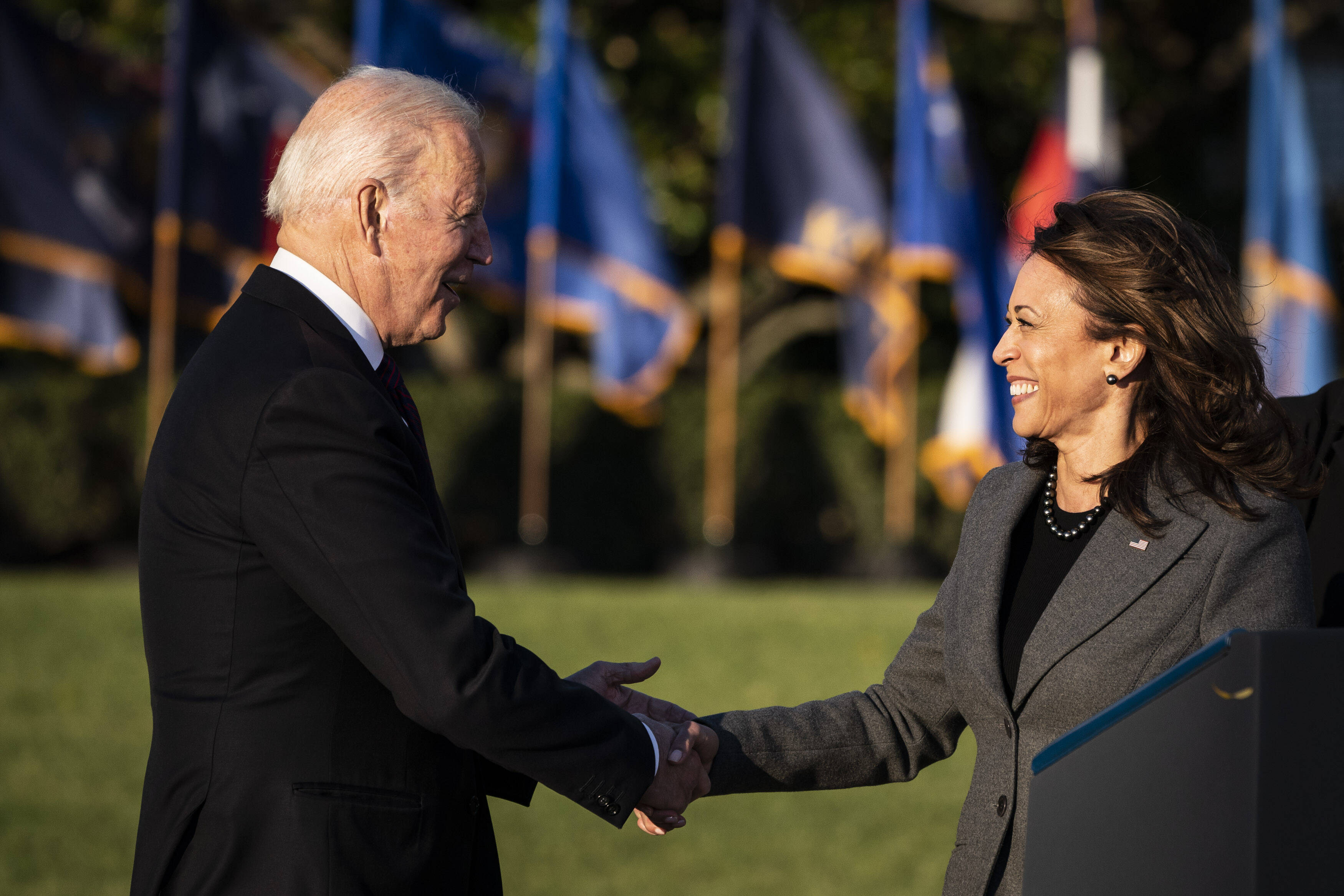 President Biden greets Vice President Harris on Monday before celebrating the signing of the infrastructure package. | Harris traveled to Guatemala and Mexico and the U.S. border to try to stem the tide of migration (the issue is still dogging the administration). She has taken on lobbying Democrats in Congress to protect voting rights (they have been unable to pass anything). She is the administration's point person on abortion rights. And she recently just got back from Paris, where the French were still fuming over a U.S. submarine deal. Regardless of how Harris is doing, she plays one absolutely critical role for Democrats: She's their tiebreaker in the Senate on legislation. How she establishes herself – and how she's perceived – is especially pertinent if Biden doesn't run for a second term. He says he will, but he's also 78, the oldest person to serve as U.S. president. One fair question to ask in all this: How much scrutiny of Harris comes from any lackluster performance so far, and how much of it comes from the expectation that she would be a big star because of the barriers she broke when she became vice president? Why even some Republicans are frustrated with backlash to the infrastructure bill As far as legislation goes, this infrastructure bill that Biden signed into law yesterday is pretty standard stuff: It sends money home to lawmakers' districts to improve their constituents' lives in tangible ways. (Fix their roads, bridges, pipes, broadband). "It's a godsend for Kentucky," Senate Minority Leader Mitch McConnell (R-Ky.) said. So why did so many Republicans vote against it — and why are the 13 in the House who voted for it taking so much heat? One Republican who voted "yes" said he has received death threats. There are many reasons not to vote for a bill, but the backlash in the Republican Party for supporting infrastructure seems directly tied to tribalism: Former president Donald Trump has framed supporting this legislation as a loss for Republicans precisely because it's a political win for Biden. One Republican from Alabama even praised the bill for building a highway in Birmingham — and then voted against it. This approach to legislating has rubbed some moderate Republicans the wrong way. Rep. Don Bacon (R-Neb.) told NBC News: "To say that a bill is right for your district … and something that you helped write, but then you've got to vote against it because you don't want to give the other side a victory? That is a sign of what's broken." Rep. Fred Upton (R-Mich.), the lawmaker who has received death threats, said this is reflective of the worst political climate in American history. How much can inflation be pinned on Biden? In politics, blame is in the eye of the beholder. But let's try to tease out how much blame Biden deserves for inflation, because rising prices are hurting his approval ratings. The Post's Jeff Stein and Heather Long write that "this inflationary burst has no single cause and no obvious solution." But, they say, trillions of dollars in spending from Congress over the past few years hasn't helped. It put money in the pockets of American consumers, who are buying more goods, goods that factories still struggling with the pandemic and a snarled supply chain can't produce. Thus, higher prices. Biden is approving lots of new spending. He presided over a $1.9 trillion coronavirus relief bill in March. This week, he's celebrating signing into law a $1.2 trillion infrastructure bill, most of which is paid for. Democrats are trying to spend about $2 trillion more to expand the social safety net (they are hoping that much of that is paid for, too). But Trump also approved more than $4 trillion in spending at the height of the pandemic, and he actually wanted more stimulus checks to go to Americans than what Congress was willing to approve. If inflation is being driven by bigger government during the pandemic, both parties have a role in contributing to it. | 




 Email
Email