Understanding Treatment Options for Myeloma: A Comprehensive Guide to 2024 Breakthroughs and Standard Care
Understanding Treatment Options for Myeloma: A Comprehensive Guide to 2024 Breakthroughs and Standard Care
Multiple myeloma, a complex and often challenging form of blood cancer, has seen a revolutionary shift in its treatment landscape over the last decade. Once considered a disease with very limited long-term prospects, the advent of novel therapies and precision medicine has transformed myeloma into a manageable chronic condition for many patients. Understanding treatment options for myeloma is no longer just about choosing a single drug; it is about navigating a sophisticated roadmap of induction therapy, consolidation, maintenance, and the exciting frontier of immunotherapy.
As we move through 2024, the "trending" news in hematology-oncology revolves around the increasing accessibility of CAR-T cell therapies and the emergence of bispecific antibodies. For patients and caregivers, staying informed about these advancements is crucial for participating in shared decision-making with healthcare providers. This article provides an in-depth exploration of current standard treatments, emerging clinical breakthroughs, and the supportive care strategies essential for maintaining quality of life during the myeloma journey.
The Evolving Landscape of Multiple Myeloma Treatment
The primary goal of treating multiple myeloma is to eliminate as many malignant plasma cells as possible, achieve deep remission, and prevent the disease from returning for as long as possible. Because myeloma affects the bone marrow, the immune system, and the kidneys, treatment is rarely "one-size-fits-all." Instead, oncologists use a "risk-adapted" approach, tailoring therapy based on the patient's age, fitness level, and the specific genetic mutations found in the cancer cells.
In the current clinical environment, treatment is typically divided into several phases: induction, stem cell transplant (if applicable), maintenance, and relapse management. Each phase utilizes different classes of drugs, often in combination, to attack the cancer from multiple angles. This multi-pronged strategy has significantly improved the "Minimal Residual Disease" (MRD) negativity rates, which is a key indicator of long-term survival.
Induction Therapy: The First Line of Defense
Induction therapy is the first phase of treatment for a newly diagnosed patient. The objective is to reduce the tumor burden rapidly. Traditionally, this involved a "triplet" regimen—a combination of three drugs. However, the latest clinical data suggests that "quadruplet" regimens (four drugs) are becoming the new gold standard for fit patients.
Common drug classes used in induction include:
- Proteasome Inhibitors (PIs): Drugs like Bortezomib (Velcade) and Carfilzomib (Kyprolis) block the "garbage disposal" system of the cancer cell, causing toxic proteins to build up and kill the cell.
- Immunomodulatory Drugs (IMiDs): Lenalidomide (Revlimid) and Pomalidomide (Pomalyst) work by boosting the immune system's ability to recognize and attack myeloma cells.
- Corticosteroids: Dexamethasone is almost always used in combination with other drugs to reduce inflammation and enhance the effectiveness of chemotherapy.
- Monoclonal Antibodies: Daratumumab (Darzalex) is often added to the triplet mix to create a powerful quadruplet therapy that targets specific proteins (like CD38) on the surface of myeloma cells.
Stem Cell Transplantation: Is It Still Necessary?
For decades, Autologous Stem Cell Transplantation (ASCT) has been a cornerstone of myeloma treatment for eligible patients (usually those under 70-75 with good heart and lung function). The process involves collecting the patient's own healthy stem cells, administering high-dose chemotherapy (Melphalan) to wipe out the bone marrow, and then reinfusing the stem cells to "rescue" the blood-building system.
With the rise of highly effective new drugs, some have questioned whether transplant is still necessary. However, current evidence indicates that for "transplant-eligible" patients, ASCT still offers the longest periods of progression-free survival. The trend in 2024 is not necessarily to replace the transplant, but to optimize the therapies used before and after it to ensure the deepest possible response.
Maintenance Therapy: Keeping the Disease at Bay
Following a transplant or initial induction, patients enter the maintenance phase. The goal here is "disease control." Patients typically take a lower dose of a single agent, most commonly Lenalidomide, for several years. Maintenance therapy has been proven to delay the time until the disease returns, effectively turning myeloma into a manageable condition rather than an acute crisis.
Advanced Immunotherapy: CAR-T and Bispecific Antibodies
The most significant "trending" updates in myeloma treatment involve the immune system. When standard treatments stop working, or if the disease is "triple-class refractory" (resistant to PIs, IMiDs, and monoclonal antibodies), immunotherapy offers a new lease on life.
CAR-T Cell Therapy
Chimeric Antigen Receptor (CAR) T-cell therapy involves harvesting a patient's T-cells (immune cells), genetically modifying them in a lab to recognize a specific protein on myeloma cells (usually BCMA), and reinfusing them into the patient. Drugs like Ide-cel (Abecma) and Cilta-cel (Carvykti) have shown remarkable results in patients who had previously run out of options.
Bispecific T-cell Engagers (BiTEs)
Bispecific antibodies are "off-the-shelf" treatments, meaning they don't require the complex manufacturing process of CAR-T. These drugs, such as Teclistamab (Tecvayli), act like a bridge. One arm of the antibody grabs onto a myeloma cell, while the other arm grabs onto a healthy T-cell, forcing the immune system to destroy the cancer. This is one of the most rapidly expanding areas of myeloma research today.
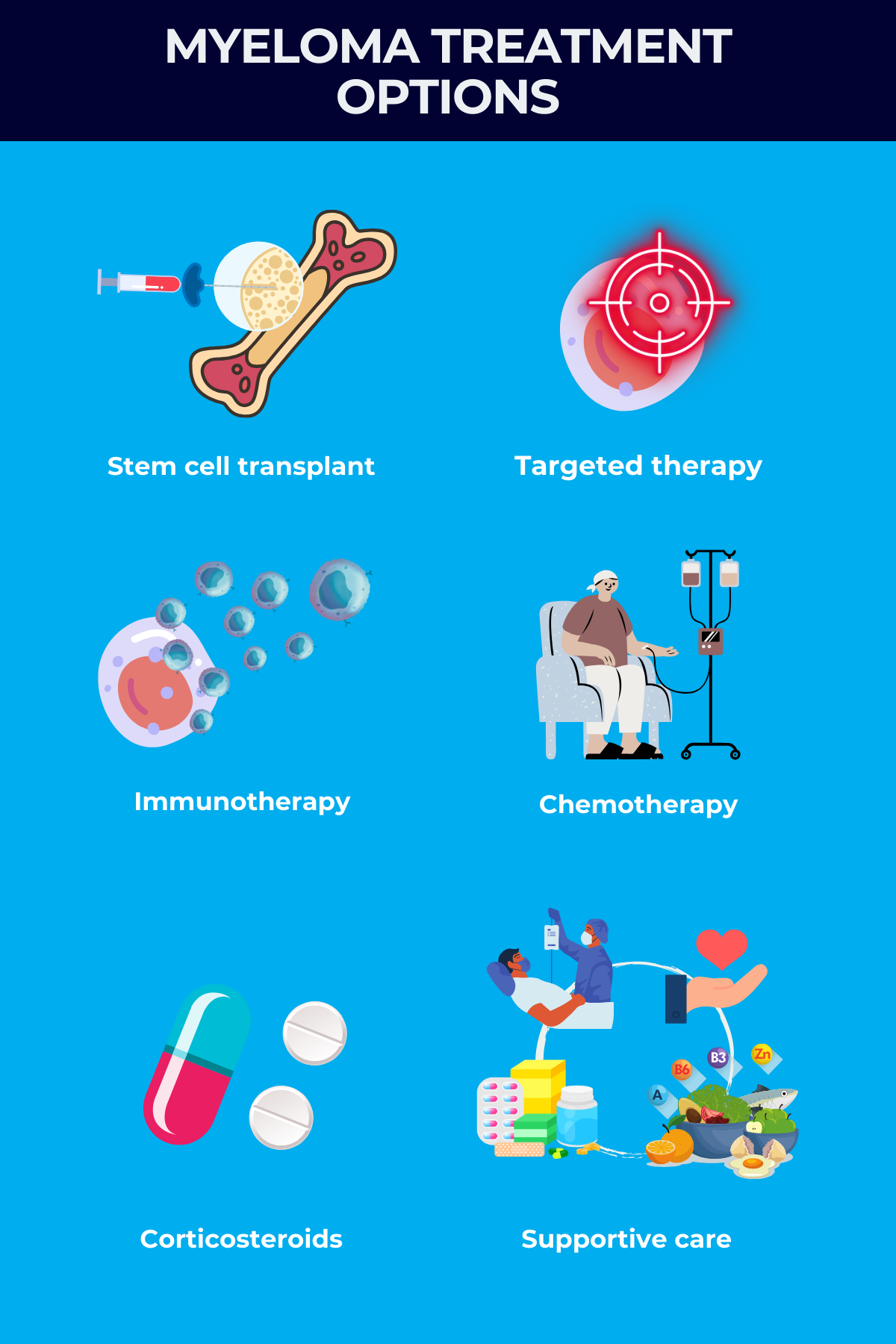
| Treatment Category | Description and Examples |
|---|---|
| Targeted Therapy | Drugs like Proteasome Inhibitors (Bortezomib) that attack specific molecular pathways in cancer cells. |
| Immunotherapy | Includes Monoclonal Antibodies (Daratumumab), CAR-T cell therapy, and Bispecific antibodies. |
| Stem Cell Transplant | High-dose chemotherapy followed by a rescue of the patient's own healthy stem cells. |
| Supportive Care | Bisphosphonates for bone health, antivirals to prevent shingles, and erythropoietin for anemia. |
| Clinical Trials | Research studies testing new drugs (like CELMoDs) or new combinations not yet widely available. |
Managing Relapsed and Refractory Myeloma
Despite the best initial treatments, myeloma is characterized by a pattern of remission and relapse. When the disease returns, it is known as "relapsed" myeloma. If it no longer responds to the drugs being used, it is called "refractory."
The strategy for relapsed myeloma is to switch to a different class of drugs. For instance, if a patient relapsed while on Lenalidomide, the doctor might switch them to a Pomalidomide-based regimen or move toward the newer immunotherapies mentioned above. Recent trends show that combining drugs with different mechanisms of action (e.g., combining a monoclonal antibody with a proteasome inhibitor) is the most effective way to overcome drug resistance.
The Role of Precision Medicine
Modern myeloma care is increasingly driven by "genomics." By analyzing the DNA of the plasma cells, doctors can identify specific mutations, such as the translocation t(11;14). Patients with this specific mutation may respond exceptionally well to a drug called Venetoclax, which is typically used for leukemia but is showing great promise in specific subsets of myeloma. This move toward "personalized" or "precision" medicine ensures that patients receive the most effective drug for their specific biology.
Supportive Care and Quality of Life
Because myeloma is a systemic disease, treating the cancer is only half the battle. Managing the side effects of both the disease and the treatments is vital for long-term success. Myeloma often causes "lytic lesions" (holes in the bones), which can lead to fractures and severe pain.
- Bone Health: Patients are frequently prescribed bone-modifying agents like Zoledronic Acid (Zometa) or Denosumab (Xgeva) to strengthen bones and prevent fractures.
- Infection Prevention: Because myeloma and its treatments suppress the immune system, patients often require prophylactic (preventative) antibiotics, antivirals, and monthly IVIG (intravenous immunoglobulin) infusions.
- Kidney Function: High levels of "M-protein" can damage the kidneys. Hydration and careful monitoring of renal function are standard parts of the treatment plan.
- Anemia Management: Myeloma crowds out healthy red blood cells. Treatments may include blood transfusions or medications to stimulate red blood cell production.
The Future: What’s Next in Myeloma Research?
The "news trending update" for myeloma involves the development of CELMoDs (Cereblon E3 Ligase Modulatory Drugs). These are the next generation of immunomodulatory drugs that appear to be more potent than Lenalidomide or Pomalidomide and can work even when those drugs fail. Mezigdomide and Iberdomide are two such drugs currently in late-stage clinical trials.
Furthermore, researchers are investigating "Allogeneic CAR-T," which uses healthy donor cells rather than the patient's own cells, potentially making the treatment faster and cheaper. There is also a significant push toward "MRD-guided therapy," where treatment intensity is adjusted based on whether any trace of the disease can be detected at the molecular level.
Frequently Asked Questions (FAQ)
1. Is multiple myeloma curable in 2024?
While most experts still consider multiple myeloma to be an incurable but treatable chronic disease, a small but growing percentage of patients who achieve sustained MRD negativity for many years may effectively be "functionally cured." The goal of modern treatment is to maximize these long-term remissions.
2. What are the common side effects of myeloma treatments?
Side effects vary by drug but commonly include fatigue, increased risk of infection, peripheral neuropathy (numbness or tingling in hands and feet), and low blood counts. Modern supportive care is very effective at managing these symptoms.
3. How do I know if a clinical trial is right for me?
Clinical trials should be considered at every stage of the myeloma journey, especially if standard treatments are not working or if you have high-risk genetic features. Discussing clinical trial options with a myeloma specialist (rather than a general oncologist) is highly recommended.
4. How often is follow-up testing required?
Typically, patients in active treatment or maintenance require monthly blood and urine tests to monitor M-protein levels and organ function. Bone marrow biopsies and imaging (like PET or MRI scans) are done less frequently, usually to confirm remission or investigate new symptoms.
Conclusion
Understanding treatment options for myeloma is an ongoing process for both patients and clinicians. The field is moving at an incredible pace, with new drug approvals and clinical trial results emerging almost every month. From the foundation of quadruplet induction therapies and stem cell transplants to the groundbreaking innovations of CAR-T and bispecific antibodies, there are more reasons for hope today than ever before.
The key to navigating a myeloma diagnosis is a collaborative approach. Patients are encouraged to seek care at specialized centers of excellence where the latest therapies and clinical trials are available. By combining cutting-edge science with robust supportive care, the medical community is steadily turning the tide against multiple myeloma, offering patients not just longer lives, but better ones. Stay informed, ask questions, and remember that the "standard of care" today is far superior to what it was even five years ago, paving the way for a brighter future in cancer treatment.
Understanding treatment options for myeloma
Understanding treatment options for myeloma Wallpapers
Collection of understanding treatment options for myeloma wallpapers for your desktop and mobile devices.

Exquisite Understanding Treatment Options For Myeloma View for Desktop
This gorgeous understanding treatment options for myeloma photo offers a breathtaking view, making it a perfect choice for your next wallpaper.

Dynamic Understanding Treatment Options For Myeloma Wallpaper Digital Art
A captivating understanding treatment options for myeloma scene that brings tranquility and beauty to any device.
Amazing Understanding Treatment Options For Myeloma Scene Collection
Transform your screen with this vivid understanding treatment options for myeloma artwork, a true masterpiece of digital design.

Mesmerizing Understanding Treatment Options For Myeloma Moment Nature
Transform your screen with this vivid understanding treatment options for myeloma artwork, a true masterpiece of digital design.

Stunning Understanding Treatment Options For Myeloma Artwork Art
Immerse yourself in the stunning details of this beautiful understanding treatment options for myeloma wallpaper, designed for a captivating visual experience.
Mesmerizing Understanding Treatment Options For Myeloma Photo in 4K
Explore this high-quality understanding treatment options for myeloma image, perfect for enhancing your desktop or mobile wallpaper.

Stunning Understanding Treatment Options For Myeloma Capture for Mobile
Immerse yourself in the stunning details of this beautiful understanding treatment options for myeloma wallpaper, designed for a captivating visual experience.
Captivating Understanding Treatment Options For Myeloma Moment Concept
This gorgeous understanding treatment options for myeloma photo offers a breathtaking view, making it a perfect choice for your next wallpaper.

Breathtaking Understanding Treatment Options For Myeloma View for Mobile
Explore this high-quality understanding treatment options for myeloma image, perfect for enhancing your desktop or mobile wallpaper.
Amazing Understanding Treatment Options For Myeloma View Art
Discover an amazing understanding treatment options for myeloma background image, ideal for personalizing your devices with vibrant colors and intricate designs.

Lush Understanding Treatment Options For Myeloma Image in HD
This gorgeous understanding treatment options for myeloma photo offers a breathtaking view, making it a perfect choice for your next wallpaper.
High-Quality Understanding Treatment Options For Myeloma Abstract for Your Screen
Explore this high-quality understanding treatment options for myeloma image, perfect for enhancing your desktop or mobile wallpaper.

Artistic Understanding Treatment Options For Myeloma View for Mobile
A captivating understanding treatment options for myeloma scene that brings tranquility and beauty to any device.

Detailed Understanding Treatment Options For Myeloma Landscape Art
Explore this high-quality understanding treatment options for myeloma image, perfect for enhancing your desktop or mobile wallpaper.

Gorgeous Understanding Treatment Options For Myeloma Image in 4K
Immerse yourself in the stunning details of this beautiful understanding treatment options for myeloma wallpaper, designed for a captivating visual experience.

Artistic Understanding Treatment Options For Myeloma Artwork for Your Screen
Immerse yourself in the stunning details of this beautiful understanding treatment options for myeloma wallpaper, designed for a captivating visual experience.

Serene Understanding Treatment Options For Myeloma Picture in HD
Explore this high-quality understanding treatment options for myeloma image, perfect for enhancing your desktop or mobile wallpaper.

Dynamic Understanding Treatment Options For Myeloma View Art
Find inspiration with this unique understanding treatment options for myeloma illustration, crafted to provide a fresh look for your background.

Dynamic Understanding Treatment Options For Myeloma Wallpaper Digital Art
A captivating understanding treatment options for myeloma scene that brings tranquility and beauty to any device.

Dynamic Understanding Treatment Options For Myeloma Scene for Mobile
Immerse yourself in the stunning details of this beautiful understanding treatment options for myeloma wallpaper, designed for a captivating visual experience.
Download these understanding treatment options for myeloma wallpapers for free and use them on your desktop or mobile devices.